A serving spoon that dumps gravy, tongs that crush pasta, or a pie server with a sharp corner can turn an easy meal into a messy one. The useful distinction is not simply between larger and smaller utensils, but between the way each utensil controls food: lifting liquid, draining it, gripping it, cutting it, or portioning it. Selection also depends on the serving vessel and the food’s texture, so material choice, handle reach, bowl shape, and edge design should be assessed together rather than in isolation. This serving-utensils buying guide focuses on pieces that can be used freely, cleaned properly, and stored without becoming precious clutter.
Key Takeaways
- Choose the utensil by the food’s texture, moisture, and serving vessel.
- Match stainless steel, silicone, or wood to the cookware and serving surface.
- Inspect handles, joints, edges, and grips before buying.
- Care instructions matter because dishwasher cleaning can shorten the useful life of some utensils.
Beginner: Start with the Food, Dish, and Movement
The right utensil gives you control over the food without forcing you to scrape, stab, squeeze, or pour awkwardly. A serving utensil should suit the path food takes from the serving dish to the plate.
Step 1: Identify the action
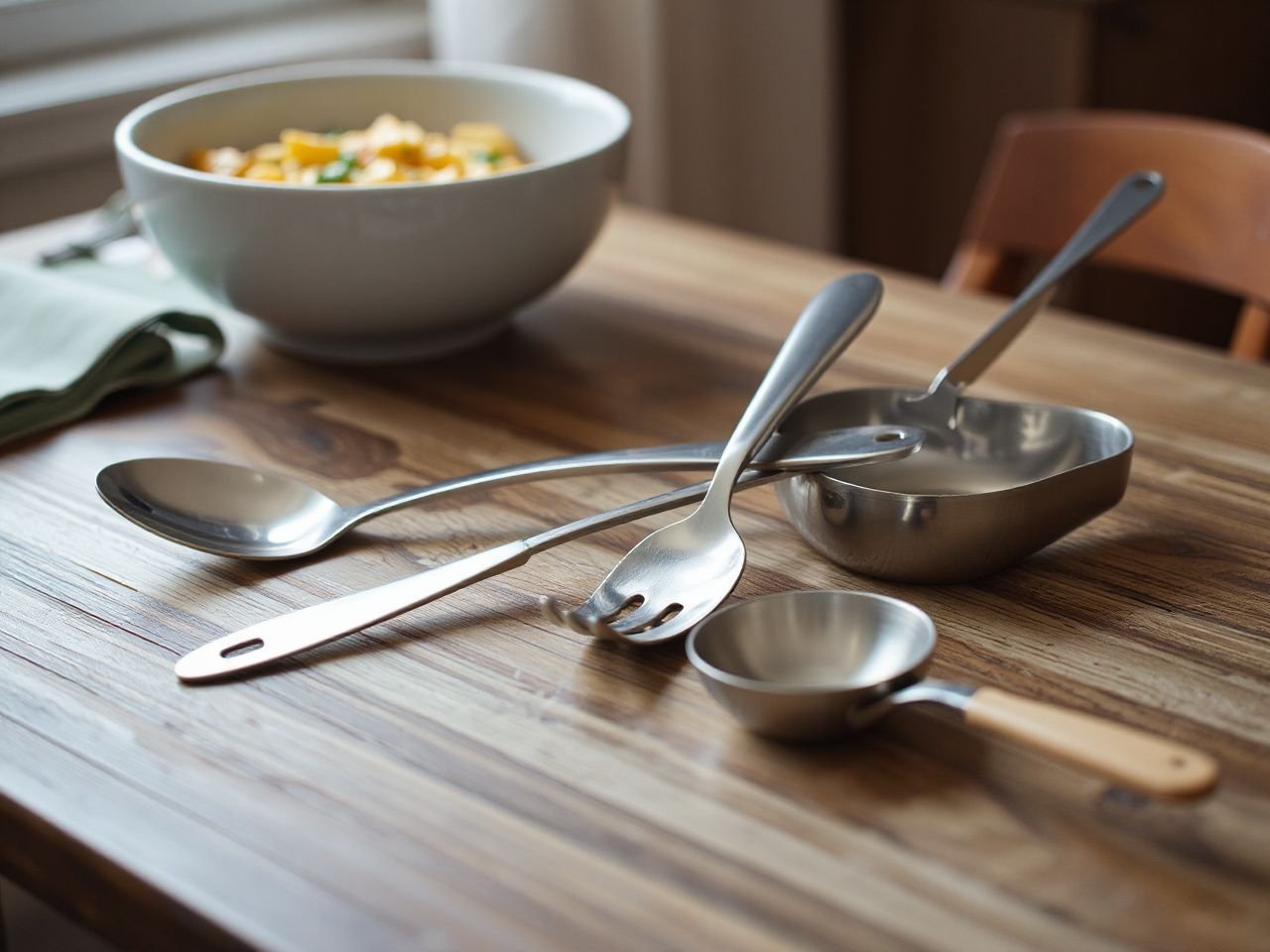
Begin by naming the job. A ladle lifts and transfers liquid or food suspended in liquid. A solid serving spoon carries foods that need support from below, while a slotted serving spoon lets liquid drain before the food reaches the plate. A serving fork separates and lifts pieces that benefit from prongs. Tongs grip food from two sides, and a pie server slides beneath a portion while supporting its edge.
A serving spoon is useful for rice, vegetables, grains, and other foods that need a broad supporting bowl. A serving fork gives more separation than a spoon, which helps with pieces that should not be pressed together. Tongs suit food that can be held securely without being crushed, but the hinge and gripping ends deserve close inspection.
A ladle needs a bowl deep enough to carry the food and a handle long enough to reach the base of the serving vessel. A shallow bowl can make soup or sauce spill during the transfer. A broad serving spoon can be more useful for a wide platter because its bowl reaches across the food rather than digging down into it.
A ladle is designed for controlled transfer of liquid, while a serving spoon is designed to support food from below. Treating those shapes as interchangeable usually creates spills or uneven portions.
Step 2: Match the utensil to texture
Soft food needs a gentle edge and enough surface area to stay intact. Firm food may need a sharper leading edge or prongs, but sharp edges can scratch glazed serving dishes and create handling hazards. That makes a serving fork or pie server a tool to inspect carefully rather than an object to choose by appearance alone.
- Loose and moist foods: Consider a solid spoon when liquid should remain with the food, or a slotted spoon when excess liquid should fall away.
- Leafy salads: Salad servers give separate points of contact and can lift leaves without compressing the bowl as much as a single spoon.
- Long or irregular pieces: Serving tongs can provide a better grip than a spoon, provided the tips meet evenly.
- Layered or cut portions: A pie server needs a thin, stable edge that slides beneath the portion without gouging the serving dish.
A slotted serving spoon is more useful than a solid serving spoon when the food should be lifted while cooking liquid, dressing, or brine is left behind. A solid spoon is the better fit when the liquid is part of the portion and needs to travel with the food.
Step 3: Inspect the serving vessel
Deep bowls, wide platters, and narrow containers create different access problems. A deep bowl favors a ladle or a spoon with a long, comfortable handle. A wide platter often favors a broad spoon, serving fork, or salad servers that can reach sideways without pushing food over the rim. A narrow container needs a head that can enter cleanly and a handle that does not collide with the sides.
Handle reach should be judged against the actual serving bowls and platters on the table. A very long handle can be awkward on a shallow dish, while a short handle may force fingers close to hot food or sauce. The useful handle is the one that lets the hand stay clear while the bowl, tines, or gripping ends remain easy to control.
A deep serving bowl requires enough handle reach for the utensil head to reach the base without forcing the hand over the rim. Check that relationship before buying a coordinated set that may contain several shapes you do not use.

Intermediate: Compare Materials, Edges, and Construction
Material choice affects compatibility, cleaning, grip, and how freely a utensil can be used. No material deserves automatic approval. The finish, edge, joined areas, and care instructions matter just as much.
Stainless steel for open use
Stainless steel is an iron-based alloy that incorporates chromium, and the inclusion of at least 10.5% chromium gives it characteristic resistance to corrosion. That resistance does not mean every stainless-steel utensil is immune to staining, rust, or damage.
Corrosive conditions combined with tensile stress can trigger stress corrosion cracking in stainless-steel components. A crack or sudden failure is a reason to retire the utensil rather than continue using it. Inspect the working end, handle connection, and any thin or bent section for changes that are visible to the eye.
Stainless steel suits many serving tasks because it does not depend on a soft coating at the food-contact edge. However, a hard or sharp edge can mark glazed serving dishes, delicate surfaces, and nonstick cookware. A stainless-steel serving utensil should be kept away from nonstick cooking surfaces unless the cookware maker specifically permits that contact.
Stainless steel resists corrosion because chromium helps protect the iron-based alloy, but corrosion resistance is not the same as damage-proof construction. Drying, storage, and inspection still matter.
Silicone for coated cookware
Silicone is often considered for cookware-safe utensils because its softer working surface is less likely to scratch a nonstick coating than a hard metal edge. The important check is the complete utensil, not only the visible tip. A rigid inner part may be exposed if the silicone tears, separates, or wears away.
Use silicone where a flexible edge helps follow a pan or protect a delicate surface, then inspect the edge for cuts, lifting, or a change in texture. Do not assume a silicone utensil is suitable for every high-heat task. Read the care and use instructions supplied with the utensil and cookware.
For a focused look at softness, grip, and care, the Silicone Utensils Buying Guide: Getting It Right at Home provides useful context for cookware-safe choices.
Wood and joined construction
Wood can feel comfortable and gentle against serving surfaces, but it requires more attention after washing. Wooden utensils need thorough drying and careful storage because retained moisture can contribute to cracking, odors, or microbial growth. A wooden handle should not be put away while damp or trapped against other wet items.
Look closely at joined parts, seams, rivets, and transitions between the handle and working end. Dishwasher cleaning can damage wood, loosen joined parts, dull finishes, or accelerate corrosion. Dishwasher-safe labeling is useful, but it does not make every cleaning method the best choice for long-term ownership.
Wooden serving utensils need complete drying before storage because retained moisture can contribute to cracks, odors, and microbial growth. Air circulation is more helpful than a crowded drawer.
Finish and edge design
A polished finish may be easy to wipe, but visual shine tells you little about the comfort of the grip or the safety of the edge. Run a clean finger along the handle and inspect the working end visually. Do not use a utensil with a burr, exposed sharp corner, loose joint, or rough split.
Serving forks and pie servers deserve special care because their edges or tines may be sharp enough to scratch a glazed dish or catch a hand during washing. The tool should guide food, not act like a makeshift knife unless its design and instructions clearly support that use.
Intermediate: Make Tongs, Spoons, Forks, and Ladles Work Properly
Shape controls movement. The goal is a clean lift with a stable grip, not a dramatic squeeze that drops food halfway to the plate.
Serving tongs
Good serving tongs open far enough for the food but do not require excessive hand force. The tips should meet evenly, remain aligned, and hold food without shredding it. A tong with narrow, smooth ends may slide off a slick item, while a deeply ridged end may crush soft food or trap residue.
Check the hinge or spring area for food-catching gaps. A complicated joint can be harder to clean than a simple construction. Tongs should open and close without scraping, sticking, or producing a feeling that the handle is twisting under pressure.
Serving tongs are easiest to control when the gripping ends meet evenly and the handle does not twist during a normal squeeze. Alignment matters more than decorative detail.
Serving spoons and slotted spoons
Compare the bowl shape with the food. A deeper bowl carries sauces and loose food, while a flatter bowl can slide beneath pieces on a platter. Slots should allow unwanted liquid to escape without making the food fall through or become difficult to lift.
Slots also create cleaning points. Sauce, seeds, fibers, and dressing can remain in the openings, so check whether the spaces are easy to rinse and inspect. A utensil that cannot be cleaned visibly is a poor choice for repeated service.
Serving forks and salad servers
Serving forks are useful for separating pieces and lifting food that would slide off a spoon. Their tines should be smooth, aligned, and free of sharp burrs. Salad servers work best when the spoon and fork portions are balanced enough to lift leaves without tearing them or forcing the hand into an awkward angle.
Salad dressing and acidic ingredients can cling to seams and textured surfaces. Choose shapes that can be washed fully, especially when the utensil will move between dishes during a meal.
Ladles and pie servers
A ladle should be judged by its bowl, handle, and pouring control. A narrow pour point can help direct liquid, but any shape that creates a recess also needs careful cleaning. Hold the ladle as though it were full and consider whether the handle remains comfortable while the bowl is tilted.
A pie server needs a stable, thin edge and enough surface area to support the portion. Sharp edges should be treated as a handling concern, particularly during washing and storage. If the server must be forced beneath food, the shape is wrong for the dish or the portion is being cut too aggressively.
Advanced: Protect Cookware, Food, and Long-Term Ownership
A utensil’s purchase cost is only one part of ownership. A piece that is cheap but difficult to clean, incompatible with your cookware, or likely to be discarded after damage can cost more in practical terms than a simpler utensil that remains useful.
Match utensils to cookware and serving surfaces
Nonstick coatings and delicate cookware call for a soft or carefully rounded food-contact surface. Silicone may be suitable where its condition is intact and its instructions allow the intended use. Stainless steel and other hard edges should not be dragged across coated surfaces unless the cookware maker says that contact is acceptable.
Glazed serving bowls and platters also deserve protection. A serving fork or pie server can scratch a surface if its tines or edge are rough. Lift and slide with control rather than cutting into the dish.
Food acidity, salt, moisture, and heat can affect materials and finishes. Because the exact limits depend on the utensil and its instructions, use the care information supplied by the maker rather than guessing from appearance. The Types of Cookware Explained: A Practical Buying Guide can help clarify why utensil compatibility should be considered alongside cookware surface and construction.
Cookware-safe utensils protect a coating or delicate surface by keeping the hard or sharp working edge away from it. The label and the actual condition of the utensil both matter.
Prevent cross-contact and flavor transfer
Separate utensils may be needed for allergens, raw foods, and ready-to-eat dishes. A spoon used in one dish should not move casually into another if residue could transfer. This is especially important with thick sauces, nut-containing foods, dairy-based dishes, and ingredients that cling inside slots or tong hinges.
Use separate, clearly distinguishable utensils where your meal requires separation. Wash the working end, handle junction, slots, and hinge rather than rinsing only the visible bowl. A lingering garlic, spice, or sauce flavor is also a sign that residue remains in a seam or textured surface.
The U.S. Food and Drug Administration provides federal food-safety information, so consult its main guidance when your question involves food-contact safety or cross-contact procedures rather than relying on a utensil’s appearance.
Clean by material and construction
- Stainless steel: Wash away food residue promptly, pay attention to joints and slots, and dry the utensil before storage if moisture remains.
- Silicone: Inspect for cuts, peeling, trapped residue, and changes at the connection between soft and rigid parts. Follow the maker’s cleaning instructions.
- Wood: Clean according to its instructions, dry thoroughly, and store where air can circulate. Avoid leaving wooden pieces submerged or damp.
- Joined utensils: Examine seams after cleaning. A loose connection or visible gap can hold residue and affect safe handling.
Dishwasher cleaning is convenient, but dishwasher-safe does not always mean dishwasher cleaning is ideal for long-term use. Heat, water, detergent, and repeated movement may damage wood, loosen joined parts, dull finishes, or accelerate corrosion. If the care label permits a dishwasher, place the utensil so water and detergent can reach the food-contact surfaces, and inspect it after the cycle.
Store for access, not display
Utensils that are too tightly packed rub against one another and become harder to inspect. Sharp-edged serving forks and pie servers should not sit where a hand can grab them blindly. Wooden pieces need ventilation, while damp silicone or stainless steel should not be sealed into a container before drying.
A drawer divider, utensil crock, or hanging arrangement can work if it keeps working ends clean and prevents damage. Store frequently used pieces where they can be reached without moving fragile serving ware. A utensil that is difficult to retrieve is likely to be replaced by an unsuitable kitchen tool.
Kitchen organization affects utensil hygiene because crowded storage can hide residue, moisture, and damaged edges. Storage should make inspection ordinary rather than burdensome.
Compare long-term ownership cost
Do not compare utensils by purchase price alone. Consider how often each piece will be used, whether it fits the serving dishes already owned, whether it needs hand washing, and whether its design creates residue traps. A utensil that serves one task well may be sensible if that task appears often; a specialized piece that rarely leaves the drawer may not earn its space.
- Check whether one shape can serve several compatible foods without becoming awkward.
- Read care instructions before deciding that a dishwasher is suitable.
- Look for replaceable or separable parts only if the construction remains easy to clean.
- Reject pieces with sharp burrs, loose joints, cracked wood, peeling soft material, or staining that will not clean away.
- Consider storage space as part of the ownership cost.
The aim is not to build the largest collection. I prefer a small working group of utensils that can be used, washed, dried, and returned to service without special ceremony. Pieces too precious to use are simply expensive clutter.
Advanced: A Practical Selection Sequence
Use this sequence before adding a utensil to your table setting or serveware drawer. It keeps the decision tied to actual use rather than matching finishes.
Step 1: Name the dish and vessel
Write down the food’s texture and moisture, then identify the serving bowl, platter, pan, or narrow container. A spoon for thick vegetables may be unsuitable for broth. A long ladle may be awkward in a shallow platter. A serving fork may be helpful for firm pieces but wrong for soft food that breaks under pressure.
Step 2: Choose the control method
Decide whether the food needs lifting, draining, gripping, cutting, or portioning. Choose a solid spoon for support, a slotted spoon for draining, tongs for a secure two-sided grip, a serving fork for separation, a ladle for liquid, or a pie server for sliding beneath a portion.
Step 3: Check compatibility
Compare the working surface with the cookware and serving dish. Soft or rounded contact is generally the safer direction for delicate surfaces, while sharp or hard edges require greater care. Read the utensil and cookware instructions where the material or finish is unclear.
Step 4: Check the hand and handle
Hold the utensil naturally. Open the tongs, tilt the ladle, and lower the spoon into a representative vessel. Look for twisting, pinching, slipping, or contact between fingers and the dish rim. A comfortable grip cannot rescue a head that is too small, too deep, too sharp, or badly aligned.
Step 5: Check cleaning and storage
Inspect slots, hinges, seams, edges, and transitions. Ask whether food can be removed from each area by ordinary washing. Confirm whether the material should be hand-washed, dried immediately, or kept away from certain surfaces. If the answer requires care you will not follow, choose a simpler design.
Step 6: Reconsider duplication
Coordinated sets can contain several similar tools, but matching appearance does not guarantee useful variety. Compare the set with your existing serving spoons, salad servers, tongs, ladles, and pie servers. A single well-shaped utensil that solves a real serving problem is more useful than several decorative pieces with no clear job.
A serving utensil earns its place by controlling a specific food cleanly and remaining practical to wash and store. Appearance can support that decision, but it should not replace it.
Frequently Asked Questions
When is a slotted serving spoon more useful than a solid serving spoon?
A slotted serving spoon is useful when you want to lift food while leaving cooking liquid, dressing, or brine behind. A solid serving spoon is better when the liquid belongs with the portion, such as a sauce or broth. Compare the slot size with the food: openings that are too wide may let small pieces fall through, while narrow slots may trap residue.
Which serving utensils are safest for nonstick or delicate cookware?
Choose a utensil with a soft or carefully rounded working surface when the cookware maker permits it. Silicone may suit some coated surfaces, but inspect it for cuts or separation and follow its care instructions. Hard stainless steel edges can scratch nonstick coatings or glazed dishes, so use them only where the relevant instructions allow that contact.
Are dishwasher-safe serving utensils always the best choice for long-term use?
No. Dishwasher-safe labeling tells you that the maker permits that cleaning method, but repeated dishwasher exposure can still damage wood, loosen joined parts, dull finishes, or accelerate corrosion. Check the utensil after washing, dry it properly, and hand-wash materials or constructions whose instructions call for gentler care.
How do I prevent serving utensils from transferring allergens or flavors?
Use separate utensils for foods that must remain apart, including allergen-containing dishes, raw foods, and ready-to-eat food. Wash the bowl, slots, tines, tong hinge, and handle junction rather than rinsing only the visible surface. Strong flavors that remain after cleaning often indicate residue trapped in a seam or textured area.
Why do serving utensils bend, stain, rust, or lose their grip?
Bending can follow forceful use or a construction that does not suit the food. Staining and corrosion can follow retained moisture, residue, or a corrosive environment, while stress corrosion cracking involves corrosive conditions and tensile stress in stainless-steel components. Loss of grip can result from worn, cracked, loose, or separated material. Retire any piece that becomes unsafe or difficult to clean.
For related decisions about measuring tools, the Measuring Spoons Buying Guide: Getting It Right at Home offers a useful reminder that shape and cleanability matter as much as a matching finish.
The NSF develops standards and certification programs relevant to products and systems, so its information is a suitable place to check general questions about food-equipment certification rather than assuming that a material name alone proves compliance.