Heat distribution comes first.
The useful distinction among cookware types is not simply material but the combination of heat response, heat retention, surface reactivity, and maintenance: copper and aluminum respond quickly, while cast iron retains heat, and stainless steel often depends on a conductive layered core. A complete guide should also separate the cooking surface from the pan’s construction and from cooktop compatibility, because a stainless-steel exterior, an aluminum core, a PTFE coating, and an induction-compatible base describe different properties of the same piece of cookware. That framework makes the many types of cookware easier to understand and harder to choose by appearance alone.
Key Takeaways
- Heat response and retention matter as much as the named material.
- Induction requires a magnetic base; aluminum, copper, glass, and many ceramic pieces need compatible construction.
- Surface condition, seasoning, handles, lids, coatings, and care instructions determine practical safety and service life.
Types of Cookware: Start With Heat Behavior
A pan does not cook food according to its label alone. The body, cooking surface, base, and handle all affect how heat reaches the food. A thin single-layer pan may react quickly but show hot spots, while a clad or tri-ply pan may combine a stainless-steel cooking surface with a more conductive aluminum or copper core.
Stainless steel cookware illustrates the point clearly. Stainless steel resists rust, scratches, and dents relatively well, and it does not react with food in the way unlined aluminum or copper can. However, stainless steel without a more conductive base or core may heat unevenly. The construction matters as much as the visible finish.
Heat response versus heat retention
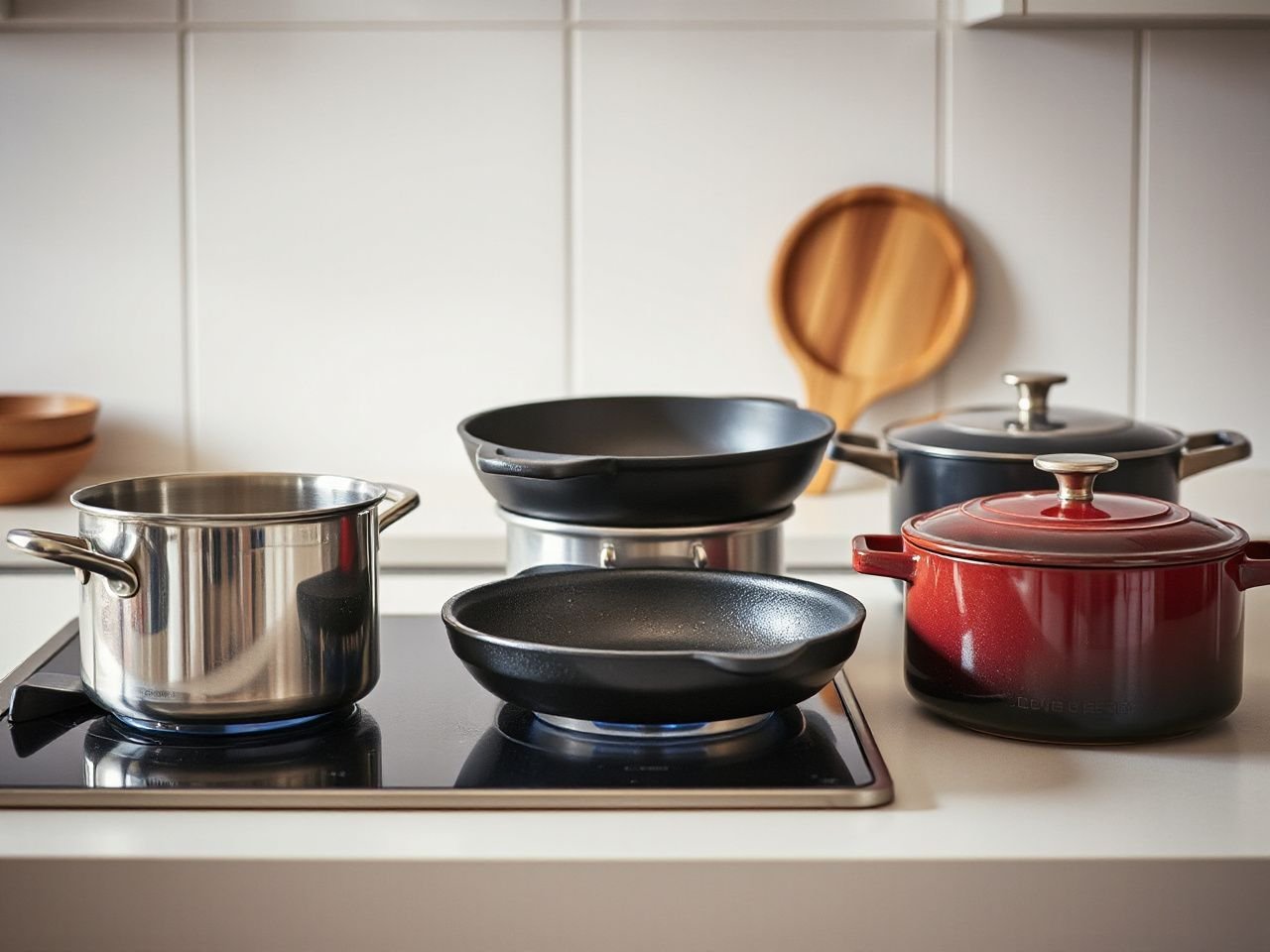
Heat response describes how quickly a pan changes temperature after the heat setting changes. Copper and aluminum respond quickly, which gives a cook more immediate control during sautéing or simmering. Cast iron changes more slowly and retains heat strongly, making it useful for searing and cooking that benefits from a steady hot surface.
Cast iron cookware retains heat and distributes it evenly once the pan is thoroughly heated. That behavior suits searing, frying, and oven cooking, but it also means that a high setting can leave the pan hotter than expected after the burner is lowered. Carbon steel offers similar high-temperature cooking benefits while weighing less than cast iron and conducting heat more readily.
Heat retention is a property of cast iron, not proof that every cast-iron pan heats evenly from the beginning. The cooking surface still needs time to warm through. A cold center or a burner smaller than the base can produce uneven results, even in a heavy pan.
Construction changes the result
Single-layer construction places most of the heat behavior in one material. Clad construction bonds layers together, and tri-ply construction commonly combines a stainless-steel cooking surface with a conductive core and another outer layer. The listing should identify the layers if they are important to the pan’s performance; a stainless-steel exterior alone does not tell you what lies beneath the cooking surface.
Aluminum cookware heats quickly and can offer useful control, but uncoated aluminum can react with acidic or alkaline foods. Copper also responds quickly and can react with food when the cooking surface is unlined. Stainless-steel linings, anodized surfaces, and enamel are used to create a less reactive cooking surface.
Material Types and Their Best Uses
Stainless steel cookware
Stainless steel is a practical uncoated surface for browning, sautéing, boiling, and pan sauces because it does not react with food and preserves natural flavors. The trade-off is heat distribution. Without an aluminum or copper base or core, stainless steel may develop hot spots that scorch food before the rest of the pan catches up.
Stainless steel cookware is a durable choice when surface resilience and food neutrality matter more than effortless release. Food can stick when a pan is not sufficiently preheated, when the cooking surface is crowded, or when moisture causes ingredients to steam instead of brown. Those are heat and technique problems, not evidence that stainless steel is defective.
Stainless steel cookware provides a nonreactive cooking surface, but a conductive core is important for more even heating. That sentence should guide any comparison between a single-layer pan and a layered one.
Cast iron cookware
Bare cast iron is built around heat retention. It suits searing, frying, baking, and dishes that move from stovetop to oven when the entire pan is rated for that use. Bare cast iron needs seasoning and thorough drying to limit rust. Prolonged soaking and acidic cooking can damage or weaken the seasoning layer.
Seasoning is a maintained surface rather than a permanent coating. The layer benefits from regular care, and abrasive cleaning or long contact with water can work against it. A cast-iron pan should not be selected solely because it feels heavy; the burner size, lifting comfort, storage space, and cleaning routine matter just as much.
Readers comparing different shapes and pieces can use this cast iron cookware sets overview to understand how a set’s contents affect everyday use, without confusing a list of included pans with evidence about heat distribution.
Enameled cast iron
Enameled cast iron keeps the heat-retaining body of cast iron while placing enamel between the food and the iron. The enamel surface is non-reactive, so seasoning is unnecessary, and enameled cast iron works well for acidic dishes that could react with uncoated cast iron.
The enamel surface still deserves careful handling. A chip, crack, or damaged area changes the condition of the cooking surface, so the manufacturer’s care instructions take priority. The presence of enamel also does not automatically answer questions about the lid, knob, handle, oven rating, or cooktop compatibility.
Carbon steel cookware
Carbon steel sits between cast iron and thinner conductive pans in practical behavior. It is lighter than cast iron while offering similar cooking benefits, including high-temperature resistance and a surface that can become more release-friendly through seasoning.
Carbon steel requires seasoning and thorough drying because it can rust when moisture remains on the surface. Prolonged soaking is poor care, and acidic cooking can damage or weaken its seasoning layer. The pan is useful for searing and high-heat cooking, but its maintenance is part of the material’s identity rather than an optional extra.
Aluminum cookware
Aluminum responds quickly because it is more conductive than stainless steel. That quick response can help with sautéing and temperature changes, yet uncoated aluminum can react with acidic or alkaline foods. A coating, anodized surface, or stainless-steel lining changes the cooking surface and therefore changes the care and reactivity discussion.
Aluminum may appear in a pan’s core even when the visible exterior is stainless steel. This is why judging cookware by the outside color gives an incomplete answer. The pan’s heat map comes from the full construction.
Copper cookware
Copper responds quickly and gives fine control over changing heat. Because unlined copper can react with food, many pieces use a stainless-steel lining or another less reactive cooking surface. The cooking surface and the body are separate properties; a copper exterior does not necessarily mean food touches copper.
Copper cookware is most useful when rapid heat response matters and the lining, care instructions, and cooktop compatibility are clear. The listing should state the cooking surface. If it does not, the missing information matters.
Nonstick cookware and PTFE
Nonstick cookware describes a release-focused cooking surface, not one single material. PTFE, or polytetrafluoroethylene, is one type of nonstick coating. PTFE-coated cookware should not be overheated or used when the coating is peeling, badly scratched, or otherwise deteriorated.
Ceramic-coated cookware is a separate category, not another name for PTFE. The word ceramic may describe a coating or a ceramic cooking vessel, so the product listing needs to identify the actual surface. A ceramic coating and a solid ceramic pan should not be treated as interchangeable.
Nonstick surfaces are useful for delicate foods and lower-stick cooking, but their condition controls continued use. Metal utensils, harsh cleaning tools, overheating, and visible coating damage can shorten the useful life of the surface. For a wider discussion of surface materials and kitchen safety, see this guide to cookware surface choices for safer kitchens.
Glass and ceramic cookware
Glass cookware and ceramic cookware are distinct from coated metal pans. A glass or ceramic vessel may be useful for baking, serving, or cooking methods stated by the manufacturer, but compatibility varies by the exact piece. Glass and ceramic pans generally do not heat directly on an induction cooktop unless the construction includes a compatible magnetic base.
Glass cookware makes the most sense when visibility, oven use, or serving matters and the listing clearly states the permitted heat sources. Cookware should not be treated as ordinary glassware; the relevant care and heat instructions belong to the cookware listing. For a separate look at household glass categories, see this guide to glassware types.
Cooktop Compatibility, Oven Use, and Safety
Induction, gas, electric, and ceramic-glass cooktops
Induction heating requires a magnetic material in the cookware base. Aluminum, copper, and many glass pans will not heat directly on induction unless they include a compatible magnetic base. A stainless-steel exterior alone does not guarantee induction compatibility because stainless-steel grades and pan construction vary.
Gas and standard electric cooktops transfer heat through direct contact or a heated element, while ceramic-glass cooktops add a smooth surface that benefits from cookware with a suitable, stable base. The exact pan listing should state compatibility. If induction is your cooktop, the magnetic base is the deciding feature, not the handle color or the number of layers claimed in a headline.
Induction cookware must contain a magnetic material in the base or it will not heat directly on an induction cooktop. This is a construction requirement, not a preference.
Oven, broiler, and dishwasher questions
Oven safety depends on the entire pan, including the handle, lid, knobs, coating, and maximum temperature. A metal body does not make every assembled pan suitable for every oven setting. The manufacturer’s stated limit is the information that controls the decision.
Broiler use deserves separate attention because the heat source and exposure can differ from ordinary oven cooking. A pan may be oven-safe while its lid, handle, coating, or knob is not suitable for broiling. If the listing does not state broiler use, do not infer it from the body material.
Dishwasher instructions also depend on the complete construction and surface. Bare cast iron and carbon steel need seasoning and thorough drying, so prolonged soaking and careless washing work against rust prevention and the maintained cooking surface. Stainless steel may have different cleaning instructions, while PTFE and ceramic-coated surfaces should be matched with the utensils and cleaning tools permitted by the manufacturer.
Standards can clarify material or product requirements, but a general standard does not replace the pan’s own care instructions. The NSF explains standards and certification information for products and public health, while the U.S. Consumer Product Safety Commission provides consumer safety information; neither page supplies a missing oven limit for a particular pan.
Overheated or damaged nonstick surfaces
PTFE-coated cookware should not be overheated. A pan with peeling, badly scratched, or otherwise deteriorated coating should not remain in routine use, because the surface no longer matches the condition described for normal cooking.
Damage also matters on enamel, glass, and ceramic surfaces. Do not hide a chip, crack, or peeling area behind attractive exterior styling. A pan’s safe use depends on the condition of the surface and the instructions for that specific construction.
For general food-contact information and consumer guidance, the U.S. Food and Drug Administration is the appropriate government body to consult. That resource cannot determine the condition of an individual coating, so visible damage still requires a direct decision based on the manufacturer’s instructions.
Why Food Sticks, Burns, or Cooks Unevenly
Sticking
Food sticks for different reasons, and the pan material is only one of them. Stainless steel can hold food when the surface is not properly heated, when wet ingredients are added too early, or when the food is moved before it has formed a browned surface. A crowded pan also lowers the cooking surface’s ability to brown food evenly.
Bare cast iron and carbon steel depend on a maintained seasoning layer. Acidic food, prolonged soaking, aggressive tools, and incomplete drying can weaken that layer and make release less predictable. Nonstick cookware depends on an intact coating, so overheating and scratching create a different kind of release problem.
Burning and hot spots
Burning often begins where the heat entering the pan exceeds the heat being carried away by food, liquid, or the surrounding metal. A small burner under a large pan can leave the outer area cooler than the center. A large burner under a smaller pan can concentrate heat at the base and scorch a small zone.
Stainless steel without a conductive core may heat unevenly. Aluminum and copper respond quickly, while cast iron retains heat and changes temperature slowly. These differences affect when to add food, how far to lower the burner, and whether the pan should be moved during cooking.
Uneven cooking is often a heat-map problem before it is a recipe problem. The pan diameter, burner pattern, layer construction, and preheating routine should be considered together.
Acidic foods and reactive surfaces
Tomatoes, wine, citrus, and other acidic ingredients deserve attention in unlined cookware. Uncoated aluminum and copper can react with acidic or alkaline foods, which is why stainless-steel linings, anodized surfaces, and enamel are used to create less reactive cooking surfaces.
Bare cast iron and carbon steel also need caution with acidic cooking because prolonged contact can damage or weaken the seasoning layer. Enameled cast iron is suited to acidic dishes because its enamel surface is non-reactive and does not require seasoning.
Care, Lifespan, and the Cost of Ownership
Match cleaning to the surface
Care should follow the cooking surface, not the handle style or exterior finish. Bare cast iron and carbon steel need thorough drying and regular seasoning. Prolonged soaking is a poor fit for both materials because moisture can contribute to rust and weaken the maintained surface.
Stainless steel tolerates a different routine because the cooking surface is not a seasoning layer. Even so, harsh tools may change the finish, and stuck food is easier to manage when the pan is handled according to its instructions rather than attacked with whatever scrubber is nearest.
PTFE and ceramic-coated cookware require utensils and cleaning tools that do not damage the coating. A dishwasher label, if supplied, applies to the complete item and not merely to its metal body. Missing care information should be treated as missing information.
Maintenance affects useful value
A pan with a low-maintenance surface may fit a busy kitchen better than a material requiring regular seasoning. A highly heat-retentive pan may earn its storage space for searing or braising, while a quick-response pan may be more useful for delicate heat changes. The right choice depends on the cooking tasks and care routine rather than a universal material ranking.
Long service depends on maintenance, but a precise lifespan cannot be promised from material alone. Surface damage, rust, warping, lost enamel, coating deterioration, and unsuitable cleaning all change the result. The listing’s construction and care instructions are more useful than a generic claim that one material lasts forever.
Choose construction, not appearance or weight
A bright stainless exterior may conceal a useful aluminum core, or it may cover a construction that does not distribute heat as evenly. A heavy pan may retain heat well, but weight alone does not prove that the base matches the burner or that the handle is comfortable for the intended task.
Cookware sets can also create false value by including shapes that do not match the kitchen’s actual work. Count the cooking surfaces, lid fit, handle design, cooktop compatibility, oven limits, and care demands before counting pieces. This cookware set buying guide addresses common set-selection mistakes without reducing the decision to a piece count.
Appearance is a weak guide to heat distribution. The material layers, base design, surface, and cooktop fit deserve attention before color or finish.
How to Choose Among Cookware Types
Step 1: Identify the heat job
Write down the tasks that matter most: searing, sautéing, simmering, braising, baking, or delicate release. Searing and high-temperature work point toward heat-retentive cast iron or seasoned carbon steel. Fast changes favor copper or aluminum behavior, while a conductive-core stainless pan can pair a nonreactive surface with improved distribution.
One material rarely handles every task in the same way. A kitchen’s useful combination may include a nonreactive pan for acidic sauces, a seasoned pan for high heat, and a release-focused surface for delicate foods. The point is to map tasks to heat behavior.
Step 2: Check the cooking surface
Separate the visible body from the food-contact surface. Stainless steel, enamel, PTFE, ceramic coating, bare iron, anodized aluminum, and lined copper behave differently during cooking and cleaning. The listing should state which surface touches the food.
Acidic ingredients narrow the choices. Unlined aluminum and copper can react with acidic or alkaline foods, while stainless-steel linings and enamel provide less reactive cooking surfaces. Bare cast iron and carbon steel need seasoning care when acidic ingredients are involved.
Step 3: Confirm cooktop and heat-source compatibility
Induction requires a magnetic base. Gas, electric, ceramic-glass, and induction cooktops transfer heat differently, so the pan’s stated compatibility matters. A pan that fits one heat source may not behave or heat on another.
Check the complete contact area rather than the rim or outside wall. A magnetic base that is too small for the cooking area can create a heat pattern that does not match the pan’s apparent size.
Step 4: Read the care and safety limits
Look for oven, broiler, dishwasher, utensil, coating, seasoning, and lid instructions. Oven safety depends on the whole assembled pan, and the manufacturer’s maximum temperature is essential information. If the listing omits a detail, do not fill the gap with an assumption based on metal alone.
Finally, inspect the condition of any coating, enamel, glass, or ceramic surface before use. Damaged surfaces require a more cautious decision than an intact surface of the same material.
Frequently Asked Questions About Types of Cookware
Which cookware materials work on induction cooktops?
Induction cookware must contain a magnetic material in the base. Cast iron and carbon steel generally fit that material requirement, while stainless steel depends on its grade and construction. Aluminum, copper, glass, and many ceramic pans will not heat directly unless they include a compatible magnetic base. Always confirm induction compatibility in the manufacturer’s listing rather than judging by appearance.
Is ceramic cookware the same as PTFE nonstick cookware?
No. PTFE, or polytetrafluoroethylene, is a nonstick coating, while ceramic-coated cookware uses a different surface category. Solid ceramic cookware is another separate construction. The words ceramic and nonstick do not identify the same material, so check the listing for the actual cooking surface and follow its care instructions, especially if the surface is scratched, peeling, or otherwise damaged.
Which cookware is suitable for acidic foods such as tomatoes and wine?
Nonreactive cooking surfaces are the straightforward choice for acidic foods. Stainless-steel linings and enamel create a less reactive surface, and enameled cast iron works well for acidic dishes without requiring seasoning. Uncoated aluminum and copper can react with acidic or alkaline foods, while prolonged acidic cooking can damage or weaken the seasoning layer on bare cast iron and carbon steel.