
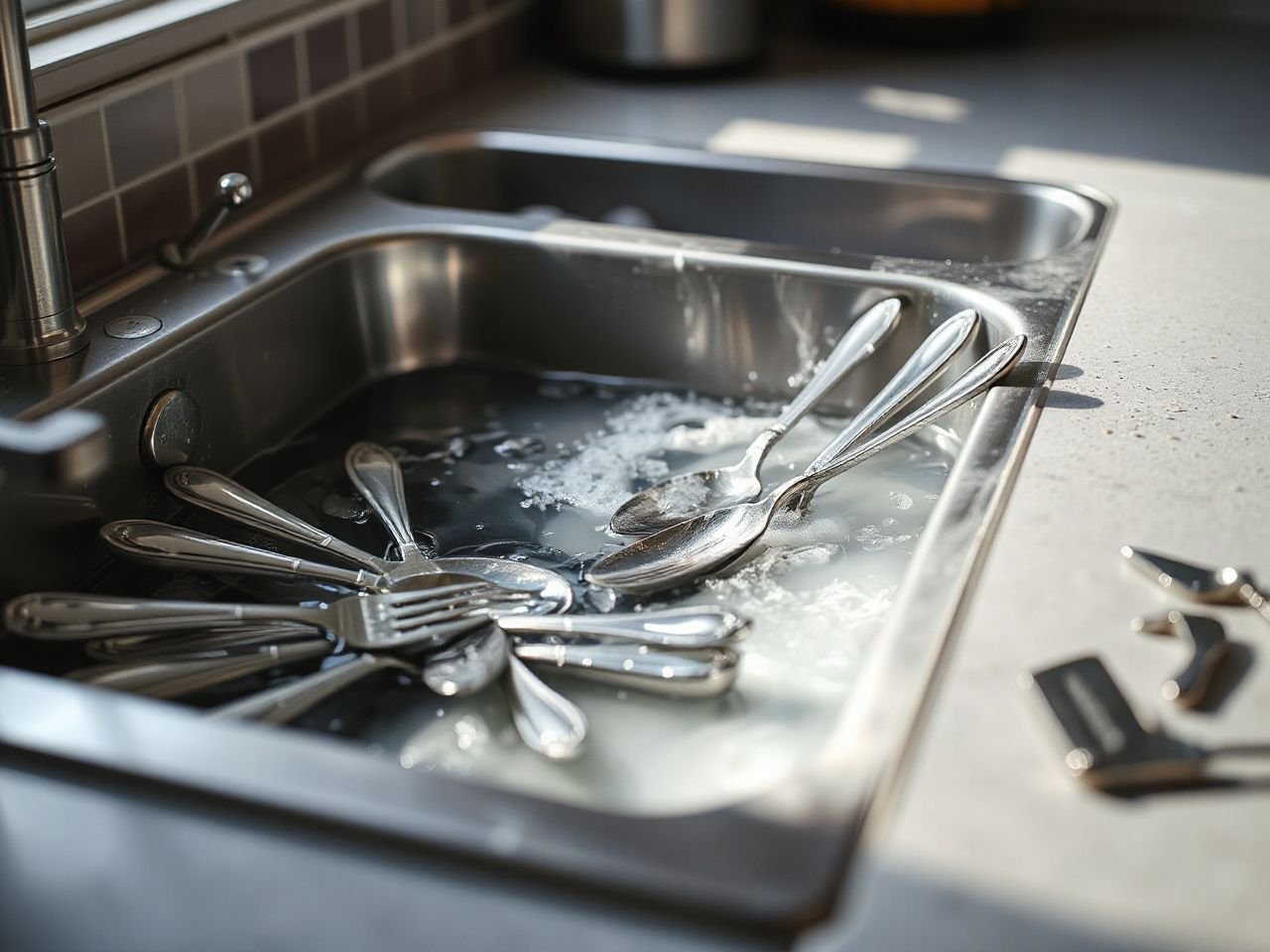
Know the metal before you scrub.
The essential distinction is between removing food soil and removing silver sulfide tarnish: washing degreases and rinses the surface, while polishing or an electrochemical treatment changes or removes the tarnish layer. Cleaning should begin by identifying the base metal and any plating, finish, handle construction, or intentional patina, because repeated abrasion and dishwasher chemistry can permanently alter silver-plated or composite flatware even when the piece looks clean.
That distinction makes cleaning silverware much less mysterious. Stainless steel usually needs controlled washing and thorough drying; sterling silver, silver plate, and electroplated nickel silver need gentler handling and a deliberate choice between washing, polishing, or tarnish removal.
Key Takeaways
- Identify stainless steel, sterling silver, silver plate, or EPNS before choosing a cleaner.
- Use mild hand-washing for routine soil and reserve polishing or foil treatment for actual tarnish.
- Avoid abrasive powders, steel wool, bleach, mixed cleaners, and harsh dishwasher conditions.
Cleaning Silverware Starts With Identification
The surface may look similar, but the material underneath determines how much abrasion, heat, detergent, and chemical contact the piece can tolerate.
How to identify the metal
- The listing or original packaging may also identify the grade. Stainless flatware is generally used as a solid metal surface rather than a thin decorative coating, but that does not make it immune to scratches, rust spots, cloudy detergent film, or discoloration.
- A mark may appear near the handle end, on the back of a fork, or on the underside of a serving utensil.
- Silver-plated flatware: Plated pieces have a base metal covered by a thin silver layer. Marks may include language such as silver plate or electroplate, but markings vary. Worn edges, yellowish areas, or a different-colored patch at a high-contact point can indicate that the plating is thin or damaged.
- Electroplated nickel silver, or EPNS: EPNS refers to electroplated nickel silver, a base material that is silver-plated rather than solid sterling silver. Treat EPNS as plated flatware, especially if the mark is unclear or the surface has worn through.
Marks are useful, but a mystery piece deserves restraint. Do not begin with a scouring powder or strong chemical simply because a stamp is hard to read. The safest first move is a small, gentle wash in an inconspicuous area, followed by inspection under good light.
Silver-plated flatware has a thin silver surface that repeated abrasive polishing can remove. That fact matters more than a bright result achieved in one afternoon.
Inspect construction before adding water
Knives can have hollow, weighted, wooden, plastic, resin, or bonded handles. A seam, crack, loose handle, or damaged finish changes the cleaning plan because water and detergent can enter areas that are difficult to dry.
Hollow and bonded handles should be washed briefly and dried at once rather than left submerged. Wooden and other vulnerable nonmetal handles should not be placed in a foil-and-hot-water bath, and damaged pieces should not be aggressively polished around the seam.
Causes: Food Soil, Water Spots, and Tarnish
Food residue is a washing problem
Grease, sauce, starch, and dried food are ordinary soil. A mild dishwashing solution and warm water can loosen that material, after which the piece should be rinsed and dried. Washing removes material sitting on the surface; it does not restore silver that has reacted with sulfur compounds.
Hard-boiled eggs can tarnish silver rapidly because sulfur present in the food can contribute to silver sulfide formation. A piece that looks gray or black after contact with such food may need tarnish treatment rather than more soap.
Water spots and mineral scale need a different response
Water spots are dried droplets or mineral deposits left behind after rinsing. They often appear as pale marks, rings, or a cloudy film, especially on stainless steel. A clean microfiber cloth and prompt drying are usually more sensible than abrasive rubbing.
Mineral scale on stainless steel should be handled separately from silver tarnish. Do not assume that a cleaner made for scale is suitable for sterling silver or plated flatware, and do not let an acidic cleaner sit on an unknown metal.
Silver tarnish is a chemical surface change
Silver reacts with sulfur-containing compounds such as hydrogen sulfide or sulfur dioxide to form silver sulfide, written as Ag₂S. Moisture in the atmosphere accelerates the tarnishing process, so silver stored in damp conditions can darken faster than silver kept clean and dry.
Tarnish may look yellow, brown, gray, or black depending on its thickness and the surface beneath it. Dark detailing in engraved or intentionally antiqued silver may be part of the design, so a uniformly bright finish is not always the correct goal.
Silver sulfide is the material responsible for the dark tarnish layer on silver. Soap alone cannot be expected to reverse that surface reaction.
Solutions: A Safe Step-by-Step Washing Method
Step 1: Separate and pre-rinse
Separate stainless steel from sterling silver, silver plate, and EPNS. Remove loose food soil with a gentle rinse rather than scraping with another utensil. Check the handle and blade joints for cracks, looseness, or trapped debris.
Do not mix cleaners in the sink. Chlorine bleach, strong oxidizers, and incompatible cleaners can stain or corrode metal, and all utensils should be thoroughly rinsed after cleaning.
Step 2: Wash with mild detergent
Use warm water and a small amount of ordinary dish detergent. The exact detergent amount depends on the sink and soil load, so the goal is a lightly soapy solution rather than a dense bath of concentrated product.
Wash one piece at a time with a soft sponge, microfiber cloth, or soft dish brush. Keep plated surfaces away from abrasive pads, steel wool, scouring powders, and rough scrubbers. Pay attention to the junction between a blade and handle, where food soil often remains after a quick rinse.
Step 3: Rinse completely
Rinse under clean running water or in a separate basin of clean water. Detergent residue can leave stainless steel cloudy and can interfere with later polishing. Thorough rinsing is also important for utensils that will touch food.
The U.S. Food and Drug Administration provides the federal Food Code framework used for food-contact sanitation guidance, so clean utensils should be fully rinsed and free of cleaning residue before returning to service. Local requirements may apply in commercial settings.
Step 4: Dry immediately
Dry each piece with a clean, soft towel. Air-drying lets droplets evaporate on the surface, which encourages water spots and mineral film. Dry the underside of handles and the edges around any joint.
Immediate hand-drying is the simplest way to reduce water spots on washed stainless steel and silverware. It also gives you a useful inspection point before the piece goes back into storage.
Step 5: Inspect before storage
Look for dark crevices, pitting, loose handles, peeling plating, and scratches. Dark material in a groove may be tarnish, but pitting and finish loss cannot be washed back into existence. Set damaged pieces aside for careful repair or professional assessment rather than repeatedly buffing them.
Solutions: Removing Tarnish Without Wearing Away Plating
Start with the least aggressive option
For lightly tarnished silver, wash first, rinse well, and dry. A microfiber cloth can then remove remaining surface tarnish after soaking, provided the piece is solid silver or the plating is in sound condition and the cloth is used gently.
A silver polishing cloth or controlled silver cream can be appropriate for sterling silver and sound silver plate, but follow the cleaner’s directions and use a light touch. Work in small areas, stop as soon as the desired finish returns, and rinse away residue as directed by the product label.
Toothpaste is a poor default for valuable, plated, engraved, or highly finished pieces because its abrasive ingredients vary and can leave fine scratches or thin the silver layer. Abrasive powders have the same basic problem. A bright surface is not a success if the silver coating has been reduced.
A gentle polishing cloth is safer for silver plating than repeated aggressive buffing. The objective is controlled tarnish removal, not maximum friction.
How the aluminum-foil method works
The commonly described method uses aluminum foil, hot water, sodium bicarbonate, and sometimes sodium chloride. Tarnished silver must contact the aluminum in the solution for the electrochemical process to work; a silver piece floating above the foil is not receiving the same treatment.
- Line a heat-safe container with aluminum foil, keeping the foil in contact with the bottom.
- Place the washed silver or silver-plated piece on the foil so tarnished areas touch the aluminum where possible.
- Add hot water and sodium bicarbonate. Sodium chloride is sometimes included, but more ingredients do not automatically make the method safer.
- Allow the piece to soak briefly, then remove it, rinse it thoroughly, and dry it with a soft cloth.
The process can transfer sulfur from silver sulfide through an electrochemical reaction involving the aluminum, but it is not a universal replacement for washing or polishing. It may remove intentional dark detailing, and the hot solution is unsuitable for wood, plastic, resin, hollow, bonded, or otherwise vulnerable handles.
Use this method cautiously on silver plate. If plating is already thin, cracked, or worn, a chemical treatment can expose the base metal or make existing finish damage more obvious. The method should also be avoided for pieces with stones, inlays, glued decorations, or unknown construction.
The National Sanitation Foundation evaluates and develops standards related to public health and food equipment, but a household tarnish method should not be treated as a certification of food-contact safety. Cleaning residue still needs to be rinsed away completely.
Why vinegar, bleach, and abrasive cleaners require restraint
Vinegar is commonly suggested for cleaning silverware, but an acidic liquid is not a universal silver cleaner. It may be inappropriate for plated finishes, mixed metals, vulnerable handles, or pieces with an intentional patina. Never combine vinegar with bleach or another cleaner.
Chlorine bleach and strong oxidizers can discolor or corrode metal. Dishwasher detergent can also be too aggressive for sterling silver, silver plate, decorative finishes, and certain handle constructions. Steel wool can scratch stainless steel and remove silver plating from silverware.
Rinse thoroughly after any approved cleaning product, then dry immediately. If a label does not identify the cleaner as suitable for the specific metal and finish, do not use it on an irreplaceable piece.
Dishwasher Decisions and Stainless Steel Problems
When hand-washing is the sensible choice
Hand-wash sterling silver, silver-plated flatware, EPNS, pieces with decorative finishes, and knives with hollow or bonded handles unless the maker specifically permits dishwasher use. Dishwasher heat, detergent chemistry, prolonged wetness, and contact with other metals can damage these surfaces or construction types.
Hand-washing also makes sense for pieces with loose handles, worn plating, intentional patina, wood, resin, or other nonmetal parts. Keep them out of a crowded sink where they can strike harder utensils.
Stainless steel is more dishwasher-tolerant on paper, but tolerance is not the same as immunity. Sort stainless utensils away from silver and avoid leaving them wet in the machine after the cycle ends.
Loading stainless steel correctly
Separate dissimilar metals where practical, keep blades and handles from rubbing against one another, and avoid nesting spoons so water and detergent can reach the surfaces. Follow the utensil maker’s instructions if they are available.
Dishwasher use may save hand labor, but a complete household cost comparison would need water, detergent, electricity, labor, and the cost of replacing damaged flatware. No universal claim that hand-washing is cheaper can be made without those figures. The practical priority is preventing avoidable damage.
Rainbow stains, rust spots, and cloudy film
Stainless steel may develop rainbow discoloration after heat exposure or contact with residues. Rust-colored spots can arise from contamination or corrosion at a damaged area, while a cloudy film commonly points to detergent or mineral residue.
Begin with a mild wash, clean water, and immediate drying. Do not jump straight to abrasive powder. If a mark remains, identify whether it is a film, a spot, a scratch, or a change in the metal itself before trying a more active cleaner.
Stainless steel rainbow stains and cloudy films should be treated as surface-residue or discoloration problems before abrasive polishing is considered. Scrubbing can turn a removable film into a permanent scratch pattern.
Preventive Measures for Daily Use
Clean according to the soil, not by habit
Wash silverware after use rather than allowing food to dry on the surface. Eggs and other sulfur-containing foods deserve prompt attention around sterling silver and silver plate. Routine washing should remain gentle; tarnish treatment should be occasional and targeted.
For daily stainless steel, the basic sequence is wash, rinse, dry, and inspect. For sterling silver or plate, add a soft polish only when tarnish is visible and avoid polishing merely to make every piece look newly manufactured.
Store silver dry and separated
Silver tarnishes faster in moist atmospheric conditions. Store clean sterling silver, silver plate, and EPNS in a dry place, separated so pieces do not rub against each other. Soft storage material can reduce scratching, while tight wrapping around a damp piece traps the problem rather than solving it.
Do not store silver with detergent residue, food soil, or damp cloth. Serving pieces that are used rarely deserve the same basic treatment as daily flatware: wash, rinse, dry, and inspect before storage.
Set a practical cleaning frequency
- After each use: Remove food soil, wash, rinse, and dry.
- When spots appear: Address water marks or mineral film before they become harder to remove.
- When tarnish appears: Identify the substrate, then choose a soft polish or carefully controlled tarnish method.
- After special cleaning: Rinse thoroughly, dry completely, and check joints, crevices, and decorative areas.
Readers who are comparing household cleaning supplies can review Best Silverware Cleaning Products: The Shortlist for 2026, but the metal and finish should decide which type of cleaner is appropriate.
What to do with damage
Dark crevices may respond to gentle cleaning or polishing, but pitting is a loss of metal, not a layer of dirt. Loose handles, leaking hollow knives, exposed base metal, peeling plating, and damaged bonded joints should be removed from regular use until their condition is assessed.
Do not fill a damaged joint with household adhesive and return the knife to food service. A compromised handle can trap cleaning residue or fail during use. For a piece with sentimental or monetary importance, controlled professional restoration is safer than repeated home experiments.
Cleaning Mistakes That Leave Silverware Worse
- Using one method for every metal: Stainless steel, sterling silver, silver plate, and EPNS are different substrates. Sort them first.
- Polishing until every dark mark disappears: Engraved or intentionally darkened details may be part of the finish, and repeated rubbing can remove them.
- Using steel wool or abrasive powder: These can scratch stainless steel and wear through silver plating.
- Using bleach or mixed cleaners: Chlorine bleach, strong oxidizers, and incompatible products can stain or corrode metal. Use one approved cleaner at a time and rinse fully.
- Leaving silver in a hot bath with vulnerable parts: Wood, plastic, resin, bonded, hollow, and decorated handles can be damaged by soaking.
- Putting silver next to other metals in the dishwasher: Heat, detergent, and contact can affect sterling silver, silver plate, and decorative finishes.
- Air-drying everything: Water spots and mineral film become more likely when droplets remain on the surface.
For broader household routines, the same principle applies to these practical oven cleaning tips: identify the soil and surface first, then choose a method that removes the problem without damaging the material underneath.
Frequently Asked Questions
How can I tell whether my silverware is stainless steel, sterling silver, silver-plated, or EPNS?
Check the back of the handle, underside, or blade for marks. EPNS means electroplated nickel silver. If markings are missing or unclear, use gentle hand-washing first and avoid abrasive or chemical treatment.
What is the safest way to clean silver plate without removing the plating?
Wash silver plate gently with warm water and mild dish detergent, rinse thoroughly, and dry immediately. For tarnish, use a soft silver-polishing cloth with light pressure and stop once the surface is clean. Avoid steel wool, abrasive powders, toothpaste, aggressive buffing, and repeated foil treatments because each can wear or alter the thin silver layer.
Does cleaning silverware with aluminum foil and baking soda work for every piece?
No. The method depends on contact between tarnished silver and aluminum in hot water with sodium bicarbonate, and it is intended for tarnish rather than food soil. It may remove intentional dark detailing and is unsuitable for vulnerable nonmetal handles, glued decorations, hollow construction, or damaged plating. Wash first and inspect the piece before considering it.
Can stainless steel silverware go in the dishwasher?
Some stainless steel flatware is dishwasher-tolerant, but the maker’s instructions should control. Load pieces so they do not rub against other metals, avoid leaving them wet after the cycle, and keep sterling silver, silver plate, EPNS, decorative finishes, and vulnerable handles out unless specifically approved. Hand-washing is the safer choice for damaged or composite pieces.
