The moment cast iron touches a glass top stove, the margin for error drops to zero. A rough-textured base, a hairline wobble from slight warping, or one careless slide and you’ve permanently marked a surface with no undo button. The honest truth is that best cast iron grill pans for a glass top stove are a narrower category than most buyers assume—it’s not about which pan sears hardest, it’s about which pan sits perfectly flat, transfers heat evenly, and doesn’t act like sandpaper on ceramic. Before we dig in, check out our guide to cast iron safety on glass top stoves if you’re still on the fence about whether iron belongs on ceramic at all.
The Northriver Casting 10.5 Inch Cast Iron Square Grill Pan pairs a longer 5.8-inch handle with a tempered glass lid, and its 10.5-inch footprint keeps it anchored to a single burner. It is a dedicated grill pan made for this surface.
📌 This article contains affiliate links. As an Amazon Associate I earn from qualifying purchases, at no extra cost to you. Full disclosure.
CERTAIN CONTENT THAT APPEARS ON THIS SITE COMES FROM AMAZON. THIS CONTENT IS PROVIDED ‘AS IS’ AND IS SUBJECT TO CHANGE OR REMOVAL AT ANY TIME.
Northriver Casting 10.5 Inch Cast Iron Square Grill Pan (The Lid-Included Pick)

Cuisinel Cast Iron Square Grill Pan + Glass Lid + Pan Scraper + Handle Cover

Utheer Reversible Cast Iron Griddle for Stovetop (The Two-Burner Workhorse)
Comparison Table: 7 Cast Iron Grill Pans for Glass Top Stoves
| Product | Best For | Buy Link |
|---|---|---|
| Northriver Casting 10.5 Inch Cast Iron Square Grill Pan with Tempered Glass Lid | Dedicated grill pan | Check Price |
| Cuisinel Cast Iron Square Grill Pan + Glass Lid + Pan Scraper + Handle Cover | Budget with accessories | Check Price |
| Utheer 19.5×10.5 Reversible Cast Iron Griddle for Stovetop Gas Grill | Two-burner flexibility | Check Price |
| Grill Pan for Stove Top | Compact 9-inch searing | Check Price |
| EWFEN Reversible Grill/Griddle | Pure iron purist | Check Price |
| Ghligna Cast Iron Grill Pan | Large square format | Check Price |
| NutriChef Cast Iron Reversible Griddle 18×10 Inch | Classic reversible | Check Price |
How We Chose These Grill Pans for Glass Top Stoves
These seven picks come from comparing published specifications, materials, and documented features against what actually separates a safe pan from a liability on ceramic. The baseline is simple: a good cast iron grill pan for a glass top stove must have a perfectly flat, smooth base. Every pan here had to clear that bar on paper—meaning no obvious casting defects, no raised edges, no rough texture that would grind against the cooktop. The thickness of the iron matters just as much. A heavier pan resists warping on a large burner and distributes heat evenly, while thin iron bows under high heat and creates hot spots that sear unevenly. Handle design gets weighted heavily too: cast iron is heavy, and a glass top is unforgiving, so a secure, heat-resistant grip is non-negotiable. The quality of pre-seasoning seals the deal—a poor factory season means sticking, rust, and a pan that fights you from day one. One thing a buyer should always confirm before ordering: check your own stove’s manual, because some glass top manufacturers explicitly advise against cast iron regardless of how flat the base is.
Northriver Casting 10.5 Inch Cast Iron Square Grill Pan (The Lid-Included Pick)
Why it earns a spot: If you want a dedicated grill pan that ships with a tempered glass lid and a handle long enough to keep your knuckles safe, this is the one.
The Northriver Casting is a 10.5-inch square grill pan made from high-grade cast iron, and it arrives with a tempered glass lid that retains moisture and prevents grease splatter across your ceramic surface. The handle measures 5.8 inches with a curved radius, which is longer than what many competitors offer—an underrated advantage when you’re lifting a hot, oil-slicked pan off a glass top. A longer handle means more leverage, which means fewer accidental drops, which is exactly the kind of safety margin ceramic cooktops demand.
Where this design wins is in its simplicity. A square 10.5-inch pan sits dead center on a single burner without overhanging, so there’s no wobble, no bridging across two heating zones, and no risk of the edges hanging off and cooling unevenly. The glass lid converts the grill pan into something closer to a Dutch oven when you need to melt cheese over burgers or keep a steak warm after pulling it from the heat. The limitation worth naming: the listing doesn’t specify the weight, and that’s a number I’d want to know for a glass top stove. Cast iron is heavy by nature, and without a published weight you can’t verify whether this pan falls into the “manageable one-hander” category or the “two hands and crossed fingers” category.
Pros:
- Longer 5.8-inch handle — better leverage for lifting a heavy pan off delicate glass
- Tempered glass lid included — traps moisture, reduces splatter, and adds versatility
- 10.5-inch square footprint — fits a single burner cleanly without overhang
Cons:
- Weight not published — impossible to verify how manageable it is for one-handed lifting
- No pouring spouts mentioned — draining grease from a square pan without spouts gets messy fast
- No accessories beyond the lid — you’ll need your own scraper and handle cover
Our Take
Great match for: Someone who wants a purpose-built grill pan with a lid and is willing to accept the weight on faith. Think twice if: You need a spout for grease management or want a pan with its exact weight listed before buying.
Cuisinel Cast Iron Square Grill Pan + Glass Lid + Pan Scraper + Handle Cover
In a nutshell: The Cuisinel bundle gives you the most complete cast iron kit for a glass top stove at a price that doesn’t punish curiosity.
The Cuisinel is a square cast iron grill pan that ships with a glass lid, a pan scraper, and a silicone handle cover—a rare bundle at this price point. The iron is seasoned, and the listing specifically calls out a smooth finish designed to provide even heat distribution, which is the single most important spec for protecting a glass cooktop. A smooth base means more surface area actually touching the ceramic, which means better heat transfer and fewer hot spots.
The scraper and handle cover are not throwaway extras. A good pan scraper is the single most useful tool for cleaning cast iron without water and soap, and the silicone handle cover addresses the exact problem that a heavy, hot handle creates on a glass top: the reflex to grab it bare-handed and the resulting drop. The one thing to check before ordering: the listing does not state the pan’s dimensions or weight, so you can’t confirm the footprint against your individual burner size. For a glass top, that missing measurement is the kind of gap you’re better off resolving by checking the seller’s spec sheet directly rather than guessing.
Pros:
- Complete accessory bundle — glass lid, scraper, and handle cover included from day one
- Smooth seasoned finish — maximizes contact with the cooktop and reduces scratching risk
- Pre-seasoned iron — ready to cook with after a quick wash and re-oil
Cons:
- No dimensions listed — can’t verify the pan size against your burner before ordering
- No weight listed — makes it harder to judge whether you’ll need two hands
- Square shape limits oven broiler fit — may be too wide for some smaller ovens’ broiler racks
The Real Deal
Ideal for: A first-time cast iron buyer who wants the full setup without buying accessories separately. Pass on this if: You need to know every dimension before committing, because the listing leaves those out.
Utheer Reversible Cast Iron Griddle for Stovetop (The Two-Burner Workhorse)
The short version: This reversible slab spans two burners and gives you a flat top on one side and ribs on the other, which is flexibility no single-sided pan can match—but it comes with a catch.
The Utheer measures 19.5 inches long by 10.5 inches wide and 1.3 inches tall, which means it spans two burners on most glass top stoves. The construction is cast iron with an upgraded ceramic nonstick layer, and the dual-sided design offers a smooth flat top on one side for pancakes, eggs, and sandwiches, and a ribbed side on the other for grill marks and grease drainage. That ceramic coating is a meaningful departure from traditional bare iron—it changes the maintenance routine and the searing behavior.
The trade-off is clear. A ceramic nonstick layer means less seasoning maintenance and easier release for certain foods, but it also means you can’t build up the same patina that a bare cast iron surface develops over years. The two-burner footprint spreads heat across a larger area, which works well for batch cooking but makes even heat distribution on a single burner essentially impossible—the ends will always run cooler than the center. The flat side also opens up versatility for dishes beyond grilling; the ridged side handles seared chicken for recipes like our chicken tortilla soup, while the flat side handles the rest of the meal.
Pros:
- Reversible dual-sided design — flat top and ridged surface in one pan
- 19.5-inch span covers two burners — great for batch cooking and large families
- Ceramic nonstick layer — easier release for eggs and delicate foods than bare iron
Cons:
- Two-burner requirement — poor heat distribution if used over a single burner
- Ceramic coating limits seasoning — you can’t build the same patina as bare cast iron
- 1.3-inch height is shallow — splatter control is minimal compared to deeper pans
Final Thoughts
Perfect for: A cook who wants one pan that does pancakes at breakfast and grill-marked chicken at dinner, and has two burners to spare. Not great if: You’re cooking for one or two people on a single burner—this pan will frustrate you every time.
Grill Pan for Stove Top (The Compact 9-Inch Searing Option)

Quick take: At 9 inches across, this pan is small enough to heat evenly on a single glass burner while still giving you real grill ridges, a grease spout, and a wooden handle that stays cool.
This is a 9-inch (24cm) cast iron steak skillet with a grease spout built into the rim—a detail most square grill pans skip, and a genuinely useful one when you’re pouring rendered fat into a jar instead of letting it pool across the ridges. The handle is heat-resistant wood, which means you can grab it bare-handed during a stovetop sear without reaching for a pot holder. The pan also arrives with a stainless steel steak tong bundled in the box.
The 9-inch footprint is the right size for a single burner on a glass top. A smaller pan means less mass, and less mass means faster preheating and more responsive temperature control—both of which matter when you’re trying to avoid overheating the ceramic underneath. The wooden handle is a smart choice for this surface: wood doesn’t conduct heat like bare iron, and it won’t transmit the same kind of thermal shock risk to the glass if the pan shifts. The limitation here is capacity: a 9-inch pan sears two steaks at best, and if you’re feeding a family you’ll be working in batches. The grease spout is a real advantage, but it also means the pan is not fully symmetrical, which can make storage awkward in a tight drawer.
Pros:
- 9-inch compact footprint — heats evenly on a single burner without overhang
- Wooden handle stays cool — no pot holder needed for quick stovetop adjustments
- Grease spout built in — makes draining rendered fat significantly less messy
Cons:
- Small cooking surface — you’ll need batches for anything beyond two portions
- Wooden handle requires care — can’t go in the dishwasher or soak in water
- No lid included — splatter control is entirely dependent on your own cover
Who Should Buy This
Best choice for: A single cook or couple who sears one or two steaks at a time and wants a pan that heats fast and drains clean. Think twice if: You cook for a crowd—this pan’s capacity will have you running multiple rounds every dinner.
EWFEN Reversible Grill/Griddle (Pure Iron, No Shortcuts)

Here’s the deal: If you’re the kind of person who reads “pure iron and oil” on a label and feels relieved instead of skeptical, this is your pan.
The EWFEN is crafted from pure iron and oil, exactly as traditional seasoned cast iron should be—no synthetic coatings, no ceramic layers, just iron that takes seasoning the way it’s supposed to. The reversible design puts a ribbed side on one face for grilling meats and a flat side on the other for everything else. The heavy-duty construction is called out specifically as being more durable than cast aluminum, which matters when you’re setting it down on a glass surface repeatedly.
Pure iron’s advantage on a glass top is simple: the material conforms to the heating surface when properly seasoned and maintained. There’s no coating to flake off, scratch, or degrade under high heat. The catch is that pure iron is completely unforgiving about maintenance—skip the post-cook drying step once, and rust starts forming where the seasoning is thin. The reversible design also means the pan is larger than a dedicated grill pan of the same weight, so you’ll need to check your stove’s manual for any size restrictions on cast iron cookware before committing.
Pros:
- Pure iron construction — no synthetic layers to break down under repeated high heat
- Reversible ribbed and flat sides — two cooking surfaces without two pans
- Heavier than cast aluminum alternatives — better heat retention and less warping risk
Cons:
- Zero margin for maintenance error — one missed drying session invites rust
- Ribs on one side only — you sacrifice a flat cooking surface on the grill side
- No lid or accessories mentioned — this is a bare-bones pan at a not-bare-bones price
Why It Stands Out
Suited to: A seasoning purist who treats iron maintenance as a ritual, not a chore. Avoid if: You want a pan that forgives the occasional lazy evening—pure iron holds a grudge.
Ghligna Cast Iron Grill Pan (The 13-Inch Square)
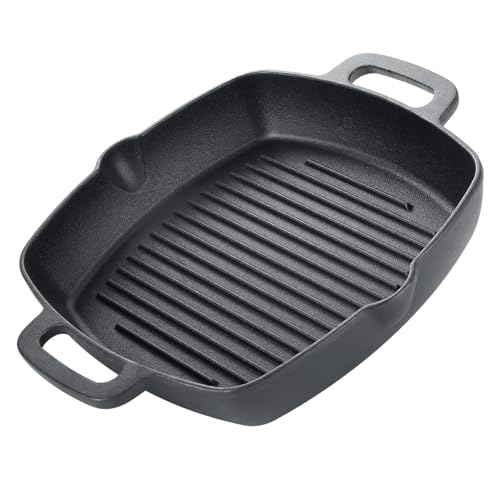
What sets it apart: If you need the largest single-burner grill surface possible without going reversible, this 13×11 inch pan delivers big food capacity in a square footprint.
The Ghligna measures 33 x 28 x 5.3 centimeters, or about 13 x 11 x 2.1 inches, making it the largest dedicated grill pan on this list. The material is premium cast iron that the listing describes as sturdy, durable, and resistant to bending or deformation—a critical property when you’re placing a hot pan repeatedly on a flat glass surface. The grill ridges on the bottom are designed to create uniform marks on the food surface, which means the cooking surface itself is a series of raised ribs with channels for grease.
The 13-inch length is the thing to pay attention to. On a standard 9-inch glass burner, the pan will overhang by about 2 inches on each end, which means the outer edges run cooler and the center runs hotter. That’s not a death sentence—plenty of cooks work around it by rotating food mid-sear—but it’s a real trade-off you’re making for the extra capacity. The 2.1-inch depth gives you more splatter containment than the shallow reversible griddles, which is a genuine plus when you’re searing fatty cuts on a glass top. The square corners also make efficient use of the cooking surface, fitting more food than a round pan of the same diameter.
Pros:
- Largest cooking surface on this list — fits four burgers or two large steaks without crowding
- 2.1-inch depth — contains splatter better than shallow reversible options
- Sturdy, warp-resistant cast iron — maintains flat contact with the cooktop
Cons:
- 13-inch length overhangs a standard 9-inch burner — uneven heat at the edges
- No handle details provided — can’t verify the grip or heat resistance before buying
- Single-sided design — no flat top option for pancakes or eggs
Our Take
Works well for: Someone with a large single burner or a four-burner stove who wants maximum grill surface per pan. Skip this if: Your burners are on the smaller side—the overhang will produce uneven searing every time.
NutriChef Cast Iron Reversible Griddle 18×10 Inch (The Classic Reversible)

The bottom line: An 18×10 reversible griddle that does exactly what reversible griddles have done for generations—flat side for breakfast, ridged side for dinner—without any clever coatings or gimmicks.
The NutriChef measures 18 x 10 inches and is built from heavy-duty, pre-seasoned cast iron with a flat side and a ridged side on a single reversible slab. The ridged surface keeps excess oil away from food and adds grill marks, while the flat side handles pancakes, eggs, and anything that needs full surface contact. The pre-seasoned finish means you can cook on it immediately after unpacking, though any cast iron purist will tell you to add a thin layer of oil and heat it once before the first use anyway.
The 18×10 footprint sits in an interesting middle ground: large enough to span two burners for even heating across the full surface, but not so large that it becomes unwieldy to flip. On a glass top, that two-burner setup is actually an advantage for even heat—the pan bridges two heating zones and evens out the temperature, rather than concentrating it in a single spot. The trade-off is the same as any reversible: the ribbed side sits directly on the cooktop when you’re using the flat side, which means the ridges themselves act as a partial barrier to full contact. That’s precisely why the flat side works better over two burners than one—the extra heat compensates for the slight lifting effect of the ridges underneath.
Pros:
- 18×10 span works over two burners — even heat distribution without overhang
- Pre-seasoned out of the box — ready to use after a quick oil and heat cycle
- Heavy-duty cast iron thickness — resists warping under sustained two-burner heat
Cons:
- Ridges on the reverse side reduce flat-side contact — slightly less efficient heat transfer
- No lid or handle cover included — bare-bones package for the price
- Two-burner requirement — single-burner use will produce significant cold spots
Final Word
Right for: A cook who wants the classic reversible experience and has two burners to spare for batch breakfasts and grilled dinners. Look past this if: You want a dedicated single-burner pan for weeknight searing—this griddle demands more real estate than that.
Buying Guide: Choosing the Best Cast Iron Grill Pans for a Glass Top Stove
A glass top stove punishes mistakes that a gas grate ignores. The decisions that matter—flatness, thickness, handle design, and seasoning quality—are not about flavor; they’re about protecting the surface underneath the pan. Our guide to cast iron grill pan buying mistakes covers the broader category, but here’s what matters most specifically for ceramic and glass.
Flatness and Smoothness of the Base
The single most important spec for any cast iron pan used on a glass top is the condition of the pan’s underside. A truly flat base makes full contact with the burner, which maximizes heat transfer and minimizes the risk of hot spots that warp the iron over time. Panels that are rough, pitted, or have raised casting marks will grind against the ceramic with every movement. Lodge, one of the most established names in cast iron, confirms that their cast iron griddle is appropriate for use on glass top stoves—but only when the base is properly cared for and kept free of burnt-on residue. That residue, even a thin layer of polymerized oil from a spill, acts like sandpaper.
Best grill pans for a glass top stove prioritize thickness over weight reduction
Thinner cast iron pans are lighter and easier to lift, but they warp under the uneven heat of a glass burner far more quickly than their heavier counterparts. When a pan warps, the center lifts and creates a gap between the iron and the ceramic, which means longer preheat times, uneven searing, and—in the worst cases—a pan that rocks and scrapes against the glass. The pans on this list that specify their heavy-duty construction, like the NutriChef and EWFEN, are inherently safer bets for long-term flatness than budget pans that cut weight by thinning the iron.
Handle Design and Grip Security
A heavy cast iron pan is only as safe as its handle. On a glass top, the worst-case scenario is a pan that slips from your grip and drops onto the ceramic—an impact that can crack the entire cooktop. The Northriver’s 5.8-inch curved handle gives you more leverage than shorter designs, and the Grill Pan for Stove Top’s wooden handle stays cool enough to grab without searching for a pot holder. A silicone handle cover, like the one included with the Cuisinel bundle, adds an extra layer of grip security and heat protection on hot handles.
Pre-Seasoning Quality and Maintenance Reality
A substandard factory seasoning leads to sticking, rust, and a pan that demands a full strip-and-reseason before it performs. The FDA sets food-contact safety standards for polymerized oil coatings on cast iron, and well-seasoned pans meet those requirements without synthetic chemicals. The EWFEN’s pure iron approach—nothing but iron and oil—is the most traditional path, but it also requires the most consistent aftercare. The Utheer’s ceramic coating sidesteps seasoning entirely, at the cost of that deep, nonstick patina that only bare iron builds over years. The 1/4-inch thickness of zucchini strips commonly used to test grill pan release is a useful benchmark: a well-seasoned pan should release food that thin without tearing.
Our Final Recommendation
For a dedicated grill pan that respects your glass top, the Northriver Casting 10.5 Inch Cast Iron Square Grill Pan wins overall—it combines the right footprint with a long handle and a lid. If budget is the priority, the Cuisinel bundle delivers the most complete setup for the least money. For reversible flexibility, the NutriChef 18×10 is the classic choice. Whichever you pick, never slide it across the glass—always lift.
Frequently Asked Questions
Will a cast iron grill pan scratch my glass top stove?
Only if the pan’s base is rough, warped, or coated with burnt-on residue. A smooth, flat bottom that makes full contact with the burner will not scratch the ceramic—but sliding any cast iron pan across a glass top is a risk, because even a smooth surface can pick up tiny particles that act as abrasives. Always lift to move, and check the underside for residue before each use.
What size cast iron grill pan is best for a glass top stove?
A 9 to 10.5-inch square pan is the sweet spot for most single burners. It heats evenly without overhanging the heating element, which prevents cold edges and hot centers. The Ghligna’s 13-inch length overhangs a standard 9-inch burner, while the Utheer and NutriChef span two burners—both are valid approaches, but only if your stove’s layout supports them.
Can I use a cast iron grill pan on an induction glass top stove?
Yes—cast iron is ferrous metal, which means it works on induction cooktops. The same flatness and smoothness rules apply, though induction heating is actually gentler on cast iron than traditional electric because it heats the pan directly rather than the surrounding glass. Check your stove’s manual for any size restrictions before using a large reversible griddle.
How do I clean a cast iron grill pan without ruining the seasoning?
Skip the soap and skip the dishwasher. After cooking, hand wash with hot water and a soft brush or pan scraper while the pan is still warm, then dry it thoroughly on the stove over medium heat. Apply a thin layer of oil while the iron is still warm, and the seasoning will build with every use. If food is stuck, boil a shallow layer of water in the pan for a minute to loosen it before scraping.
Is a reversible grill and griddle pan better than a dedicated grill pan for a glass top stove?
It depends on what you cook. A reversible pan gives you two surfaces in one, but the ribbed side on the reverse means slightly less efficient contact for the flat side, and the pan is usually larger, requiring two burners. A dedicated grill pan like the Northriver or Cuisinel heats evenly on a single burner and does one job well. If you only grill, get a grill pan. If you want pancakes and eggs too, a reversible griddle is the better trade-off.