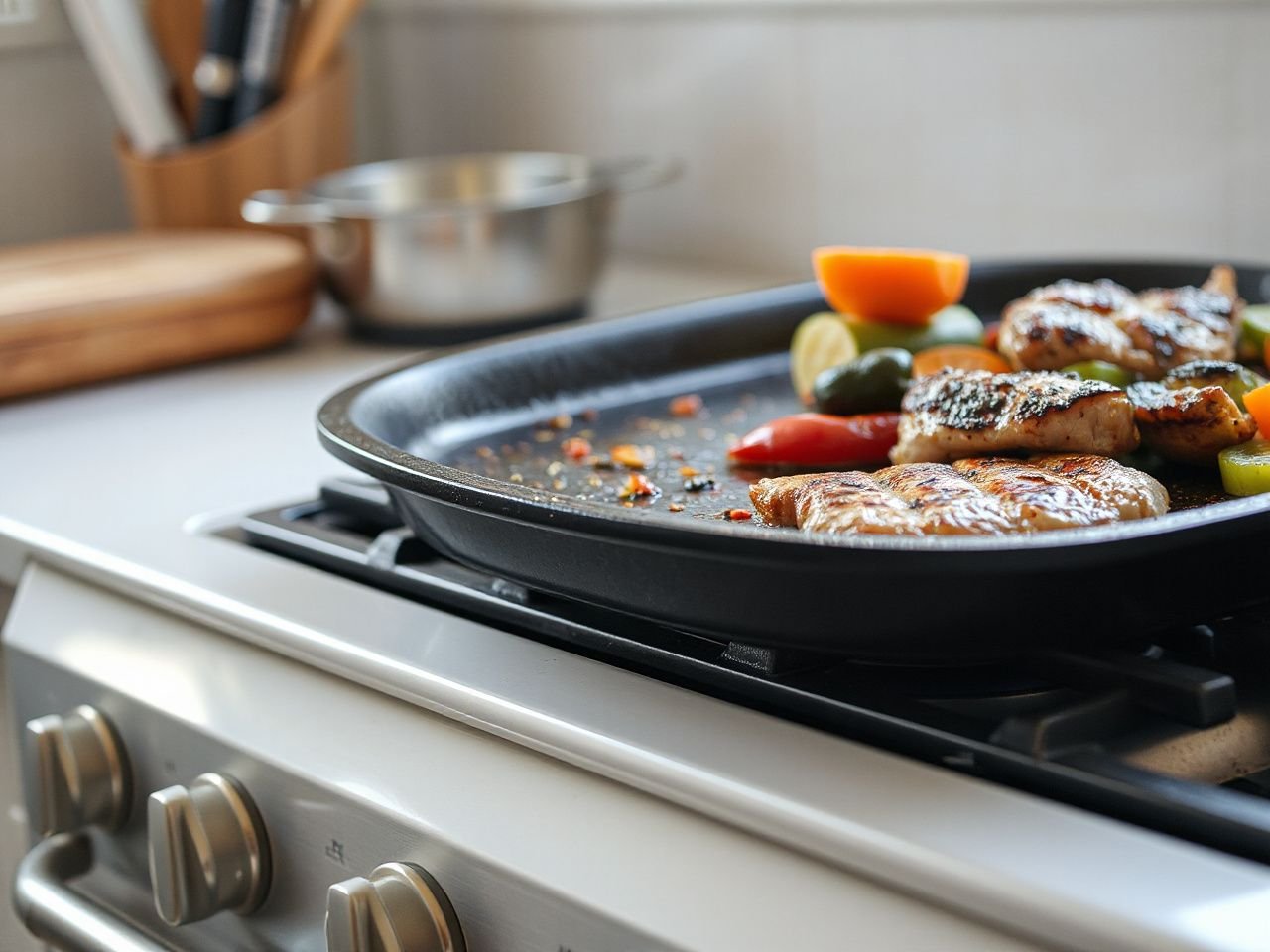
Gas burners are brutal on cast iron. They concentrate heat in rings and ramps, and that thermal shock is why thin griddles cup and spin on the grates. When ranking the best cast iron griddles for a gas stove, start with plate thickness and base reinforcement before considering the seasoning. If you’ve ever watched a cheap griddle bow over a flame, you already know the drill.
Skip the research and grab the Utheer 23″ x 16″ Enameled Cast Iron Griddle — its X-shaped reinforcement ridges and full enamel coating give it the best shot at staying flat on a gas stove’s uneven heat.
Four of the five picks below are large-format enameled plates built around warp resistance. The outlier is the NutriChef — smaller, reversible, and raw seasoned iron. It is included because sometimes a ridged side for grill marks is needed without hauling out a full griddle. The Utheer stands out based on its specifications.
📌 This article contains affiliate links. As an Amazon Associate I earn from qualifying purchases, at no extra cost to you. Full disclosure.
CERTAIN CONTENT THAT APPEARS ON THIS SITE COMES FROM AMAZON. THIS CONTENT IS PROVIDED ‘AS IS’ AND IS SUBJECT TO CHANGE OR REMOVAL AT ANY TIME.
Utheer 23″ x 16″ Enameled Cast Iron Griddle (Best Warp Resistance)

Griddle for Gas Grill Flat Top Grill Griddles Plate 25″ x 16″ Cast Iron (Largest Cooking Area)
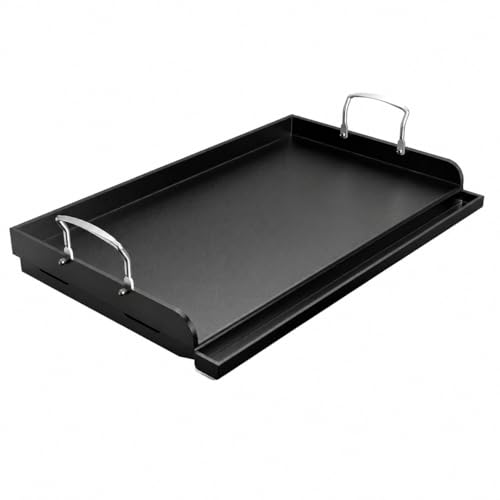
QuliMetal 23″ x 16″ Cast Iron Griddle (Matte Porcelain Enamel)

Comparison Table
| Product | Best For | Buy Link |
|---|---|---|
| Utheer 23″ x 16″ Cast Iron Griddle | Overall warp resistance | Check Price |
| Griddle for Gas Grill 25″ x 16″ Cast Iron | Large 5-burner stoves | Check Price |
| QuliMetal 23″ x 16″ Cast Iron Griddle | Matte enamel surface | Check Price |
| NutriChef 18″ x 10″ Reversible Griddle | Compact reversible cooking | Check Price |
| SearCook 23″ x 16″ Cast Iron Griddle | Budget enameled option | Check Price |
How We Chose These Cast Iron Griddles for Gas Stoves
These picks come from comparing published specifications, materials, and documented features against what actually matters on a gas cooktop. The best cast iron griddles for a gas stove are distinguished by plate thickness — thicker slabs prevent warping and distribute heat evenly across the burner rings. Surface finish is the second filter: a properly enameled or well-seasoned surface prevents sticking and rust without constant re-oiling. Then we looked at size fit. A 23″ by 16″ griddle spans two burners on most 30″ gas ranges, but the 25″ length demands a five-burner layout. We weighted the reinforced base designs heavily because gas heat concentrates directly under the flame ports. X-shaped ridges, crossbars, and single ribs all exist in this lineup; the X pattern covers more of the plate’s underside. Check your grate spacing before ordering any of these — a 16-inch width needs grates that sit reasonably flat and close together, otherwise the griddle will rock.
Utheer 23″ x 16″ Enameled Cast Iron Griddle (Best Warp Resistance)
Quick take: If you want a griddle that stays dead flat under a gas flame, the Utheer’s reinforced base and full enamel coating are the strongest argument in this lineup.
The first thing that jumps off the spec sheet is the X-shaped reinforcement ridges cast into the underside. Unlike a single crossbar, that X spreads rigidity diagonally across both axes. Gas burners heat in distinct rings, and that pattern is exactly what flexes a thin plate. The 23″ by 16″ cooking surface is big enough for eight pancakes or four smash burgers, yet the 2.6-inch height keeps the rim low enough to slide a spatula under without fighting the wall.
The enameled cast iron finish is the second half of the story. Enamel seals the iron against moisture, which means no mandatory seasoning routine out of the box. You still cannot leave it soaking in the sink, but a wipedown with warm water and a soft cloth is the daily cleanup. One honest annoyance: the listing never states the plate thickness in millimeters. Enamel adds structural mass, but without that number, you are trusting the X-ridge design to compensate for whatever gauge they used. That is not a dealbreaker — it just means I would not drop this thing into a red-hot burner immediately. Heat it gradually, same as any cast iron.
Pros:
- X-shaped reinforcement — resists cupping and twisting better than a single crossbar or rib.
- Full enamel coating — no seasoning required, and the surface shrugs off acidic foods like tomato sauce.
- 23″ x 16″ footprint — fits across two burners on a standard 30-inch gas range without overhang.
Cons:
- No stated thickness — the plate gauge is missing from the listing, which is the single number I would want before judging heat capacity.
- Enamel means no metal utensils — a fork or steel spatula will chip the coating, so you need wood or silicone tools.
The Real Story
Best for: Anyone who has already warped a cheap griddle and wants the most rigid enameled option under $100. Skip if: You need a reversible surface with grill ridges, or you insist on raw iron for high-heat searing with metal utensils.
Griddle for Gas Grill Flat Top Grill Griddles Plate 25″ x 16″ Cast Iron (Largest Cooking Area)
Here’s the deal: This is the pick for five-burner gas stoves or outdoor grills where you want 400 square inches of flat-top real estate and do not care about enamel.
The 25″ x 16″ cooking surface is the largest in this roundup. That extra two inches of length matters only if your stove has a center burner and enough grate width to support the plate without teetering. On a four-burner 30-inch range, the 25-inch span likely overshoots the outer grates, leaving uneven support. The listing explicitly recommends this for five-burner or larger gas grills, and that is honest guidance rather than marketing spin.
This is a raw cast iron griddle, not enameled. That means you season it yourself before first use and maintain the polymerized oil layer after every cook. Raw iron can take higher direct flame than enamel without cracking, and you can use metal spatulas freely. The trade-off is rust risk if you skip the drying step after washing. My heat-distribution instinct says the flat plate will show more pronounced hot spots directly over the flame ports because there is no reinforcement ridge pattern mentioned in the listing. That does not mean it will warp — 25 inches of cast iron has a lot of thermal mass — but you will need to move food across the surface more actively.
Pros:
- 400 square inches — cooks a full breakfast spread or hibachi dinner for four at once.
- Raw cast iron — survives high-heat searing and metal utensils without chipping.
- Honest fit guidance — the listing tells you to verify five-burner compatibility before buying.
Cons:
- No seasoning included — you must season it yourself, and a botched first coat leads to sticking and rust.
- Fits poorly on 4-burner ranges — the 25-inch length will overhang the outer grates on most standard stoves.
Why It Made Our List
Perfect for: Grillers with a 5-burner gas grill or large stovetop who want maximum cooking area and are comfortable maintaining raw iron. Not great if: You have a compact 30-inch range or you dislike reseasoning cast iron after each use.
QuliMetal 23″ x 16″ Cast Iron Griddle (Matte Porcelain Enamel)
What stood out: The QuliMetal swaps shiny enamel for a matte porcelain coating, which hides scratches better and gives a slightly rougher surface for browning.
Dimensions are identical to the Utheer at 23″ x 16″ x 2.6″, so the fit on a standard 30-inch gas range is the same. The key difference is the base: QuliMetal uses a reinforced crossbar rather than an X-pattern. A single crossbar running the length of the plate adds rigidity against front-to-back flex, but does little to counter diagonal twisting. On a gas stove, where two burners create uneven heat zones, that diagonal stress is real. Still, a thick crossbar is far better than a flat plate with no rib at all.
The matte porcelain enamel is the feature to think about. It is easier to clean than raw iron and does not require seasoning, but matte finishes can be slightly more porous than glossy enamel. That means oil polymerizes into the surface over time, which is actually a benefit for nonstick performance — you just need to avoid aggressive scrubbing with abrasive pads. The plastic handle on the side stays cooler than raw iron, but do not grab it bare-handed after 10 minutes on a high flame.
Pros:
- Matte porcelain enamel — dark, low-glare surface hides utensil marks and develops natural nonstick character.
- Reinforced crossbar — adds meaningful rigidity against front-to-back bowing.
- Easy cleanup — warm water and a soft sponge remove most residues without stripping seasoning.
Cons:
- Single crossbar — less diagonal warp resistance than the X-ridge on the Utheer.
- Matte finish requires gentler handling — steel wool or a metal scraper will remove the matte layer and expose the iron beneath.
Our Take
Great match for: Cooks who prefer a modern matte look and want the convenience of enamel without the glassy shine. Think twice if: You regularly move a hot griddle from burner to burner; the single crossbar offers less twist resistance than a diagonal reinforcement.
NutriChef Cast Iron Reversible Griddle 18″ x 10″ (Compact Reversible)

In a nutshell: This is the only reversible option here, and the 18″ x 10″ footprint makes it the most stove-friendly for tight kitchens or glass-top gas stoves with limited grate area.
The defining feature is the two-sided design: one flat side for pancakes and eggs, one ridged side for grill marks and fat drainage. The ridges channel grease away from food, which the listing frames as a health benefit — though in practice it just means less smoke and crispier exteriors. This griddle is pre-seasoned, not enameled. Pre-seasoned means the factory applied a thin layer of oil and polymerized it, so you can cook immediately, but that factory seasoning is shallow. After a few high-heat sessions, you will need to re-oil the surface or food will start sticking.
At 18 inches long, this spans only one and a half burners on most gas stoves. That is actually an advantage for cast iron because it reduces the temperature differential across the plate. A smaller plate heats more evenly. The trade-off is capacity: you get roughly 180 square inches of cooking area, which is fine for two people but tight for a family breakfast. The ridged side also cannot be seasoned as effectively because oil pools in the grooves, so rust can start there if you do not dry it thoroughly after washing.
Pros:
- Reversible design — flat side for delicate foods, ridged side for meats and vegetables.
- Pre-seasoned — usable right out of the box without a lengthy initial seasoning process.
- 18″ x 10″ compact size — fits smaller gas stoves and stores more easily than full-size griddles.
Cons:
- Factory seasoning wears quickly — expect to re-season after the first month of regular use.
- Ridged grooves trap moisture — rust forms in the valleys if the griddle is not bone-dry before storage.
Final Thoughts
Ideal for: A solo cook or couple with limited burner space who wants the option of grill marks without a separate grill pan. Pass on this if: You regularly cook for more than two people or you hate maintaining raw cast iron.
SearCook Cast Iron Griddle for Gas Grill and Stove Top (Budget Enameled)

Why it made our list: The SearCook is the third 23″ x 16″ enameled contender, and it competes on price while still offering a reinforced warp-proof design.
The marketing copy leans hard on “no more hot spots or rust,” which is a tall claim for any cast iron on a gas flame. The reality is that enameled cast iron reduces hot spots compared to thin raw plates, but no 23-inch griddle will heat perfectly evenly across two burners. What the SearCook does have is a reinforced base — the listing calls it an upgraded design, though it does not specify whether it is a crossbar, rib, or X-pattern. That ambiguity is the main reason it sits below the Utheer and QuliMetal in my ranking. Without knowing the exact base geometry, you cannot predict how it will resist diagonal flex.
What you do get is the same 23″ x 16″ x 2.6″ footprint and a full enamel coating. That means no seasoning, quick wipedown cleanup, and resistance to acidic foods. The price point is typically lower than the other two enameled options, which makes it a reasonable entry point if you are not sure whether you will use a full-size griddle often. Just accept that the base reinforcement is unspecified, so avoid rapid temperature swings on a high-output burner.
Pros:
- Full enamel coating — same rust resistance and easy cleaning as the Utheer and QuliMetal.
- Budget-friendly price — the cheapest way to get a full-size enameled griddle for a gas stove.
- Reinforced base — some form of structural ribbing is included, which is better than a flat slab.
Cons:
- Unspecified reinforcement type — cannot confirm whether it uses an X-ridge, crossbar, or single rib.
- No distinctive feature — it does nothing the QuliMetal and Utheer do not already do, aside from a lower price.
The Bottom Line
Best for: Budget shoppers who want an enameled full-size griddle and are willing to treat it gently on the heat ramp. Skip if: You plan to crank all burners to max immediately, or you want a clearly documented reinforcement design for long-term flatness.
Buying Guide: How to Choose a Cast Iron Griddle for Your Gas Stove
Gas stoves punish bad cast iron. The open flame produces intense, uneven heat that can crack or warp a thin plate within minutes if you heat it too quickly. So before you buy, think through four factors: plate reinforcement, surface finish, size fit, and heat management.
Plate Reinforcement and Thickness
Thicker plates resist warping because they have more mass to absorb thermal expansion without deforming. The Utheer’s X-shaped ridges are the strongest design in this lineup, followed by the QuliMetal’s crossbar and the SearCook’s unspecified rib. The 25-inch griddle has no mention of reinforcement, which means its sheer bulk is doing the work. If you cook on high heat often, choose a reinforced plate. For a deeper dive into what goes wrong with cheap griddles, our cast iron griddle buying guide breaks down the six most common mistakes people make before purchase.
Enameled vs. Raw Cast Iron
Enameled griddles like the Utheer, QuliMetal, and SearCook require no seasoning and are rust-resistant as long as the coating stays intact. Raw cast iron such as the 25-inch griddle and the NutriChef needs regular oiling and careful drying. The FDA regulates food-contact coatings and materials, so enameled plates must meet safety standards for lead and cadmium leaching. Raw iron is inherently food-safe but demands more upkeep. If you want the convenience of wipe-and-go, enameled wins.
Size and Burner Layout
A 23-inch by 16-inch griddle fits two burners on most 30-inch gas ranges. The 25-inch version needs a fifth center burner and wider grate support. Measure your stove’s grate width and the distance between burner centers before ordering. The Lodge cast iron skillets are a good fallback if you only need single-burner coverage and are wary of full-size griddle fit.
Heat Management on a Gas Stove
Never blast a cold cast iron griddle on a high flame. Start on medium-low for five minutes, then raise the heat gradually. This prevents thermal shock, which is the number one cause of warping and cracking. The ASTM standards for cast iron specify material properties, but no standard can save a plate that is heated too aggressively. Your griddle will develop hot spots directly over the flame ports — move food around rather than leaving it in one place.
Our Final Recommendation
The Utheer 23″ x 16″ Enameled Cast Iron Griddle takes the overall win because its X-shaped reinforcement and full enamel coating address the two biggest gas-stove threats: warping and rust. For budget buyers, the SearCook offers similar dimensions at a lower price, though with an unspecified base design. The NutriChef is the best value for small households that want reversible cooking. If you have a five-burner stove and need maximum space, the 25-inch griddle is the clear size pick. My own money would go to the Utheer — the base geometry alone puts it ahead.
Frequently Asked Questions
Do I need to season an enameled cast iron griddle?
No. Enameled surfaces like the Utheer, QuliMetal, and SearCook have a glass-like coating that does not require seasoning. You should still wipe them with a thin layer of oil after drying to keep the surface from looking dull, but the coating itself will not rust or absorb oil the way raw iron does.
Can I use a cast iron griddle on a glass-top gas stove?
You can, but with caution. A full-size 23-inch griddle may overhang the circular heating zone of a glass-top burner, causing the surrounding glass to stay cool while the center gets very hot. That uneven load can stress the glass. The NutriChef 18″ x 10″ is a safer choice for glass-top stoves because its smaller footprint stays within the typical burner ring diameter.
How do I prevent my cast iron griddle from warping on a gas stove?
Heat it slowly. Start on medium-low for five minutes, then ramp up. Never place a cold griddle over a high flame. Also choose a griddle with a reinforced base — the Utheer’s X-shaped ridges resist the diagonal flex that gas burners create. If your griddle already warps, no hammer will fix it; replace it and change your heating habit.
What’s the difference between a reversible griddle and a flat-top griddle?
A reversible griddle like the NutriChef has one flat side and one ridged side, so you can cook pancakes on one and grill steaks on the other. A flat-top griddle is smooth on both sides, which means faster browning and easier cleaning but no built-in grill marks. If you want one pan that does both, reversible is the only option in this roundup.