Home Fresh Eats is funded by affiliate commission. Our picks come from comparing published specifications and documented features against what matters in the category — no brand pays for a place on this page. If you buy through a link here we may earn a commission at no extra cost to you, and it pays for the research behind the next guide. Full disclosure.
As an Amazon Associate we earn from qualifying purchases. This does not affect the price you pay.
CERTAIN CONTENT THAT APPEARS ON THIS SITE COMES FROM AMAZON. THIS CONTENT IS PROVIDED ‘AS IS’ AND IS SUBJECT TO CHANGE OR REMOVAL AT ANY TIME.
The short answer
- Best overall: Blingco 6.5-Quart Enameled Dutch Oven — roomy round design with a complete baking kit
- Best value: Umite Chef 6-Quart Enameled Dutch Oven — dome lid and sourdough tools at a sensible price
- Recommended: GdnWings Oval Enameled Dutch Oven — oval geometry for bâtards and longer loaves
- Specialist option: SEFILENCE Double Dutch Oven — two square baking compartments in one vessel
A properly sized pot gives sourdough room to expand, keeps steam close to the dough, and makes the first bake feel far less fiddly. The best enameled dutch ovens for bread baking still need more scrutiny than a capacity number: lid clearance, interior shape, hardware, enamel care, and safe dough transfer all matter.
My overall pick is the Blingco 6.5-Quart Enameled Cast Iron Dutch Oven because its round capacity, documented baking accessories, and tight-lid claim make the strongest all-round case on paper. Umite Chef is the best value, while GdnWings is the more natural choice for oval loaves.
How We Chose the Best Enameled Dutch Ovens for Bread Baking
Our shortlist comes from comparing published specifications, materials, dimensions, and documented features against the parts of bread baking that actually decide the result. Usable interior space received more weight than headline capacity because a pot can be large yet awkward for a boule or bâtard. Round geometry generally suits round dough, while an oval body can give a longer loaf better support. Lid fit matters because bread steam retention depends on keeping the covered baking space enclosed during the early stage. We also looked for clear information about weight, enamel, lid hardware, handles, and oven guidance. Missing information counts against a product: the four listings do not provide complete oven limits for every lid and knob, so buyers should check the current manual before preheating. The same caution applies to empty-pot restrictions, cooktop compatibility, cleaning instructions, and warranty coverage. No product here was physically tested; these rankings are judgments from the specifications buyers can verify before ordering.
Blingco Enameled Cast Iron Dutch Oven (6.5-Quart Baking Kit)
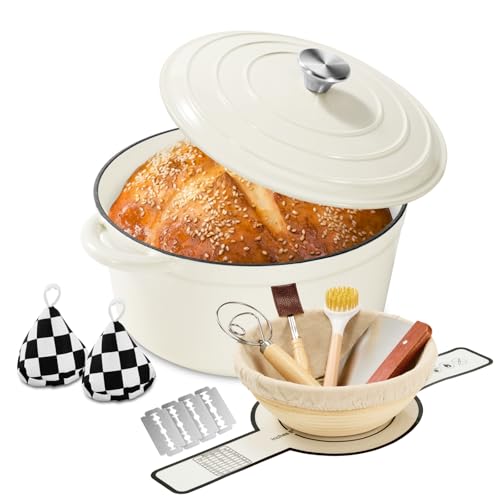
- BrandBlingco
- ModelBlingco-095
- Dimensions14.17 inches x 14.17 inches x 8.11 inches
- Size / capacity6.5qt
- ColourCream White
Quick take: The Blingco is the strongest all-purpose choice for bakers who want a roomy round pot and useful dough-preparation tools included in the listing.
Blingco lists the Blingco-095 at 6.5 quarts, with dimensions of 14.17 by 14.17 by 8.11 inches and a cream-white finish. The listing describes it as enameled cast iron and includes a proofing basket, dough whisk, and scoring tool in the complete baking kit. That combination points toward a round boule workflow, although the listing does not provide the usable interior width or the pot’s weight.
The manufacturer claims a seven-layer design for even heat distribution and an airtight lid lock intended to retain steam and moisture. Those are relevant features for covered bread baking, but the listing does not state an oven-temperature limit for the body, lid, or knob. I would rank Blingco first because it offers the most complete bread-focused package here, not because an unverified heat rating should be assumed.
Pros:
- 6.5-quart capacity — gives a typical round loaf more working room than a smaller bread pot.
- Round footprint — naturally suits boule-shaped dough and circular proofing baskets.
- Documented baking kit — the listing includes a proofing basket, dough whisk, and scoring tool.
- Airtight lid-lock claim — the stated design is aimed at keeping steam around the dough.
- Cream-white enamel finish — a neutral colour that works well in a visible kitchen.
Cons:
- Weight is not listed — buyers cannot judge lifting and storage demands from the specification sheet.
- Heat guidance is incomplete — the listing does not state separate limits for the pot, lid, or knob.
Why It Stands Out
Ideal for: Bakers wanting one round enameled cast iron pot with bread accessories included. Pass on this if: you need a confirmed oven limit, a published weight, or a documented warranty before ordering.
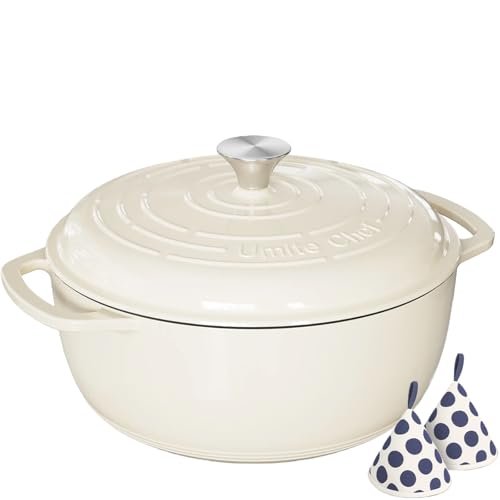
Umite Chef Enameled Dutch Oven (Dome Lid)

- BrandUmite Chef
- ModelBread Oven
- Dimensions1.0 inches x 1.0 inches x 1.0 inches
- Size / capacity6QT
- ColourCream White
In a nutshell: Umite Chef is the sensible value pick for sourdough bakers who care about lid shape and starter tools more than a fully documented specification sheet.
The Umite Chef Bread Oven is listed at 6 quarts in cream white. The product page gives its dimensions as 1.0 by 1.0 by 1.0 inches, which is plainly not useful for judging interior space, and it does not list the weight or warranty. The listing describes an enameled cast iron Dutch oven and includes six sourdough tools, but the individual tools are not identified in the supplied specifications.
Its dome-shaped lid is marketed as a way to retain steam and support an artisan-style crust. That shape may offer useful clearance above rising dough, yet the listing does not provide the interior height, lid diameter, or a separate knob temperature rating. Umite Chef has an advantage over the oval GdnWings for round loaves, but the missing dimensional information means buyers should confirm the usable interior before ordering a large bâtard or high-hydration dough.
Pros:
- 6-quart capacity — a practical size category for standard sourdough batches.
- Dome-shaped lid — the documented design is intended to provide steam space above the loaf.
- Six-piece sourdough kit — reduces the need to source basic bread tools separately.
- Cream-white colour — keeps the appearance understated beside darker bakeware.
- Bread-specific positioning — the product is designed around sourdough rather than general casserole cooking.
Cons:
- Unhelpful dimensions — the listed 1.0-by-1.0-by-1.0-inch figures do not let a buyer assess loaf fit.
- Unlisted heat limits — pot, lid, and knob guidance must come from the manual rather than the supplied listing.
Our Take
Great match for: Value-focused sourdough bakers who want a dome lid and included tools. Think twice if: you need dependable interior measurements for a particular banneton or want published weight and warranty details.
GdnWings Oval Enameled Dutch Oven (Long-Loaf Shape)
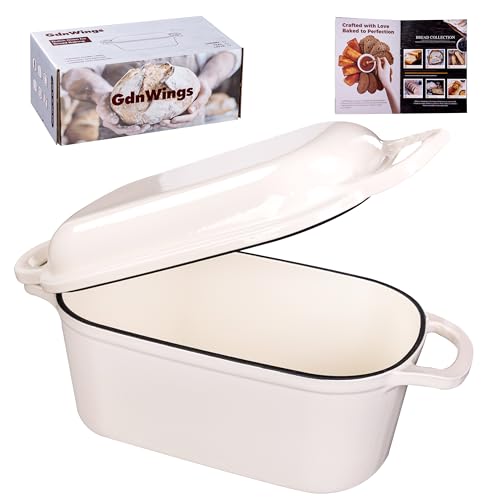
- BrandGdnWings
- ModelGdn002(White)
- Dimensions14.13 inches x 14.13 inches x 6.16 inches
- Weight13.2 Pounds
- Size / capacityXL
- ColourWhite
Here’s the deal: GdnWings earns its recommendation by offering an oval body that makes more sense for bâtards and elongated sourdough than a standard round pot.
The GdnWings Gdn002(White) is listed as an XL white enameled cast iron Dutch oven measuring 14.13 by 14.13 by 6.16 inches. Its published weight is 13.2 pounds. The listing does not state a capacity in quarts, so the XL label cannot replace a usable interior measurement when you are checking it against a proofing basket or loaf length.
Oval geometry can support a longer loaf more naturally than a round vessel, but shape alone does not confirm a better bake. The listing does not state the lid’s fit, oven limit, knob material, or warranty, and the 13.2-pound published weight makes handling and storage a more serious consideration than with an unspecified model. I would choose GdnWings for a bâtard, not for the promise of a universal bread pot.
Pros:
- Oval geometry — better suited to elongated sourdough shapes than a round interior.
- 13.2-pound published weight — gives buyers a clear warning about handling and storage.
- 14.13-inch listed length — useful when comparing the exterior footprint with oven and cabinet space.
- 6.16-inch listed height — helps buyers think about clearance, though usable interior height is not provided.
- White finish — a clean, bright alternative to the red and cream options here.
Cons:
- No quart capacity listed — the XL label does not tell you how much dough the interior can comfortably hold.
- Heavy ownership profile — 13.2 pounds before dough is added makes safe loading and storage especially important.
Who Should Buy This
Perfect for: Bakers who regularly shape bâtards and can accommodate a 13.2-pound pot. Not great if: you want a compact, clearly dimensioned round Dutch oven for boule baking.
SEFILENCE Double Dutch Oven (Two-Compartment Design)

- BrandSEFILENCE
- Dimensions7.3 inches x 13.0 inches x 5.9 inches
- Weight15.61 Pounds
- Size / capacity6.4 inches
- ColourRed
What sets it apart: The SEFILENCE Double Dutch Oven is a niche option for bakers who specifically want two square baking compartments rather than one conventional bread chamber.
The listing gives the SEFILENCE model a red finish, dimensions of 7.3 by 13.0 by 5.9 inches, and a published weight of 15.61 pounds. It describes the capacity as 6.4 inches, not quarts, and says the double design has two square compartments, each 6.4 inches wide. The listing also describes an enamel coating and cast iron construction, while the supplied data does not provide a warranty.
Two compartments may suit smaller separate loaves, but the square layout is less natural for a single boule or bâtard than the Blingco, Umite Chef, or GdnWings shapes. At 15.61 pounds, this is the heaviest product in the supplied data, so safe dough loading deserves extra attention. The manufacturer claims uniform heat distribution and enamel protection, yet the oven limits for the body, lids, and knobs are not listed.
Pros:
- Two baking compartments — allows separate square spaces instead of one shared chamber.
- 6.4-inch compartment width — gives a concrete starting point for judging smaller loaves.
- 15.61-pound listed weight — leaves no ambiguity about the handling burden.
- Red finish — offers a stronger visual accent than the cream-white and white alternatives.
- Enamel-coated cast iron listing — provides the surface type many buyers want for easier everyday cleanup than bare cast iron.
Cons:
- Square divided layout — does not naturally suit one round boule or one long bâtard.
- Heaviest listed model — 15.61 pounds creates a real loading, lifting, and storage concern.
The Real Deal
Best for: Bakers who specifically want two square compartments and accept the weight. Skip if: your main goal is one spacious, conventional chamber for a standard sourdough loaf.
| Product | Best for | Capacity or layout | Published weight |
|---|---|---|---|
| Blingco 6.5-Quart Enameled Dutch Oven | Round boules | 6.5 quarts | Not listed |
| Umite Chef 6-Quart Enameled Dutch Oven | Value-focused sourdough | 6 quarts | Not listed |
| GdnWings Oval Enameled Dutch Oven | Long bâtards | XL; capacity not listed | 13.2 pounds |
| SEFILENCE Double Dutch Oven | Two square loaves | Two compartments, each 6.4 inches wide | 15.61 pounds |
How to Choose Among the Best Enameled Dutch Ovens for Bread Baking
Best enamel cast iron pots for bread baking: start with usable shape
Capacity alone does not decide bread performance. A 6- to 6.5-quart pot may suit a standard boule, but the interior length, width, height, and lid clearance determine whether dough can expand without touching the lid. Blingco and Umite Chef are the natural round choices from this list. GdnWings is the better shape match for an elongated bâtard, while SEFILENCE is built around two square compartments rather than one conventional loaf space.
Preheating, oven limits, and lid hardware
Do not treat a Dutch oven’s body rating as the rating for the whole assembly. The body, lid, knob, and any other hardware can have different limits, and none of these supplied listings gives a complete temperature limit for every part. The manual must take precedence on empty-pot preheating and restrictions. Published guidance for several other enameled Dutch ovens reaches 500°F, but that figure cannot be transferred to these four products. For food-contact and material-safety questions, check the manufacturer’s documentation and relevant FDA food-contact guidance rather than assuming an enamel finish answers every question.
Thermal shock and safe dough loading
Enameled cast iron can be damaged by thermal shock. Never move a hot pot onto a cold or wet surface, plunge hot cookware into cold water, or pour cold liquid into a heated vessel. Use heat-resistant protection, a parchment sling, and a controlled two-handed loading method; keep metal tools away from the enamel because a scoring blade or dough scraper should not be used to pry stuck dough from the pot.
Cleaning, storage, and cooktops
Let the cookware cool before cleaning, then use the care instructions supplied with the product. Avoid assuming dishwasher safety, induction compatibility, or suitability for gas, electric, and glass cooktops when the listing does not state those details. Sticky dough is usually easier to manage with parchment paper, and flour residue should be softened rather than attacked with abrasive tools. Our rules for cleaning an enameled Dutch oven cover the care decisions that matter after baking.
For broader comparisons, our enameled Dutch oven buying guide explains why lid fit, handles, knob design, and warranty deserve as much attention as colour. Readers comparing general bread cookware can also use our shortlist of Dutch ovens for bread baking, while the bread oven buyer’s shortlist covers purpose-built alternatives such as a bread cloche. The Challenger bread pan and Emile Henry bread cloche are different design routes, not interchangeable entries in this four-product ranking.
Our Final Recommendation
Blingco is our overall winner because the 6.5-quart round format and included proofing basket, dough whisk, and scoring tool address the full bread workflow better than the alternatives on paper. Umite Chef is the best value, pairing a 6-quart size with a dome lid and six sourdough tools, though its listed dimensions are not useful. GdnWings is the specialist pick for longer loaves, provided 13.2 pounds and missing capacity details are acceptable. SEFILENCE is too niche for most bakers, but its divided layout has a clear audience.
Frequently Asked Questions
What size Dutch oven works best for sourdough bread?
A 6- to 6.5-quart round vessel is the clearest match for a typical boule among these products, with Blingco and Umite Chef fitting that description. A bâtard benefits from oval geometry, making GdnWings the more logical shape choice. Capacity does not tell the whole story, so compare the basket, dough length, interior width, lid clearance, and manufacturer guidance before ordering.
Can I preheat these enameled Dutch ovens empty?
Do not assume that all four models share the same preheating rules. The supplied listings do not state complete oven-temperature limits for each pot, lid, and knob, and they do not establish empty-pot restrictions. Read the current manual for the exact model before preheating. The manual also takes priority over generic advice about oven use, cooktops, and maximum heat.
How do I prevent bread from sticking to enamel?
Use parchment paper or a parchment sling to separate sticky dough from the enamel during loading. Lower the dough carefully with heat-resistant protection, and avoid metal tools that can scratch or chip the surface. Let the pot cool before cleaning; never plunge hot enameled cast iron into cold water. A soft cleaning approach is safer than abrasive scrubbing on baked-on flour.
Is enameled cast iron better than bare cast iron for bread?
Neither surface wins for every baker. Enameled cast iron avoids the seasoning routine associated with bare cast iron and can be easier to integrate into general cooking, but enamel needs protection from thermal shock, impacts, and abrasive cleaning. Bare cast iron has different care demands. For these products, lid fit, loaf geometry, hardware limits, and documented instructions matter more than choosing by surface name alone.