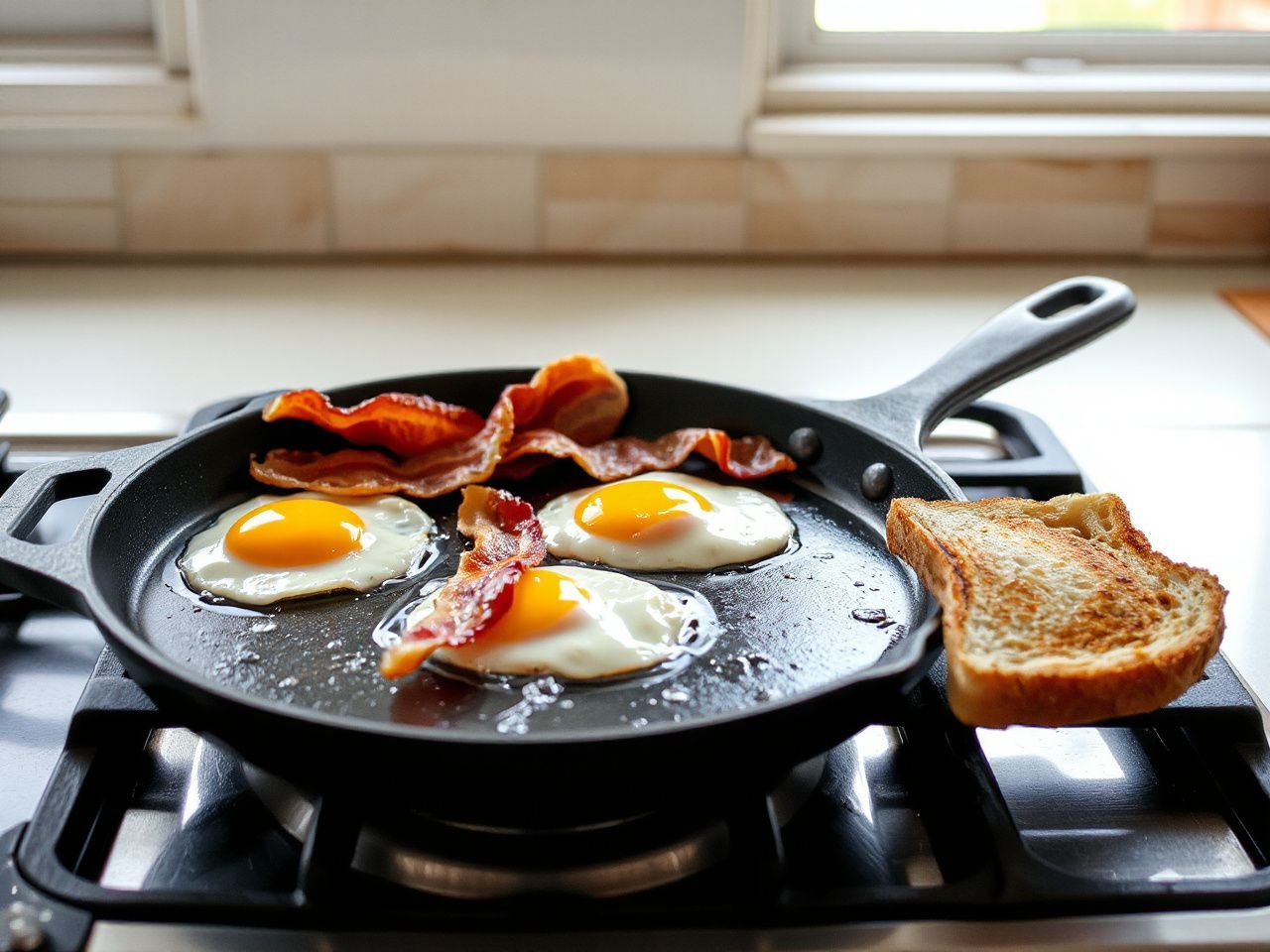
It’s 7 a.m. and pancake number three has a black center while its edges stay raw. That’s a heat distribution problem, not a batter problem. The best cast iron griddles for breakfast fix it by holding heat across a thick, flat surface, so your eggs set evenly and your bacon doesn’t curl into burnt knots. After comparing the published specs and construction details of every griddle on this list, the Lodge Reversible Cast Iron Grill/Griddle Pan suits most kitchens best.
Here’s the short answer: the Lodge earns the top spot on thickness, pre-seasoning, and usable flat space. Here’s the long answer.
📌 This article contains affiliate links. As an Amazon Associate I earn from qualifying purchases, at no extra cost to you. Full disclosure.
CERTAIN CONTENT THAT APPEARS ON THIS SITE COMES FROM AMAZON. THIS CONTENT IS PROVIDED ‘AS IS’ AND IS SUBJECT TO CHANGE OR REMOVAL AT ANY TIME.

Bayou Classic 7428 28-Inch Reversible Griddle (The Crowd Feeder)

Comparison Table
| Product | Best For | Buy Link |
|---|---|---|
| Patravious 4-Hole Cast Iron Egg Pan | Four eggs at once | Check Price |
| Bayou Classic 7428 28-Inch Reversible Griddle | Large-batch breakfast | Check Price |
| JUSTUP Nonstick Frying Pan | Divided one-pan meals | Check Price |
| Lodge Reversible Cast Iron Grill/Griddle Pan | Best overall breakfast surface | Check Price |
| Camp Chef Cast Iron Griddle 14×16 | Portable outdoor breakfast | Check Price |
| Utheer Cast Iron Griddle | Grill-top flat inserts | Check Price |
How We Chose These Breakfast Griddles
The published specifications for each pan were compared, with thickness and pre-seasoning weighted highest, because thin cast iron warps and creates the hot spots that burn eggs, and a poor factory seasoning forces you to re-season before the first pancake. A flat side big enough to cook eggs and pancakes without crowding also mattered, which is why a reversible griddle is only worth it if you also do meats; a dedicated flat top maximizes breakfast surface otherwise. Handle design mattered too — wooden handles stay cool but are not oven-safe, cast-iron handles are durable but need a mitt. Before ordering, check your stove’s weight limit and individual burner diameter against the griddle’s footprint; a 28-inch slab on a small electric coil will never heat evenly. No product here was physically handle-tested; every pick comes from comparing materials, dimensions, and documented features.
Patravious 4-Hole Cast Iron Egg Pan (Four Separate Eggs)
In a nutshell: This is the narrowest pick on the list, built for someone who wants exactly four eggs cooked at once and nothing else.
By the numbers, the Patravious is a cast iron pan with four individual wells, each sized for one egg. The listing leans hard on its natural nonstick claim — no chemical coating, just iron that takes seasoning over time. What it doesn’t state is thickness or overall footprint, and those omissions matter. A four-hole pan is not a flat top; there is no continuous surface to cook pancakes, bacon, or a folded omelet. If you scramble eggs or want a single large egg sheet, this pan cannot do it.
Where this design wins is temperature stability inside each well. Cast iron holds heat once hot, so four eggs set at close to the same rate. The tradeoff is seasoning upkeep; eggs are notorious for sticking to under-seasoned iron, and the listing gives no indication of a factory pre-season. A buyer should expect to season this before the first use and to avoid metal utensils until that layer builds.
Pros:
- Four-egg capacity — cooks a complete egg course in one pan.
- Uncoated cast iron — no PTFE or ceramic layer to degrade.
- Even heat inside wells — thick iron reduces hot spots within each cup.
- Compact footprint — smaller than a full griddle, easier to store.
- Natural nonstick build — becomes more release-friendly as seasoning develops.
Cons:
- No flat cooking surface — pancakes, bacon, and large omelets are off the table.
- Missing core specs — no listed weight, thickness, or pre-seasoning status, which makes heat management a guess.
The Short Version
Best for: anyone who wants four perfect eggs and has no interest in a full griddle. Skip if: you want to cook pancakes or feed more than one egg-focused eater.
Bayou Classic 7428 28-Inch Reversible Griddle (The Crowd Feeder)
Here’s the deal: If your breakfast table seats six or more, this is the only pick on this list that gives you 392 square inches of flat cast iron without cooking in batches.
The Bayou Classic 7428 measures 28 inches long by 14 inches wide, making it the largest surface here. One side is smooth for pancakes, eggs, and grilled sandwiches; flipping it reveals a ribbed steak grill side for sausages, bacon, or chops. That reversibility is useful only if you also do meats — for pure breakfasts, the ribbed side sits unused and becomes another surface to clean. The listing does not specify thickness or handle design, so before ordering, confirm it will sit securely across two burners on your stove; a 28-inch slab over a single burner will give you a hot center and cold edges.
Size is the double-edged sword. The flat side can hold a dozen pancakes, but that same mass makes maneuvering and washing it in a standard sink a real pain. On a glass-top stove, the weight and length may exceed what the surface is rated to carry, so check the manufacturer’s weight limit. If you do outdoor cooking on a propane burner, this griddle earns its keep.
Pros:
- 28 x 14 inch cooking area — enough for a full breakfast spread at once.
- Reversible design — flat side for breakfast, ribbed side for meaty dinners.
- Double-burner span — positioned across two burners it heats more evenly.
- Large-batch friendly — no staggered flip timing for pancakes.
- Solid cast iron — retains heat longer than thinner pans.
Cons:
- Heavy and bulky — a 28-inch cast iron slab is hard to store and wash.
- No thickness or handle spec — those omissions make safe handling harder to plan.
Why It Earns a Spot
Ideal for: large families, camping breakfasts, or anyone who flips a dozen pancakes at once. Pass on this if: you cook for one or two people or have a small glass-top stove.
JUSTUP Nonstick Frying Pan (The Divided Breakfast Pan)
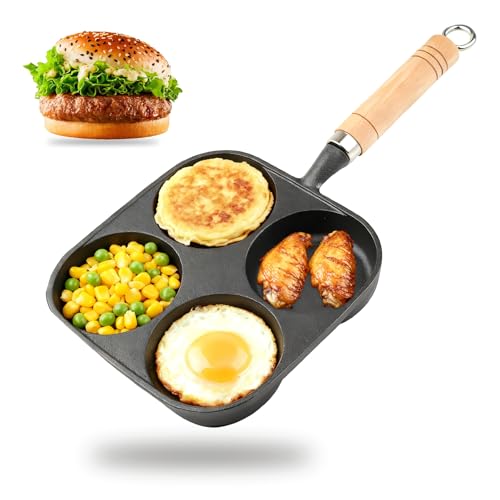
Quick take: This is a cast iron frying pan with built-in partitions, so one egg doesn’t run into the sausage and one small pancake doesn’t touch the onions.
The JUSTUP is described as a pure natural cast iron frying pan without chemical coating, with partitions that allow multiple foods to cook simultaneously. The listing leans on the classic cast iron story: oil seeps into the iron over time and forms a natural nonstick layer. That story is true, but it requires a maintained seasoning — and the listing does not state whether the pan arrives pre-seasoned. If it doesn’t, you’ll need to do a round of oven seasoning before it will release an egg.
What this pan gives up is surface. It is not a griddle; there’s no flat expanse for flipping pancakes or sliding a spatula under a whole omelet. The partitions make it useful for a single person who wants eggs, a small hash, and maybe a few vegetables all cooking side by side without mixing. For anyone trying to feed four people a full breakfast, this is the wrong tool.
Pros:
- Partitioned cooking surface — keeps ingredients separate without extra pans.
- No chemical coating — a safer surface for high-heat searing than PTFE.
- Natural nonstick over time — proper seasoning yields release without synthetics.
- Cast iron heat retention — holds temperature once brought up to heat.
- Multifunctional — can handle an egg, protein, and vegetables in one pan.
Cons:
- No flat top surface — pancakes and large batches don’t fit.
- Unspecified dimensions and weight — burner fit is a gamble until you measure.
Our Take
Great match for: a solo breakfast eater who hates washing three pans. Think twice if: you need a true flat top or cook for more than one.
Lodge Reversible Cast Iron Grill/Griddle Pan (The Seasoning Purist’s Pick)
The Short Version: A one-inch-thick, 10.56-pound slab of pre-seasoned cast iron that covers two burners — the most balanced breakfast surface on this list.
The Lodge Reversible is the reference point for cast iron breakfast cooking. It’s one inch thick and weighs 10.56 pounds, which is exactly what you want under a batch of pancakes: mass that resists temperature swings. Lodge pre-seasons it with vegetable oil, so it’s ready to cook on delivery — no flaxseed ritual required. It’s also PFAS-free and non-toxic, so there’s no chemical coating to worry about at high heat. The reversible design puts a smooth flat side up for eggs and pancakes, and a ribbed grill side up for bacon or sausage when you want char.
The tradeoff is mechanical, not culinary. Flipping a 10.56-pound slab while it’s hot requires a dry towel and some forethought; the ribbed side, once used, holds grease in its grooves and demands a stiff brush to clean without stripping the seasoning. Compared to the Bayou Classic’s 28-inch monster, the Lodge is more manageable but still spans two burners, so it won’t sit flat on a single small coil without hot corners. If you’re wondering whether a skillet would serve better, our Lodge cast iron skillet review breaks down that decision in detail.
Pros:
- One-inch thickness — prevents hot spots that burn eggs and pancakes.
- Vegetable oil pre-seasoning — usable from day one, no initial seasoning needed.
- Double-burner footprint — heats evenly when positioned across two gas or electric burners.
- Reversible with ribbed side — adds sear-mark capability for bacon and sausage.
- PFAS-free and non-toxic — no synthetic coating to degrade at breakfast temperatures.
Cons:
- 10.56 pounds — heavy to lift, flip, and wash in a standard sink.
- Ribbed side cleanup — grooves trap grease and require extra scrubbing.
Why It Stands Out
Perfect for: most home cooks who want a flat top that handles eggs, pancakes, and bacon without a chemical coating. Pass on this if: you need an ultra-light pan or cannot lift 10 pounds comfortably.
Camp Chef Cast Iron Griddle 14×16 (The Portable Reversible)
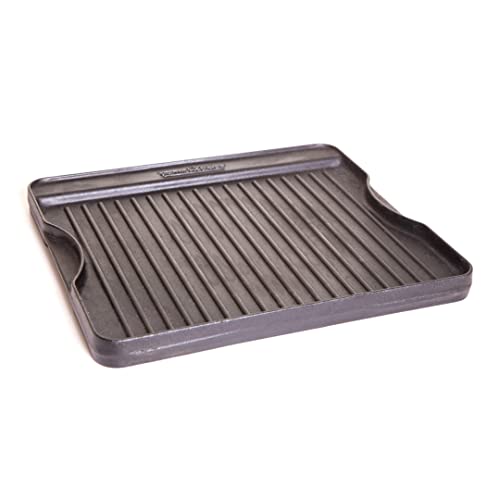
The Real Deal: Built to drop into a Camp Chef 14 or 16-inch outdoor system, this one-burner plate is the obvious pick for campsite breakfasts.
This griddle measures 14 inches by 16 inches with a reversible surface — smooth on one side, ribbed on the other. The listing promises even heat distribution and consistent results, which is plausible for a cast iron plate of this size over a properly matched burner. Because it’s designed to fit Camp Chef’s 14- and 16-inch systems, it’s really an insert for their portable stoves; adapting it to a home range means the burner underneath must be large enough to heat most of the bottom. A small gas burner under a 14×16 plate will create a central hot zone.
Unlike the Lodge, the Camp Chef listing doesn’t mention factory pre-seasoning or thickness. That omission is a real hurdle for a seasoning purist — you may open the box to bare or lightly oiled iron and need to oven-season it yourself before any eggs go down. The one-burner footprint also limits batch size compared to the Bayou Classic or Lodge; two people will be fine, four will require rounds.
Pros:
- 14 x 16 inch cooking surface — enough room for a two-person breakfast without crowding.
- Reversible flat and ribbed sides — one surface for pancakes, one for sear marks.
- One-burner design — fits Camp Chef 14 and 16-inch systems natively.
- Even heat distribution claim — thick cast iron tends to hold heat across the surface.
- Portable footprint — easier to pack and carry than a full two-burner griddle.
Cons:
- No listed pre-seasoning or thickness — you may have to season it yourself before first use.
- Single-burner size — not enough surface for a large family breakfast.
Why It Earns a Spot
Ideal for: campers or tailgaters already running a Camp Chef setup. Not great if: you want a stovetop griddle for a four-person breakfast without buying a separate burner.
Utheer Cast Iron Griddle (The Grill Insert)

In a nutshell: This 17 x 13 inch insert turns an existing gas or charcoal grill into a flat top, rated to 500°F for outdoor breakfast cooking.
The Utheer is a 17 by 13 inch cast iron griddle insert made to sit on gas or charcoal grates. Unlike the raw or seasoned iron above, this one carries a nonstick coated cast iron surface. That coating helps eggs and pancakes release, but the listing does not specify whether it’s ceramic or PTFE, and that detail matters at the 500°F upper limit. Ceramic coatings handle high heat better than many nonstick layers; PTFE can begin to degrade around 500°F if overheated. For this reason, treat the rated ceiling as a true limit, not a suggestion.
As an insert, the Utheer is not meant for stovetop use; it assumes you already own a grill. That single design choice defines who should buy it: someone who wants breakfast outside without lugging a separate griddle station. The flat surface suits pancakes, eggs, bacon, and smash burgers, but those ventilation gaps below the insert mean heat distribution depends heavily on your grill’s burner pattern. An uneven grill will bake that unevenness right into your pancakes.
Pros:
- 17 x 13 inch cooking area — generous for breakfast for three or four people.
- Rated to 500°F — explicit high-heat tolerance for outdoor grilling.
- Nonstick coated surface — easier egg release than bare seasoned iron.
- Built for gas or charcoal grills — turns what you already own into a flat top.
- Compact insert form — easy to store and carry compared to a full griddle station.
Cons:
- Nonstick coating type not specified — ceramic and PTFE behave very differently at 500°F.
- Not a stovetop pan — requires a grill underneath; no indoor use.
Final Thoughts
Great match for: grill owners who want outdoor breakfasts without buying a dedicated flat top. Pass on this if: you need something for an indoor gas or electric range.
What to Look for in a Cast Iron Breakfast Griddle
Breakfast cooking punishes thin iron. A pan that is too thin heats fast over one burner, then cold-spots in the middle; that’s why pancakes scorch and eggs glue themselves down. The thickness of the cast iron is the single most important spec on the sheet, and it’s the reason the one-inch Lodge performs differently from the four-hole Patravious. Weight follows thickness — the Lodge comes in at 10.56 lbs, while a comparable 18-inch Finex griddle weighs 14 lbs with a 15 by 10 inch cooking surface. Heavier equals steadier heat, but it also means you need to be able to lift and wash the thing. Cast iron is classified as a food-contact material and, when uncoated or seasoned with food-grade oil, meets FDA standards for direct food contact — the details live at the FDA food-contact materials page.
Pre-Seasoning: Why It Decides Your First Pancake
Pre-seasoned doesn’t mean nonstick forever; it means the maker already applied a thin oil layer and polymerized it. Lodge uses vegetable oil; Finex uses 100% flaxseed oil on its griddles. Different oils create different initial release qualities, but both need regular re-oiling. If a listing doesn’t say pre-seasoned — like the Camp Chef or JUSTUP — assume you’ll spend an evening seasoning it yourself before the eggs ever touch it. A poor factory seasoning causes sticking, and fixing that means stripping and starting over.
Flat Side vs. Ribbed Side: Which One Do You Actually Need?
A reversible griddle gives you both, but the ribbed side earns its keep only if you also cook meats. For pure breakfast use, the flat side is the whole show, and a dedicated flat top like the Utheer maximizes usable pancake surface. A ribbed side is harder to clean — grease pools in grooves and carbonizes — so if you never sear a steak, you’re carrying extra maintenance for nothing. On the Bayou Classic and Lodge, the flat side should be your default for breakfast; flip only for bacon or sausage when you want marks. For skillet-specific comparisons, our Stargazer cast iron skillet review details what a dedicated skillet does differently.
Matching the Griddle to Your Burner
Size is not just about how many pancakes fit. It’s about how well your heat source covers the bottom of the pan. A 28-inch Bayou Classic needs two burners; a 14×16 Camp Chef needs one large burner, not a small coil. The Utheer needs an entire grill. Before you order, measure the diameter of your largest burner and compare it to the griddle’s footprint; a two-inch overhang on all sides will never get hot. Also check your stove’s maximum cookware weight if you have glass cooktops — many are rated for less than a 10.56-pound Lodge plus food. If you’re still narrowing things down, our cast iron griddle buying guide walks through the mistakes that cost people the most.
Our Final Recommendation
For most kitchens, the Lodge Reversible Cast Iron Grill/Griddle Pan is the one to buy. Its one-inch thickness and vegetable oil pre-seasoning put it ahead of every other option for breakfast, and at 10.56 pounds it’s heavy but manageable. If you’re feeding a crowd and have two burners to spare, the Bayou Classic 7428 is the best value in pure surface area. Budget-minded solo eaters who only cook eggs should consider the Patravious 4-Hole Egg Pan, but understand its limits. For outdoor grill owners, the Utheer Cast Iron Griddle is the only insert that makes sense.
Frequently Asked Questions
What’s the difference between a four-hole egg pan and a flat top griddle for breakfast?
A four-hole pan like the Patravious constrains each egg to its own well, which is great for uniform yolks but useless for pancakes. A flat top griddle has one continuous surface for flipping and sliding. For a full breakfast, the Lodge or Bayou Classic flat side is the better tool; for eggs only, the four-hole pan saves time.
How do I season a cast iron griddle so eggs don’t stick?
Warm the clean griddle over low heat, then rub on a very thin layer of vegetable oil or flaxseed oil. Let it reach its smoke point for a minute or two, then wipe off the excess and let it cool. Repeat two or three times before the first use. After each wash, dry immediately and re-oil lightly. A maintained seasoning is the only nonstick surface uncoated iron needs.
Is a nonstick-coated cast iron griddle safe for high-heat cooking?
It depends on the coating. Ceramic coatings can typically handle 500°F, while PTFE begins to degrade near that temperature. The Utheer is rated to 500°F, but the listing never names the coating material. That’s a real reason to treat the rating as the ceiling and avoid preheating it empty beyond medium-high, especially if you plan to use metal utensils.