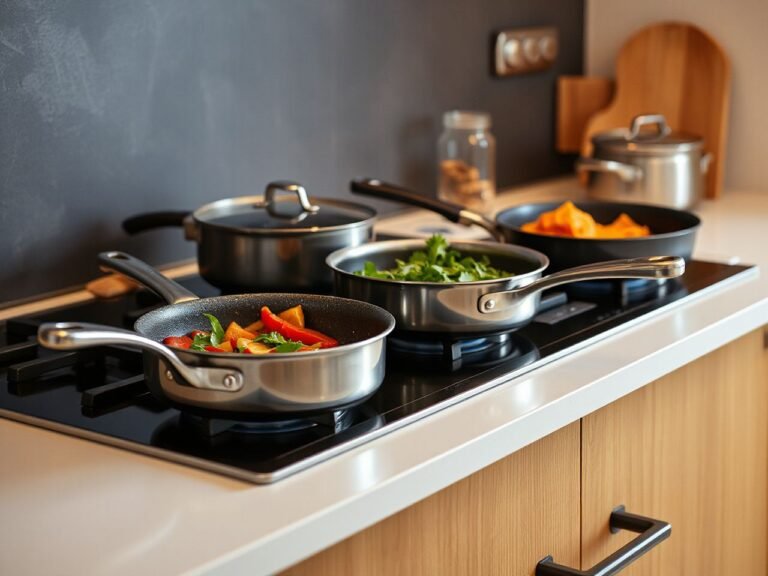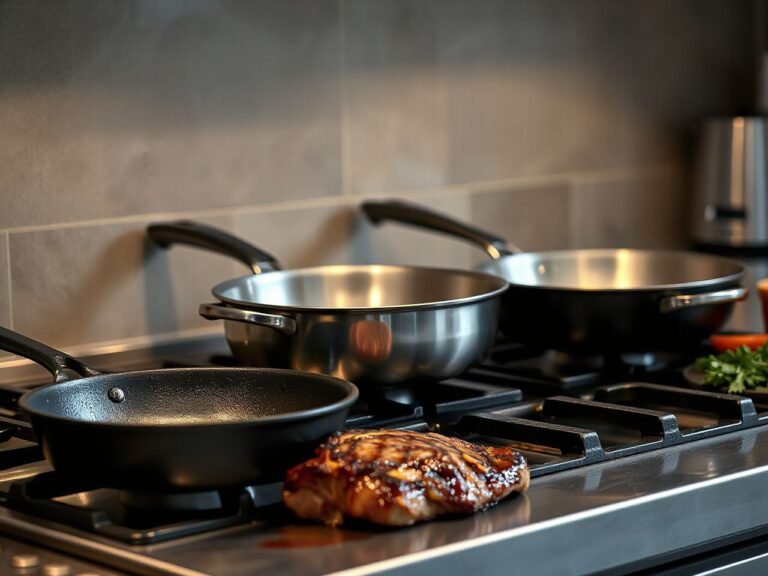
Why do two stainless pans that both read 18/10 on the box cook so differently — one browning a steak evenly while the other scorches a ring in the center and leaves the rim pale? That gap is the reason a stainless steel pan buying guide earns its keep before you spend a dollar, because the answer sits where you cannot see it. The grade stamped on the label describes the metal touching your food, not the metal that carries heat across the pan.
Key Takeaways
- Cooking performance comes from the aluminum or copper core sandwiched between the steel layers, not from the 18/10 grade printed on the surface.
- Induction only works if the pan’s outer base is magnetic (usually 430 steel), which is why an 18/10 pan can still heat on an induction hob.
- Rainbow heat tint and white chalky spots are cosmetic and food-safe — they are not defects or health hazards.
What the 18/10 stamp really measures — and what it hides
The buying decision for stainless is decided by what is between the steel layers, not the grade on the box. A well-clad 3-ply pan with an aluminum core will out-cook a heavy 18/10 disc-bottom pan whose sides heat unevenly, because the grade number only describes the food-contact surface’s corrosion resistance and shine. Cooking performance is a function of core material, how far the cladding climbs the walls, and total thermal mass.
Those three things are precisely what beginners never check while they fixate on the label.
18/10, 18/8, and 18/0 decoded
The two numbers are percentages: chromium first, nickel second. So 18/10 means roughly 18% chromium and 10% nickel; 18/8 keeps the chromium and drops a little nickel; 18/0 has effectively no nickel at all.
Chromium is what makes steel stainless. It forms a thin passive oxide film that shrugs off rust, and it does the heavy lifting on corrosion. Nickel adds a little more corrosion resistance plus that bright, slightly warm shine, which is why an 18/10 surface feels premium under your fingers.
A higher second number does not build a better-heating pan. It builds a shinier, more corrosion-resistant cooking surface — that is the entire benefit. In metallurgical terms, 18/10 and 18/8 are grades of AISI 304 austenitic stainless, while 18/0 corresponds to 430, a ferritic steel. These grades are defined by standards bodies such as ASTM International, which pins down the composition ranges for 304 and 430. Hold that 430 fact — it comes back the moment you mention induction.
Why the grade tells you nothing about heat
Stainless steel is a poor conductor of heat. Left on its own it moves warmth slowly and unevenly, so a single-wall stainless pan gives you a blistering hot spot right over the burner and a cool dead zone an inch out.
Makers fix this by bonding the steel to a metal that genuinely conducts — aluminum or copper. Aluminum spreads heat roughly fifteen times faster than stainless; copper is faster still. The steel exists to give you a non-reactive, easy-to-clean cooking surface that the U.S. Food and Drug Administration regulates as a food-contact material. The core underneath does the real work.
Stainless steel is non-reactive, which is why it handles acidic foods — tomato sauce, wine reductions, a lemony pan sauce — without picking up a metallic taste the way bare aluminum or cast iron can. The grade on the box confirms that safety and shine. It says nothing about whether your eggs will cook evenly.
The layers are where your money goes
Once you accept that the core does the cooking, the price sheet starts to make sense. You are not paying for thicker 18/10. You are paying for how much conductive metal is inside and how far it reaches.
Fully clad versus disc bottom — and whether you can feel it
A disc-bottom pan bonds a conductive slug of aluminum (sometimes with a copper layer) to the base only. The walls above it are single-wall stainless. A fully clad pan runs that conductive layer all the way up the sidewalls, wrapped in steel on both faces.
A fully clad pan carries its conductive core up the sidewalls, so a pan sauce simmers at the same rate at the rim as it does in the center, while a disc-bottom pan heats its base well and lets the walls lag behind. Yes, you can feel the difference — most obviously when you are reducing a sauce or searing something tall like chicken thighs, where the walls do real cooking. For flat, low food in a shallow pan, the gap narrows and a good disc bottom performs fine.
The catch with cheap disc-bottom pans is delamination. A thin disc glued to a thin base can warp or separate over years of thermal cycling, and once it lifts off you get a wobble and a hot spot you cannot cook around.
How many plies do you actually need?
Tri-ply is the honest baseline: steel, aluminum, steel. All-Clad’s D3 is the reference build here — 18/10 interior, aluminum core, magnetic exterior — and Tramontina’s Tri-Ply Clad line uses the same basic sandwich for a fraction of the price. Made In sells a comparable 5-ply, and Demeyere’s Proline pushes to thick 5-ply and 7-ply plates built for long, hard sears.
Extra plies mostly add thermal mass and steadier wall heating, not sorcery. For everyday home cooking, a solid 3-ply does about ninety percent of what a 5-ply does, and the 5-ply mainly rewards you when you crowd a pan with cold food and want it to hold temperature. If you want to see how a well-made 5-ply reads on a spec sheet, our breakdown of Made In’s frying pans lays out the construction claims layer by layer.
So no — 5-ply is not automatically worth double the 3-ply price. It is worth it for a heat-hungry cook who sears often and hates temperature drop. For most kitchens, a heavier 3-ply is the smarter spend.
Induction, ovens, and the checks that save you money
Will a stainless pan work on my induction stove?
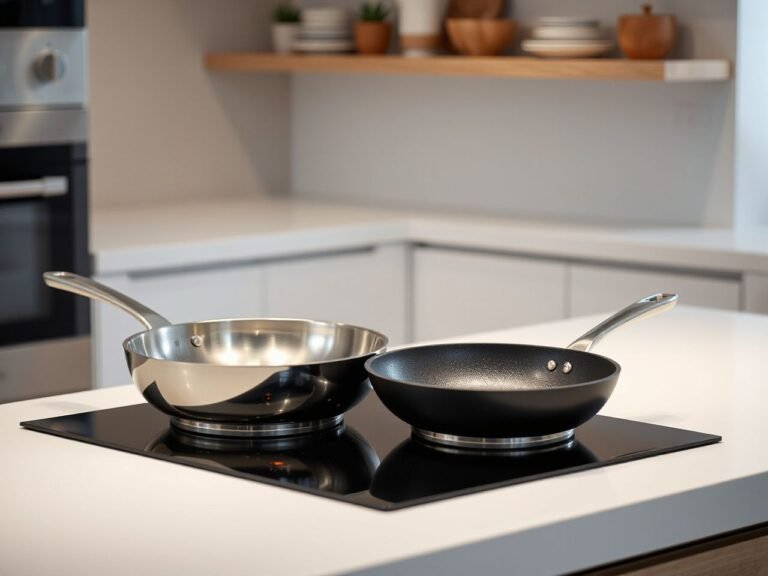
A stainless pan works on induction only if its outer base is magnetic, which is why many pans carry an 18/10 interior but a 430 exterior — the 430 is ferromagnetic and the 18/10 is not. Induction cooktops heat by inducing a current in a magnetic base, so a pure 304 pan with no magnetic layer simply will not respond.
The check takes five seconds: stick a fridge magnet to the underside of the pan. If it grabs firmly, the pan is induction-ready. If it slides off or barely clings, the base is non-magnetic and that stove will ignore it.
This is why premium clad lines list a magnetic 430 exterior in their specs. It is not a downgrade of the cooking surface — the food still touches 18/10 — it is the layer that lets the pan talk to the hob.
Can it go in the oven and under the broiler?
An all-metal stainless pan with a riveted stainless handle is one of the most oven-friendly things in your kitchen. The body itself tolerates far more heat than any oven produces, so the real limit is the handle and any glued or plastic parts.
Most fully stainless pans are rated to 500–600°F and are broiler-safe, since the steel and rivets take direct radiant heat without complaint. Pans with silicone sleeves, plastic knobs, or phenolic handles drop that ceiling sharply — often to around 350°F — so check the listing rather than guessing. The moment a pan advertises a “stay-cool” polymer handle, assume the broiler is off the menu.
Handles that stay cooler on the stovetop
Stainless conducts slowly, but it does conduct, so a solid handle bolted to a hot pan will eventually get uncomfortable. How hot depends on the handle’s shape and mass more than the metal.
Hollow or channeled stainless handles trap air and stay noticeably cooler than solid cast handles, and handles that sweep up and away from the pan body sit farther from rising burner heat. Long handles run cooler at the end than short stub handles. None of this makes a handle safe to grab bare after twenty minutes on high — a folded towel or mitt is still the rule.
Living with stainless: sticking, stains, and how long it lasts
Why food sticks — and no, your pan is probably not defective
Food sticks to stainless because hot bare metal and cold protein bond chemically the instant they meet. That is physics, not a manufacturing fault. The trick is temperature and timing.
Preheat the dry pan over medium heat, then flick in a few drops of water. When the water skitters across the surface as tight silver balls instead of spreading and boiling off, the pan has hit the right heat — that skittering is the Leidenfrost effect, where a droplet rides on its own vapor layer created by the water flashing to steam. Add your oil at that point, let it shimmer, then add the food and leave it alone. Protein releases on its own once a crust forms.
Fighting the stick on a cold pan is the classic error, and it is the same reason people give up on stainless too early. If you want a surface that forgives lazy preheating, that is a job for nonstick or a well-seasoned carbon pan — our rundown on choosing a carbon steel pan covers where each surface actually earns its place.
Rainbow stains and white chalky spots
Heat tint — that blue-and-gold rainbow bloom near the center — is just the chromium oxide film thickening under high heat and refracting light. It is purely cosmetic and completely food-safe. A wipe of Bar Keepers Friend, whose active ingredient is mild oxalic acid, lifts it right off.
Those cloudy white spots are usually mineral deposits from hard water, left behind when droplets dry, sometimes joined by chalky starch residue from boiling pasta or potatoes. Rainbow heat tint and hard-water white spots on stainless steel are cosmetic and food-safe, not signs of a defect or a health risk. A splash of vinegar dissolves the minerals; the same polish handles the rest.
Cleaning, care, and how long a good pan should last
For stuck-on burnt food, skip the wire wool as a first move. Add water, bring it to a simmer, and deglaze — the fond lifts as it rehydrates, and a wooden spatula finishes the job without scratching. Bar Keepers Friend restores the shine afterward, and a light rinse re-forms the passive chromium layer through natural passivation in air.
Dishwashers will not hurt the steel’s safety, but repeated cycles can dull a mirror finish and, over years, loosen the base bond on cheaper disc pans. A well-made clad stainless pan is genuinely a decades-long tool — there is no coating to wear out, which is its core advantage over nonstick surfaces like those in our look at Scanpan’s nonstick range. Cheap pans fail early through warping thin bases and delaminating discs, not through the steel itself giving out.
For heavy or commercial-leaning use, NSF International certification — the sanitation standard professional kitchens rely on — signals a pan meets material and cleanability requirements, and it is worth checking on a listing if durability is your top priority. One last note for anyone with a nickel sensitivity: 18/0 or 430 interiors exist and contain essentially no nickel, though they trade away a little corrosion resistance and that bright warm shine for it.
Frequently Asked Questions
Does a higher number like 18/10 mean a better stainless steel pan?
No. The numbers are chromium and nickel percentages, so 18/10 simply means a more corrosion-resistant, shinier cooking surface than 18/8 or 18/0. They describe the food-contact layer, not heating ability. A 3-ply pan with an aluminum core and a plain 18/8 interior will cook more evenly than a shiny 18/10 pan built with a weak disc bottom.
Why does everyone say fully clad beats a disc bottom?
Because a fully clad pan runs its conductive core up the sidewalls, so the whole pan heats evenly instead of only the base. You feel it most when reducing sauces or searing tall food, where the walls do real work. A disc bottom heats its base well but lets the sides lag, which shows up as uneven simmering and cooler edges.
How do I know if a stainless pan will work on my induction cooktop?
Hold a fridge magnet to the underside of the pan. If it grabs firmly, the base has a magnetic 430 layer and induction will heat it, even if the interior is non-magnetic 18/10. If the magnet slides off, the pan is pure 304 with no magnetic exterior and your induction hob will not recognize it. The check takes five seconds and never lies.
Are the rainbow and white stains on my pan safe to cook on?
Yes, both are harmless. The rainbow is heat tint — the chromium oxide film thickening and refracting light — and the white cloudiness is hard-water mineral or starch residue. Neither affects safety or flavor. A little Bar Keepers Friend removes the tint and a splash of vinegar dissolves the mineral spots, but you can keep cooking without touching either one.