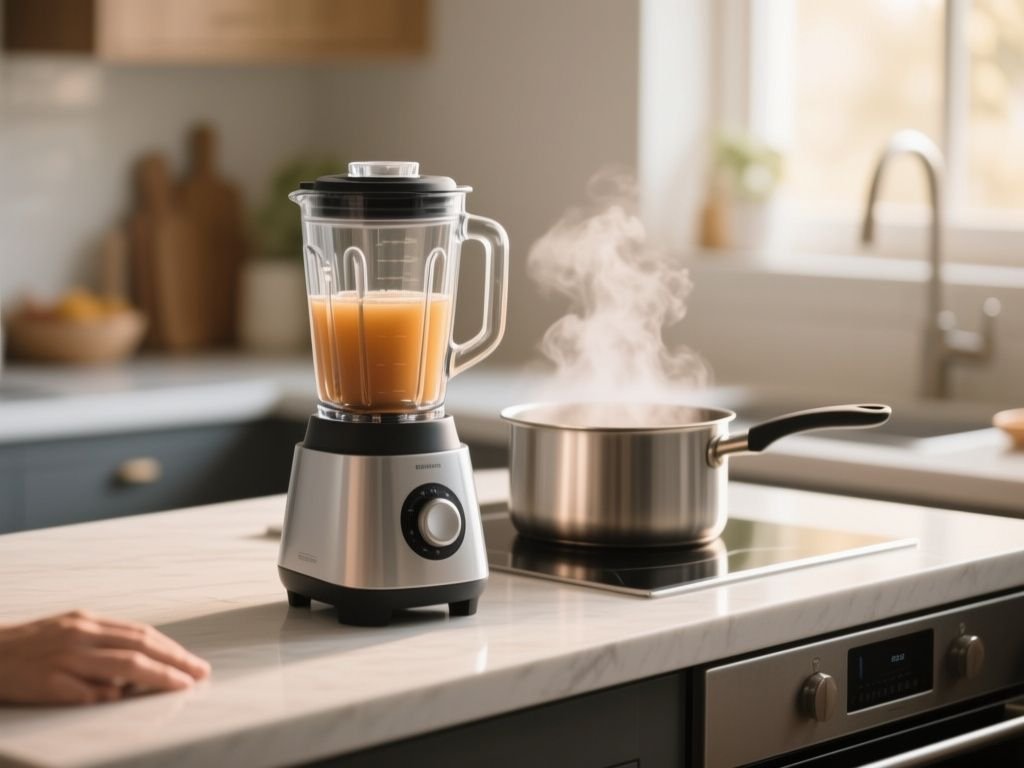
Steam takes up roughly 1,600 times more space than the same water in liquid form. That single ratio is why blending hot liquid in a blender can end with a lid hitting the ceiling, a face full of boiling soup, and a cracked jar on the floor. It also explains why people who worry about motor power are staring at the wrong variable.
So, can you blend hot liquid in a blender safely? Yes. Two conditions have to be met: the steam must have an escape route, and the temperature gap between the jar and the liquid has to stay narrow. A $600 blender will pop its lid exactly the way a $40 one will if you seal boiling soup inside and hit high. The physics does not care what you paid.
Key Takeaways
- Steam pressure, not motor power, is what turns a sealed blender jar of hot soup into a hazard. Always remove the center cap or use a vented lid.
- Let hot liquids cool for 5 to 10 minutes before blending, and never fill the jar more than halfway. Leave room for vapor expansion.
- Borosilicate glass tolerates thermal shock far better than standard soda-lime glass, and Tritan copolyester plastic resists heat-related warping if you stay below 100°C.
First, Understand What Actually Happens When You Blend Something Hot
Two separate failure modes are at work, and most kitchen accidents happen because the cook treats them as one problem. Steam pressure attacks the lid and gasket. Thermal shock attacks the jar material itself. They move at different speeds and fail in different ways.
Steam pressure is the real hazard
Hot soup constantly releases water vapor. In an open pot, that vapor drifts away. In a sealed blender jar, it has nowhere to go. The blades churn the liquid and knock even more vapor out of solution, which raises the pressure inside the jar within seconds. A tightly locked lid with no vent turns the pitcher into a modest pressure vessel.
The rubber gasket under the lid is usually the first thing to give. It is not designed to hold back pressure. It flexes, then the lid corners peel up, and the vapor burst sprays hot liquid upward. The U.S. Consumer Product Safety Commission tracks scald burns from kitchen appliances as a serious household injury category, and blender lid blow-offs under steam are squarely inside that risk profile.
Thermal shock hits the jar, not the liquid
Thermal shock is what happens when one part of a material changes temperature much faster than another part. Pour 95°C broth into a cold glass jar and the inner surface expands while the outer wall stays contracted. The stress differential can crack the glass in under a second. This is the same failure mode behind a hot casserole dish shattering on a wet counter.
Borosilicate glass, the material used in laboratory beakers and some premium blender jars, is engineered to survive wider temperature swings. Standard soda-lime glass, which most cheap pitchers use, has a much lower tolerance. The spec sheet for a borosilicate jar will usually state its thermal shock resistance explicitly; a soda-lime jar will not mention it at all, which tells you what you need to know.
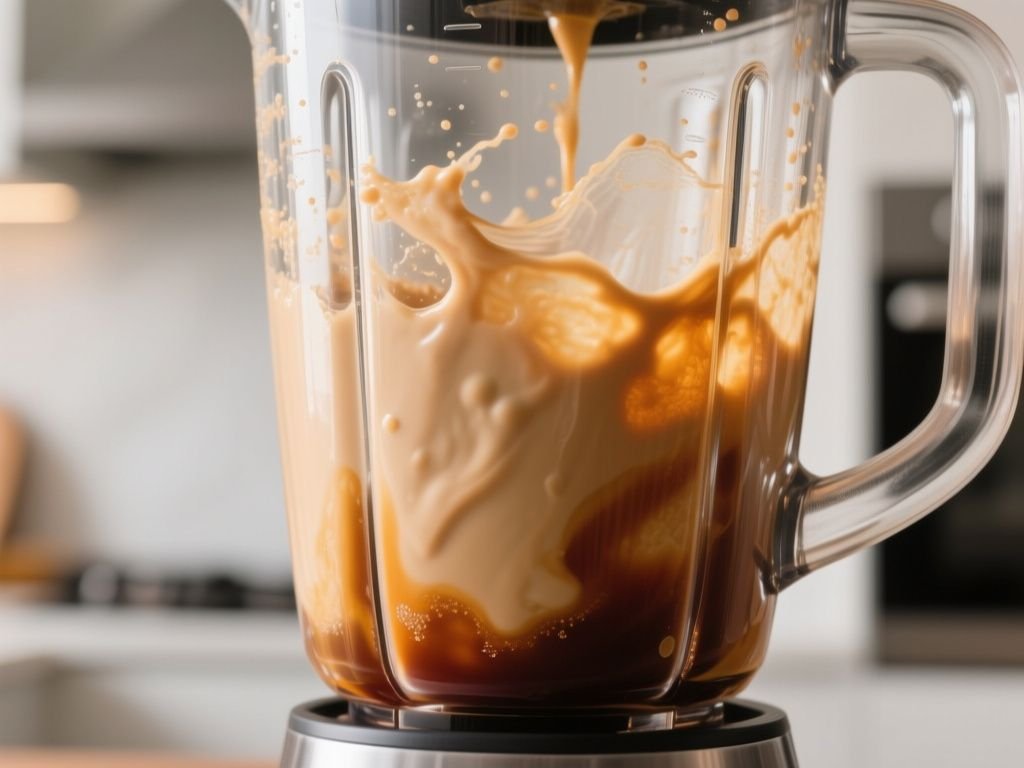
Can You Blend Hot Liquid in a Blender? Yes — Here’s the Procedure
The direct answer to the common query — can you blend hot liquid in a blender without incident — is yes, but only if you treat the process as a heat-management sequence, not a dump-and-go. Each step below removes one way the machine can fail.
Step 1: Cool the liquid for 5 to 10 minutes
Boiling water sits at 100°C, which is far above what most blender jar materials are comfortable with. Let soup, broth, or sauce cool below roughly 80°C before it goes into the jar. That threshold is not arbitrary: 80°C keeps the steam pressure manageable while still hot enough to purée smoothly. A quiet five-minute rest on the stove with the pot lid cracked does the job.
Step 2: Vent the lid before you blend
Every blender with a removable center cap gives you a built-in steam vent. Pop that cap out. If the lid has no removable cap, leave one corner cracked open and cover it with a folded towel. The towel catches any spatter but still lets vapor escape. Locking the lid fully is the single fastest way to turn a batch of butternut squash soup into a ceiling stain.
Step 3: Fill no more than half the jar
Overfilling is the second-failure domino. Hot liquid expands, steam occupies volume, and the vortex from the blades pulls air downward if there is headroom for it. Half full is the sensible ceiling for hot liquids; a quarter to a third full is even safer for thin, splashy mixtures like broth or tomato soup. Blend in batches rather than cramming everything in at once.
Step 4: Start on the lowest speed and hold the lid
The initial blade pulse creates the biggest temperature spike and the most violent agitation. Start on low or the pulse setting, keep one hand pressing down on the towel-covered lid, and ramp up gradually. High speed is fine once the mixture has settled into a steady vortex, but the first five seconds are when most blow-offs happen.
Step 5: Clean the gasket and lid thread after every hot batch
Hot liquids force vapor into the crevices around the rubber gasket. If you leave soup residue there, it hardens into a thin film that compromises the seal for the next use. Pull the gasket out, rinse it under warm water, and let it dry separately. A gasket that sits wet breeds exactly the kind of seal failure you are trying to avoid.
Glass vs. Plastic: Which Jar Survives Hot Liquid Better?
Neither material is automatically better. The honest comparison depends on what kind of glass, what kind of plastic, and whether the jar was warmed first. The question readers actually want answered — is it safer to blend hot liquids in a glass or plastic jar — has a conditional answer.
Borosilicate glass wins, but only if the jar actually is borosilicate
Borosilicate glass contains boron trioxide, which lowers its thermal expansion coefficient to roughly one-third that of ordinary soda-lime glass. That is the number that matters for thermal shock. Pouring near-boiling liquid into a cold borosilicate jar is survivable; doing the same into a soda-lime jar is a coin flip. The catch is that borosilicate pitchers are heavier and more expensive, and many budget glass blenders quietly use soda-lime glass because it is cheaper to mould.
Tritan plastic tolerates heat but softens at the extreme end
Tritan copolyester is the plastic most often used in high-end blender jars, and the listing for these pitchers typically states a heat resistance around 100°C. That means hot soup is fine, boiling water is borderline, and the jar will warp above its rated temperature. A warped jar no longer seats properly on the blade assembly, which creates leaks and unbalanced spinning. If the manufacturer does not state a maximum temperature in the spec sheet, assume the jar is not rated for boiling liquid and cool everything below 85°C first.
Run a warm-water rinse before every hot batch
Warming the jar is the cheapest insurance available. Twenty seconds of hot tap water over the inside and outside walls brings the vessel to roughly 45-50°C, which cuts the temperature gap against 80°C soup by more than half. That is the difference between a stress gradient the material absorbs and one that cracks it. The same principle applies to a thick strawberry smoothie bowl in reverse — a frozen glass jar handed suddenly to a hot dishwasher rack fails the same way, just mirrored.
What About Vitamix, Blendtec, and Oster? Where the Machine Specs Help
I approach every blender as a machine that will be pushed into stiff dough and heavy batches, which means I care about how honestly the manufacturer states its thermal and sealing limits. On paper, the higher-end machines from Vitamix and Blendtec have jar designs that handle hot liquids better than most, but the advantage is mechanical, not magical.
Vented lids and tamper-friendly designs
Many Vitamix containers ship with a two-part lid where the center cap doubles as a steam vent, which is exactly the feature you want for soup. The tamper lets you push ingredients down while the machine runs at low speed, reducing the urge to seal the jar and crank it high. Blendtec’s jars tend to be Tritan or a proprietary copolyester with a wider base, and the manufacturer publishes temperature guidance that lands in the same 80-95°C safe zone. Neither brand sells a jar that is safe to seal with boiling liquid inside, because no jar is.
Oster and budget machines: read the manual for the hot-liquid policy
Oster blenders with glass jars are often soda-lime glass, which is why the manual nearly always instructs users to let hot liquids cool before blending. That instruction is not legal boilerplate. It is the manufacturer signalling the jar’s thermal limit. A blender manual that omits any hot-liquid guidance is not a green light; it is a gap in documentation, and the safest read is to treat the jar as heat-intolerant until proven otherwise. Look for a UL listing that covers the motor housing and electrical assembly — it confirms the machine met electrical safety testing, but it does not change what steam does to a sealed lid.
Hand blenders sidestep the whole problem
If you make soup weekly, a stick or immersion blender is the most structurally honest tool for the job. The blade sits on the end of a wand that goes directly into the pot, so there is no sealed vessel to pressurize and no jar to thermally shock. The motor stays above the liquid, and steam vents straight into the kitchen air. The trade-off is a less silky purée than a high-speed countertop machine delivers, but for rustling a pot of lentil soup, the risk profile collapses to nearly nothing.
Cleaning a Blender After Hot Soup: You’re Probably Overdoing It
After blending hot liquid, the cleanup questions start. The jar is hot, the gasket is sticky, and nobody wants to reach into a pitcher full of damp soup residue. The simple answer: rinse immediately with warm water, then wash normally.
Rinse warm, not cold
Do not run cold water over a hot glass jar. The sudden drop recreates thermal shock in reverse, and a hot jar that survived the soup can still crack from a cold rinse. Use warm water first, let the jar come down to near room temperature, then wash with whatever dish soap you use. The same instinct that makes people scrub a cast iron pan with soap and a steel wool pad — covered in our guide to cast iron cleaning mistakes — is what makes them blast a hot glass pitcher with cold water. Both instincts damage the surface they are trying to protect.
Blend a soap-and-water cycle for the blade assembly
Fill the jar one-third with warm water, add a drop of dish soap, and run the blender on low for ten seconds with the lid vented. That cleans the blade housing and the underside of the gasket without you reaching under a spinning blade. Rinse thoroughly, pull the gasket, and air-dry everything separately. A damp gasket reinstalled wet is a mildew invitation and a seal failure waiting for the next hot batch.
The blade bearing can degrade faster with repeated hot use
Repeated exposure to hot liquids slowly draws the grease out of the blade bearing assembly, especially on cheaper blenders where the bearing is not sealed against moisture. The observable result is a blade that spins with more friction or a faint whine that gets louder over time. A quiet minute-long warm-water cycle after every hot batch flushes residue before it can cook onto the shaft. If the spec sheet does not mention a sealed bearing, assume hot soup shortens the machine’s working life and factor that into how often you blend hot things.
Frequently Asked Questions
Is it safe to blend boiling water in a blender?
Right off the boil, no. Water at 100°C produces aggressive steam pressure the moment the blades agitate it, and a sealed jar cannot release that pressure safely. Let boiling water cool for five to ten minutes, remove the center cap or crack the lid, and fill no more than half the jar. Even higher-rated pitchers from premium brands are not designed to be sealed with liquid at a full boil inside.
Why does my blender lid pop off when blending hot liquids?
The vapor expanding above the hot liquid raises internal pressure faster than the lid seal can hold. Agitation from the blades knocks more steam out of solution, and the pressure differential flexes the rubber gasket until one corner of the lid lifts, releasing a burst of hot spray. Venting the lid and cooling the liquid below roughly 80°C keeps the internal pressure low enough for the gasket to do its job.
Can I blend hot coffee or tea for a blended latte?
Yes, if you cool the coffee or tea below 85°C and blend with the center cap removed. Coffee and tea are thinner than soup, so they splash more aggressively; use a lower fill line and start on the lowest speed with a towel over the vent. The same rules apply as to any hot liquid: vent, cool, fill half, start slow. A healthy pumpkin pie smoothie only needs warm spices, not hot liquid, if you would rather skip the steam risk altogether.