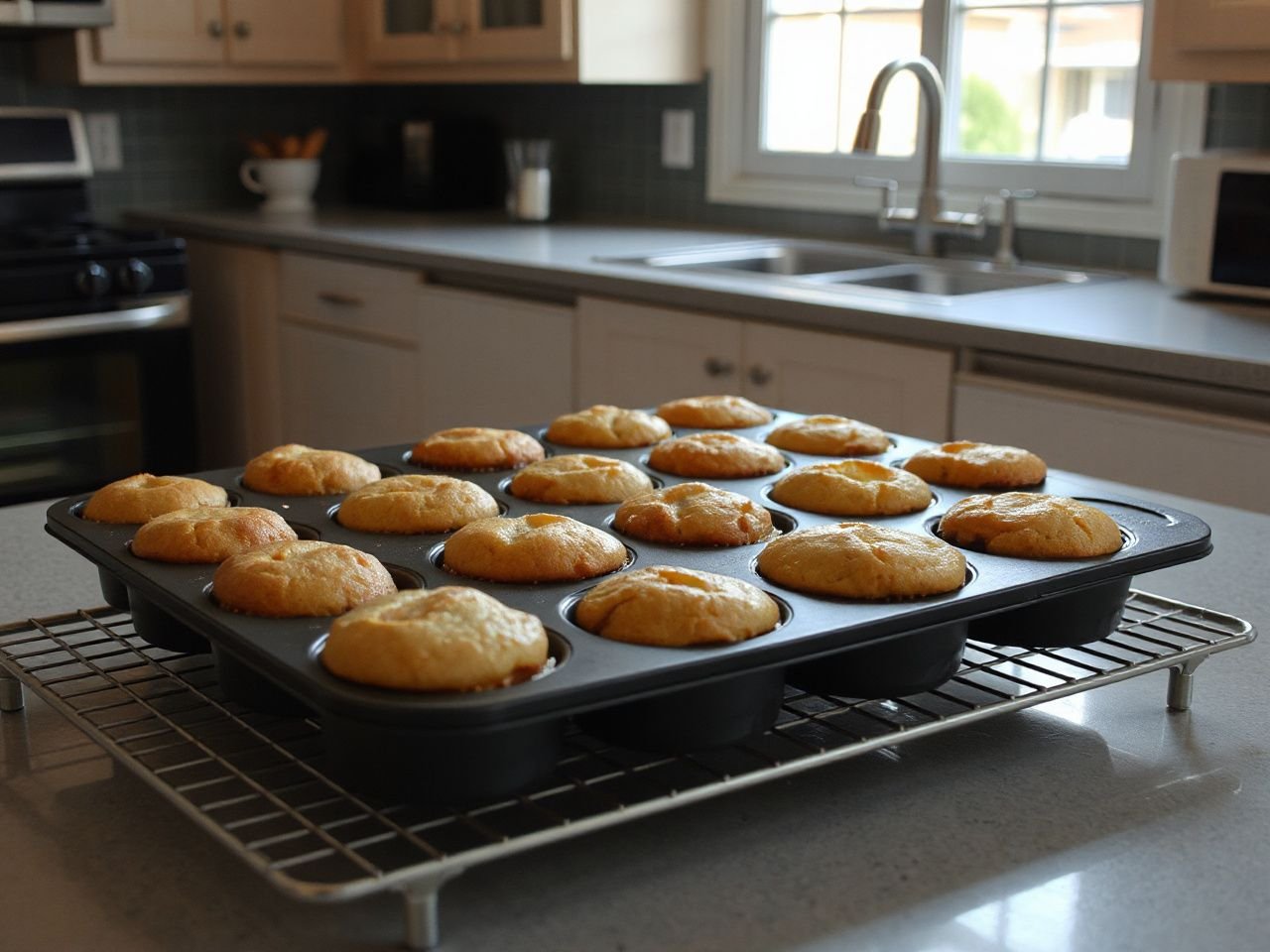
You order a muffin pan by cup count, it shows up, and the thing won’t even slide into your toaster oven — or it fits but chokes the airflow so the middle bakes raw while the edges scorch. That is the trap with the best muffin pans for a small oven: the number on the listing tells you nothing about whether the pan clears your rack or your air fryer basket walls. Fit comes first, browning behavior comes second, and cup count is a distant third.
If you want the short version: the Homikit Stainless Steel 6-Cup is a reliable choice. Pure 304-grade stainless with no coating to flake means it bakes gentler near a close element and shrugs off a dishwasher, and six standard 2.76-inch cups is about the most a compact oven handles before airflow suffers.
📌 This article contains affiliate links. As an Amazon Associate I earn from qualifying purchases, at no extra cost to you. Full disclosure.
CERTAIN CONTENT THAT APPEARS ON THIS SITE COMES FROM AMAZON. THIS CONTENT IS PROVIDED ‘AS IS’ AND IS SUBJECT TO CHANGE OR REMOVAL AT ANY TIME.

Homikit Stainless Steel Muffin Pans 6-Cup (Coating-Free Even Bake)


Quick Comparison
| Product | Best For | Buy Link |
|---|---|---|
| HYTK 4 Cup Muffin Pan | Square-fit carbon steel | Check Price |
| Homikit Stainless Steel 6-Cup | Even, coating-free baking | Check Price |
| Audingull Mini Muffin Pan | Bite-size batches | Check Price |
| Yuanfenron 4-Hole Muffin Pan | Tiny tinplate footprint | Check Price |
| Yomvzake Air Fryer Muffin Pan | Air fryer baskets | Check Price |
| FUNBAKY Silicone Mini Muffin Pan | Framed silicone minis | Check Price |
| 12 Cups Silicone Muffin Pan | Flexible full-size molds | Check Price |
How These Picks Were Chosen
These picks come from reading published specifications, materials and documented features against the one thing that actually decides a small-oven pan: physical fit. Before cup count, before finish, the pan’s outer footprint — handles included — has to clear a toaster oven rack or air fryer basket with room for hot air to move, because a pan that blocks circulation bakes unevenly or won’t let the door close. From there material is weighted heavily. Dark carbon steel and dark non-stick brown aggressively against a close element and can rust or shed coating, while food-grade silicone and 304 stainless bake gentler, though silicone flexes and needs a rigid frame to move loaded. Cup count came last, because the classic mistake is buying a 12-cup pan that simply cannot enter the appliance. One thing to check yourself before ordering: measure your basket or rack’s interior width and depth, then compare it against the pan’s listed outer dimensions. Our full muffin pan buying guide walks through that measurement step in more detail.
HYTK 4 Cup Muffin Pan (Square Carbon Steel Fit)
Why it made our list: A square 4-cup pan for the person whose toaster oven rack is wider than it is deep and who wants standard-size muffins, not minis.
The HYTK measures 8.5 x 7.48 x 1.18 inches with a square outline, and that shape is the quiet advantage — a square footprint often uses a narrow rack more efficiently than a round or long rectangular pan. It is carbon steel, so the bottoms will brown fast and dark, which is exactly what you’d expect from a dark metal sitting close to a heating element. The four cups are the standard 2.76-inch size, not jumbo, so your regular muffin recipes port over without math.
Rated from -40F to 450F, it stays under the ceiling most small ovens hit, and the low 1.18-inch wall height means it slips onto shallow racks that a taller pan fouls. The catch with carbon steel is care: leave it wet and it rusts, so it is hand-wash only and wants drying right away. Against the Homikit stainless below, the HYTK browns more aggressively on the base — great if you like a crisp bottom, a liability if your element runs hot.
Pros:
- Square 8.5 x 7.48-inch footprint — uses a shallow, wide toaster oven rack better than a round pan
- Standard 2.76-inch cups — regular muffin and cupcake recipes fit with no scaling
- Carbon steel body — heats quickly and delivers the crisp, dark bottom some bakers chase
- -40F to 450F rating — safe across the temperature range of most compact ovens
- Low 1.18-inch walls — clears shallow racks and low air fryer lids
Cons:
- Rusts if left wet — carbon steel needs immediate drying and no dishwasher
- Aggressive bottom browning — dark metal near a close element can scorch bases before tops set
- Only four cups — small batches only, so it is slow if you bake a dozen at a time
Who Should Buy This
Great match for: anyone with a wide-but-shallow toaster oven who wants standard muffins and doesn’t mind hand-washing. Think twice if: your oven’s bottom element runs hot — dark carbon steel will only push those bases darker.
Homikit Stainless Steel Muffin Pans 6-Cup (Coating-Free Even Bake)
The real story: The pick for bakers who are tired of coatings flaking and want gentler, more even browning in a tight oven.
What sells me on the Homikit is the material honesty. It is pure food-grade stainless steel with no chemical coating, so there is nothing to scratch off into a muffin and nothing that degrades under an air fryer’s direct heat. Stainless bakes gentler than dark carbon steel, which matters enormously when the element is inches from the pan. The six standard cups measure 2.76 by 1.2 inches each, giving you a proper full-size muffin.
Build quality reads well on the spec sheet too: reinforced rolled rims add rigidity so the frame won’t warp or twist when you pull it loaded from a hot oven. Six cups is roughly the sweet spot for a countertop convection oven — enough to be worth heating up, not so many that muffins crowd and steam. If you’re weighing this against the silicone options further down, remember stainless is dishwasher-safe where coated carbon steel is not. The one honest annoyance: bare stainless offers no non-stick help at all, so you must grease every cup or use liners, or the muffins tear on release.
Pros:
- Coating-free 304-grade stainless — nothing to flake, safe under direct air fryer heat
- Gentler, more even browning — lighter metal doesn’t scorch bases the way dark carbon steel does
- Reinforced rolled rims — resists warping when lifted fully loaded
- Six 2.76 x 1.2-inch cups — full-size muffins, a practical batch for a compact oven
- Dishwasher-safe — no coating to ruin, unlike carbon steel or non-stick trays
Cons:
- No non-stick at all — bare stainless demands greasing or liners every time
- Confirm the outer width — a 6-cup pan is wider than a 4-cup, so measure your rack first
- Slower browning on top — gentle bake means you may need a few extra minutes for domed tops
Why It Stands Out
Ideal for: bakers who want durable, coating-free evenness and don’t mind greasing cups. Pass on this if: you refuse to use liners or oil — bare stainless will fight you on release.
Audingull Mini Muffin Pan (Bite-Size Batches)
In a nutshell: A non-stick mini pan for anyone baking bite-size muffins, egg bites, or brownie bites in a small oven.
The Audingull leans on a non-stick coating for effortless release, which is the right call for mini cups where a torn edge ruins the whole point. Mini pans like this overlap heavily with egg bite molds, so it does double duty for air fryer breakfast batches. Mini cups run about 1.25 inches across versus the 2.75-inch standard, so plan on shorter bake times and a different recipe yield.
The listing sells versatility — more than mini muffins, it handles cake bites and similar — but it stays quiet on one number I always want: the exact outer dimensions. That gap matters more here than usual, because if you can’t confirm the footprint, you can’t confirm it clears your basket. Against a framed silicone mini pan like the FUNBAKY, this rigid tray is easier to slide and won’t sag, but a scratched non-stick surface is permanent where silicone isn’t.
Pros:
- Non-stick coating — mini cups release cleanly, which is where torn edges usually happen
- Rigid tray body — slides in and out without the sag of unframed silicone
- Multipurpose cups — doubles for egg bites and brownie bites, not just muffins
- Small batch scale — mini yields suit a compact oven’s limited rack space
- Easy cleanup — non-stick surface wipes down fast between batches
Cons:
- Outer dimensions not stated — you can’t verify basket clearance without measuring on arrival
- Coating is scratch-vulnerable — one metal fork gouge and the release is gone for good
- Mini cups only — standard muffin recipes need re-portioning
Our Take
Perfect for: snack-size baking and air fryer egg bites in a tiny oven. Not great if: you want full-size muffins or you reach for metal utensils out of habit.
Yuanfenron 4-Hole Muffin Pan (Tiny Tinplate Footprint)

Here’s the deal: A budget-friendly 4-hole standard pan for the smallest ovens and the lightest batches.
This one is heavy-duty tinplate with a non-stick surface, and tinplate conducts heat quickly — useful in a compact oven, but like carbon steel it browns bases fast and does not love moisture. Four standard cups keep the outer footprint small, which is the whole appeal for a genuinely tiny countertop oven. The non-stick layer is what stops the muffins gripping the cup, so release is easier than the bare Homikit stainless.
The trade-off sits in the same place every coated tinplate pan lands: the coating is the weak point. Tinplate under a scratched coating can rust, and non-stick has an oven-safe ceiling the listing doesn’t spell out, so I’d keep it out of an air fryer’s direct blast to be safe. Compared to the HYTK carbon steel, it’s lighter and cheaper, but lighter metal can warp sooner under repeated high heat.
Pros:
- Compact 4-hole layout — small outer footprint fits genuinely tiny ovens
- Non-stick surface — easier release than bare stainless
- Tinplate conducts fast — quick heat-up in a small cavity
- Standard-size cups — works with regular muffin recipes
- Budget-friendly — a low-risk entry pan for occasional baking
Cons:
- Coating is the failure point — scratch it and the tinplate underneath can rust
- Unstated temperature ceiling — the listing skips the oven-safe max, which you’d want before air-frying
- Lighter gauge — thin tinplate can warp sooner than heavier carbon steel
Final Thoughts
Best for: occasional bakers with the smallest ovens on a tight budget. Skip if: you bake often or plan to run it hot in an air fryer — the coating won’t last.
Yomvzake Air Fryer Muffin Pan (Basket-Sized Carbon Steel)

What stood out: A square carbon steel pan sized deliberately for air fryer baskets, and our value pick for that job.
The number that matters here is the footprint: 7.08 x 7.08 x 1.1 inches. That compact square is built to drop into a round or square air fryer basket with clearance for air to move around it, which is the exact spec most muffin pans ignore. It is heavy-duty carbon steel chosen to resist deformation, with a food-grade non-stick coating over it for release.
Now the honest part. Carbon steel plus a non-stick coating in an air fryer is a combination to respect — the coating has a heat ceiling, and an air fryer’s direct element runs hot, so keep temperatures moderate and don’t preheat empty. The low 1.1-inch wall clears most basket lids, and the square shape wastes less space than a round pan. Against the pricier Homikit, you trade coating-free durability for a better basket fit and easier release; that’s a fair swap if an air fryer is your main oven.
Pros:
- 7.08-inch square footprint — purpose-sized to clear air fryer basket walls
- Heavy-duty carbon steel — resists warping under repeated high heat
- Non-stick coating — clean release without heavy greasing
- Low 1.1-inch walls — fits under low basket lids and shallow racks
- Square shape — wastes less basket space than a round pan
Cons:
- Coating heat ceiling — direct air fryer heat can degrade non-stick if you run it too hot
- Carbon steel rusts — hand-wash and dry immediately, no dishwasher
- Dark base browns fast — watch the bottoms in a small, hot cavity
The Real Deal
Great match for: air fryer bakers who want a pan that actually fits the basket. Pass on this if: you crank your air fryer to its max — the coating won’t thank you for it.
FUNBAKY Silicone Mini Muffin Pan (Framed Silicone Minis)

Quick take: A 24-cup silicone mini pan with a hidden metal frame — the fix for floppy silicone that spills batter on the way to the oven.
Silicone’s usual sin is flexing, and a loaded, unframed tray sags and dumps batter as you carry it. FUNBAKY solves that with a hidden stainless steel frame around the outer edge, which is exactly the reinforcement food-grade silicone needs to move fully loaded. Each of the 24 cups holds 0.9 oz with a 1.8-inch top diameter and 0.9-inch depth — true mini scale.
Silicone bakes gentler than any metal here, so bottoms won’t scorch against a close element, and release is nearly automatic without greasing. The realities: 24 cups is a lot of pan, so measure the frame’s outer footprint carefully against your oven before you assume it fits. Silicone also browns muffins less on the outside than metal, and reusable silicone baking cups do a similar job if you’d rather not commit to a fixed tray. Against the Audingull, the frame makes this far safer to carry, but the whole thing is wider.
Pros:
- Hidden stainless steel frame — the rigid support silicone needs to move loaded without spilling
- Food-grade silicone — gentle bake that won’t scorch bases near a close element
- 24 mini cups at 0.9 oz each — big batch of bite-size muffins in one go
- Near-automatic release — flexible cups pop minis out without greasing
- Doubles for egg bites — the mini format suits air fryer breakfast recipes
Cons:
- Wide 24-cup frame — measure your oven, because this footprint is large for a compact cavity
- Less exterior browning — silicone won’t crisp the outside the way metal does
- Mini scale only — 0.9 oz cups don’t cover standard muffin recipes
Who Should Buy This
Ideal for: big batches of minis and egg bites, if your oven is wide enough. Skip if: your cavity is narrow or you want browned, crisp exteriors.
12 Cups Silicone Muffin Pan (Flexible Full-Size Molds)
The real story: A flexible full-size silicone mold for bakers who want standard muffins and don’t mind babying the transfer.
This is the outlier on the fit test, and I’ll be blunt about it. Twelve full-size cups is a lot of pan, and the classic small-oven mistake is buying by cup count — so measure before you assume this clears your cavity. Each cup runs a 2.75-inch top diameter with 1.1-inch depth, true standard size, and the whole pan weighs only 7.7 oz, which tells you how little rigidity it has on its own.
The material story is genuinely strong: a -104F to 446F heat range and clearance for oven, microwave, dishwasher, fridge and freezer. Silicone bakes gentle and releases without grease. The weakness is structural — at 7.7 oz with no frame, a loaded 12-cup sheet flops badly, so you need a baking tray under it to move it, or the batter goes everywhere. If your oven can take it, it’s versatile; if your oven is truly small, one of the 4- or 6-cup pans above will bake more evenly with less crowding.
Pros:
- -104F to 446F range — handles freezer-to-oven use in one mold
- Oven, microwave, dishwasher, freezer safe — the most versatile care profile here
- Standard 2.75-inch cups — full-size muffins straight from any regular recipe
- Grease-free release — flexible silicone pops muffins out cleanly
- Reusable and packable — folds flat for storage, unlike rigid metal
Cons:
- 12 cups may not fit — the biggest footprint here, and the top reason a pan fails the oven test
- Only 7.7 oz, no frame — sags badly when loaded, needs a tray underneath to move
- Gentle browning — silicone won’t give you a crisp, colored exterior
Our Take
Best for: bakers with a mid-size countertop oven who want full-size muffins and easy storage. Think twice if: your oven is genuinely compact — 12 cups will crowd it and bake the center raw.
How to Choose the Best Muffin Pan for a Small Oven
Everything here comes back to one order of operations: fit, then material, then cup count. Get those three in the right sequence and you avoid the mistake that sends most of these pans back.
Measure Your Oven or Basket First
Before anything, measure the interior width and depth of your toaster oven rack or air fryer basket, then subtract room for airflow on all sides. Compare that against the pan’s listed outer dimensions, handles included. A pan that touches the walls blocks convection heat circulation, and blocked airflow is why muffins bake raw in the center while the edges burn. The Yomvzake’s 7.08-inch square and the HYTK’s 8.5 x 7.48-inch outline are stated plainly for exactly this reason; the Audingull’s silence on dimensions is a genuine gap.
Metal or Silicone for a Small Oven?
In a compact oven the heating element sits close to the pan, so bottoms brown fast. Dark carbon steel like the HYTK and Yomvzake intensifies that, giving crisp bases but risking scorch; 304 stainless and food-grade silicone bake gentler. Food-contact materials are worth checking against recognized safety programs — the NSF food-equipment certification and FDA guidance on food-contact materials both cover the standards that stainless and PFOA-free coatings are meant to meet. Silicone bakes gentle but flexes, so it needs a frame like FUNBAKY’s or a tray beneath it.
Finding the Best Cupcake Pans for a Small Oven by Cup Count
Cup count comes last, and the best cupcake pans for a small oven are usually 4- or 6-cup models, not 12. A 4-cup HYTK or 6-cup Homikit leaves airflow around the pan; a 12-cup silicone sheet crowds a tiny cavity and bakes unevenly. If you routinely bake full batches, you may simply need a bigger oven — or two rounds in a smaller pan. For pans beyond muffins, our roundup of the top baking pans for compact ovens covers sheet and cake options with the same fit-first logic.
Coating Care and Air Fryer Safety
Non-stick coatings have an oven-safe temperature ceiling, and an air fryer’s direct high heat can push past it and degrade the surface over time. Carbon steel and coated tinplate rust if left wet, so they are hand-wash only; 304 stainless and silicone are dishwasher-safe. Season carbon steel with a light oil film after drying to keep rust off — the same habit that keeps a carbon steel skillet alive.
Our Final Recommendation
For overall value and honesty, the Homikit Stainless Steel 6-Cup is our winner — coating-free 304 stainless bakes gently near a close element, cleans in the dishwasher, and six standard cups is the right batch for a compact oven. On a budget, the Yomvzake Air Fryer Muffin Pan is the smart buy, sized at 7.08 inches square to actually clear a basket. If you want a premium, worry-free carry, FUNBAKY’s framed silicone is the standout for mini batches. Whatever you pick, measure your oven first — fit decides everything else.
Frequently Asked Questions
How do I know if a muffin pan will actually fit inside my toaster oven or air fryer?
Measure the interior width and depth of your rack or basket, then subtract about half an inch on each side for airflow. Compare that to the pan’s listed outer dimensions, including handles. The Yomvzake states 7.08 inches square and the HYTK 8.5 by 7.48 inches for exactly this check. A pan touching the walls blocks circulation and bakes unevenly.
What are the best cupcake pans for a small oven if I only have a countertop model?
Stick to 4- or 6-cup pans. A 4-cup HYTK or 6-cup Homikit leaves room for hot air to move around the pan, while a 12-cup sheet crowds a small cavity and leaves centers raw. Cup count is the last thing to prioritize — footprint and gentle browning matter far more in a compact oven.
Is silicone or metal better for baking muffins in a small oven?
Silicone and 304 stainless bake gentler, which helps when the element sits close and browns bottoms fast. Dark carbon steel crisps bases but can scorch them. Silicone releases without grease but flexes, so it needs a frame like FUNBAKY’s or a tray underneath. Metal holds its shape but coated versions need careful heat management.
Are these muffin pans safe for air fryers, or will the coating flake off?
Coating-free 304 stainless like the Homikit is safest under an air fryer’s direct heat since there’s nothing to degrade. Non-stick pans such as the Yomvzake and Yuanfenron have an oven-safe ceiling; keep temperatures moderate and never preheat them empty. Running past that ceiling repeatedly is what breaks coatings down over time.
Do I need to grease non-stick or silicone muffin pans to stop sticking?
Silicone and quality non-stick usually release without grease, though a light spray adds insurance early on. Bare stainless like the Homikit has no release help at all, so grease every cup or use paper liners or you’ll tear the muffins. For carbon steel, a thin seasoned oil film both aids release and helps prevent rust.