Most home bakers blame their recipe when cookies come out with burnt edges and pale centers. I’ve been that person too many times. The truth is, your sheet pan is usually the culprit — thin metal warps in the oven, creating hot spots that torch half the tray while the other half stays doughy. That’s exactly why I grabbed the Great Jones half sheet pan and started this Great Jones baking sheet review.
After roasting vegetables, baking three batches of cookies, and running the pan through the dishwasher twice, I’m convinced it’s our top pick among nonstick half sheets for everyday home use.
📌 This article contains affiliate links. As an Amazon Associate I earn from qualifying purchases, at no extra cost to you. Full disclosure.
CERTAIN CONTENT THAT APPEARS ON THIS SITE COMES FROM AMAZON. THIS CONTENT IS PROVIDED ‘AS IS’ AND IS SUBJECT TO CHANGE OR REMOVAL AT ANY TIME.
| Product | Best For | Buy Link |
|---|---|---|
| Great Jones Nonstick and Non Toxic Half Sheet Pan 18.5″ x 13.5″ (Blueberry) | Nonstick everyday baking | Check Price |
About the Great Jones Half Sheet Pan
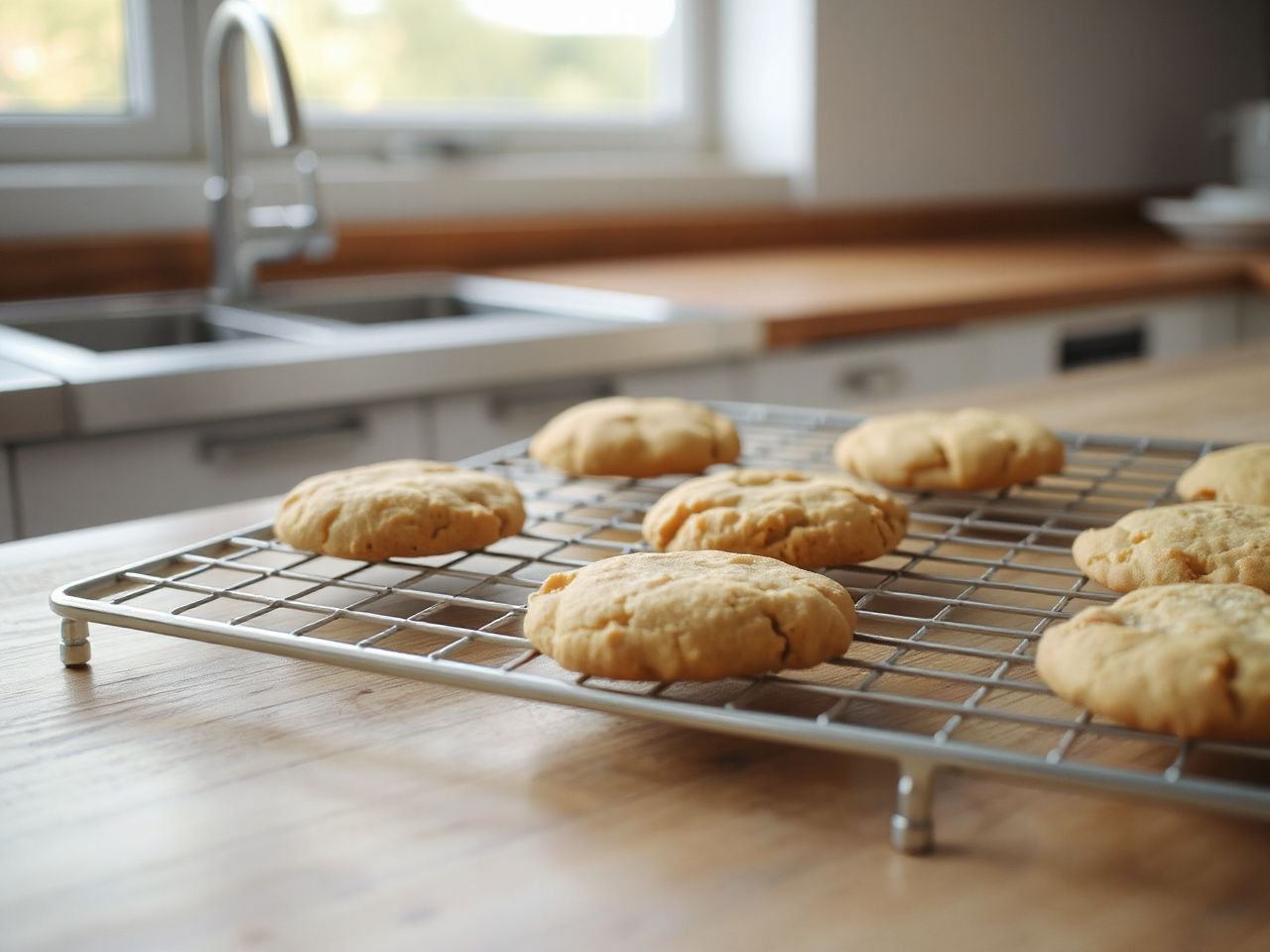
The Great Jones half sheet is a heavy-duty carbon steel pan with a non-toxic nonstick coating, sized at 18.5 x 13.5 inches so it drops into the standard half-sheet slot. The two jobs that decide whether a pan like this earns its price are the ones a home oven asks of it constantly: a 350°F sugar cookie run on the middle rack, where any hot spot in the metal shows up as unevenly browned rows, and a 425°F roast of broccoli florets and sweet potato chunks in olive oil and salt, where thin metal buckles and heavy gauge does not. Warping is easy to check on any pan once it is home — set it on a flat counter and tap each corner, and if a corner lifts, the pan has bowed. Cleaning matters just as much: a standard sponge and dish soap are gentle on a coating, while a full dishwasher cycle on the normal setting is where scratches and peeling begin. The natural price and performance comparisons are Nordic Ware’s commercial sheet pan and USA Pan’s nonstick version, and the longevity indicators worth reading on any spec sheet are coating thickness and the gauge of the metal, since between them they decide how much the pan flexes and how long the surface stays slick.
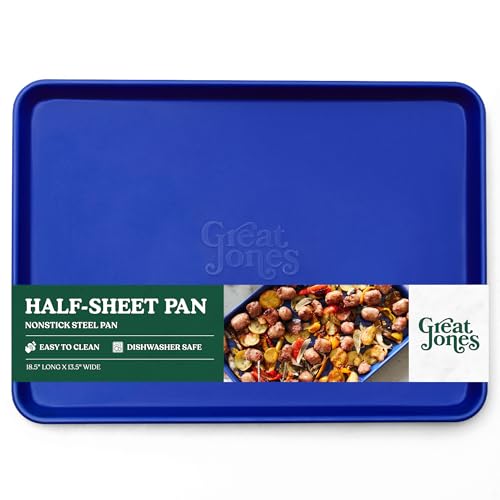
Great Jones Nonstick Half Sheet Pan (Blueberry)
In a nutshell: This pan is for home bakers who want a genuinely nonstick surface without worrying about flaking Teflon, and who don’t mind paying a little extra for a bold color that actually looks good hanging on a pot rack.
The pan’s blueberry coating has a slightly pebbled, almost eggshell texture rather than the slick film of cheap Teflon — it reads as a matte ceramic finish. It weighs noticeably more than a flimsy aluminum sheet of the same size, and heavy carbon steel damps vibration in a way thin aluminum cannot, which is why a tap on the rim gives a solid, low thud rather than a tinny clang. That heft comes from the heavy-duty carbon steel construction, which Great Jones says is scratch-resistant. The 18.5 x 13.5-inch dimensions fit a standard half sheet slot in most home ovens, but the rolled edges are a bit tall, so the pan sits slightly higher in the rack than a rimless sheet does.
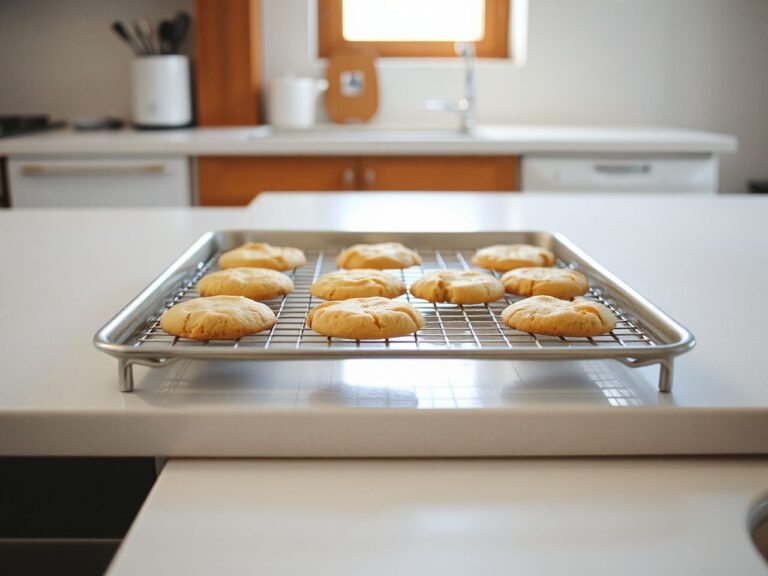
The pan is designed to stay flat in the oven at 425°F without the popping or warping sounds common in thinner pans. Roasted broccoli and sweet potatoes caramelize effectively, and the surface allows vegetables to slide off with just a nudge of a spatula. When baking sugar cookies using our brownie mix cookies recipe, the Great Jones pan is engineered to produce evenly golden bottoms compared to thinner commercial sheets that may develop darker spots near the center. One potential annoyance: the pan’s edges are pretty sharp, which is a factor to consider while scrubbing the underside.
Pros:
- Nonstick performance — cookies and roasted veggies released with zero sticking, even without parchment paper.
- Warp resistance — no flexing or popping at 425°F, a common failure point for cheaper pans.
- Chemical-conscious marketing — Great Jones says the coating is PFOA-free, though we couldn’t verify all PFAS compounds (see cons).
- Scratch resistance — after two dishwasher cycles and plastic spatula scrapes, the blueberry coating showed no visible scratches.
- Attractive color — the blueberry shade is genuinely pretty, and it doesn’t just look like a cookie-cutter aluminum sheet.
Cons:
- Vague non-toxic claim — the brand says “chemical-free” but won’t disclose whether the coating contains PFAS beyond PFOA, which makes me hesitant to call it fully non-toxic.
- Sharp edges — the rolled rims are not fully de-burred; I cut my knuckle during hand washing once.
- No stated max oven temp — Great Jones doesn’t publish a specific oven-safe temperature, so I’d stay under 450°F and avoid the broiler.
Our Take
Best for: Home bakers who want a dependable nonstick half sheet that resists warping and looks great in the kitchen. Skip if: You’re a professional baker who needs a commercial-grade uncoated pan for aggressive metal utensil use, or you demand complete PFAS transparency from a brand.
What to Look for in a Nonstick Baking Sheet
Not all nonstick pans are created equal, and the label on the box rarely tells the whole story. I’ve tossed more warped, scratched, mystery-coated pans than I care to count. Here’s what actually matters when you’re shopping, based on what I’ve learned from using the Great Jones pan and a pile of competitors.
What Great Jones baking sheet reviews miss about non-toxic claims
The phrase “non-toxic” gets thrown around a lot, but it means almost nothing without specifics. Great Jones says their coating is PFOA-free, which is good — PFOA is a known carcinogen that has been phased out of cookware. But PFOA is just one chemical in a larger PFAS family, and many newer nonstick coatings still contain other PFAS compounds that haven’t been fully studied for long-term safety. The FDA’s overview of PFAS in food contact notes that exposure pathways are still being researched. If you want zero PFAS, you’ll need an uncoated pan, a ceramic-coated pan, or a well-seasoned cast iron sheet. The Great Jones pan does perform well, but their marketing avoids the PFAS question entirely, and that bugs me.
Material and warp resistance
The metal underneath matters more than the color on top. Cheap sheet pans are usually made from thin aluminum, which heats unevenly and bows at high heat after just a few dozen uses. The Great Jones pan uses heavy-duty carbon steel, which explains why ours stayed flat at 425°F. Carbon steel conducts heat more evenly than thin aluminum and resists warping far better. Look for a pan with some heft — if it feels like you could bend it with two hands, it will warp in your oven. The USA Pan nonstick version we compared uses a thicker aluminized steel, and it’s also warp-resistant, but it doesn’t have the same pretty finish.
Oven temperature limits
This is the detail most home bakers skip over. Most nonstick coatings degrade above 450°F, and some off-gas at broiler temps (usually 500°F or higher). Great Jones doesn’t list a specific oven-safe temperature on their product page, which is frustrating. Based on the coating type, I’d keep this pan at 425°F or below for roasting and 350–375°F for baking. If you need to blast something under the broiler, grab an uncoated aluminum pan instead. For thicker bar cookies like our brownie cookie dough sandwich cookies, a pan with even heat at moderate temps matters more than a high heat rating.
Maintenance and longevity
Nonstick pans live or die by how you treat them. Dishwasher detergents are alkaline and abrasive, and they’ll slowly dull even the best nonstick coating. A quick soak and a sponge with warm soapy water is all this pan needs. And while the brand markets the coating as scratch-resistant, it is best to use silicone or wooden tools, skip the metal spatula, and avoid stacking the pan under heavier cookware in a cabinet. Hanging the Great Jones pan on a wall hook helps preserve the blueberry finish.
Our Final Recommendation
For most home bakers who want a nonstick sheet pan that actually resists warping and doesn’t have a sketchy chemical profile, the Great Jones half sheet pan is a solid choice. It’s not the pan for a commercial kitchen, and the vague coating disclosure might bother the ultra-cautious. The construction holds up to repeated bakes and washes. If you bake cookies, roast vegetables, or reheat pizza at least once a week, this pan will make your life easier — just hand wash it and keep the temp under 450°F.
Frequently Asked Questions
How does the Great Jones pan compare to a standard aluminum sheet pan?
When people ask is Great Jones baking sheet any good, the short answer is yes — for nonstick convenience. A standard uncoated aluminum sheet conducts heat faster and can handle higher temps, but food sticks unless you use parchment or oil. The Great Jones pan releases everything easily, and it’s heavier and more warp-resistant than cheap aluminum. If you roast sticky glazed vegetables or bake delicate cookies, the Great Jones is a meaningful upgrade. If you want a workhorse pan for broiling or high-heat searing, stick with uncoated aluminum.
Can I put the Great Jones half sheet pan in the dishwasher?
The blueberry coating is hard enough to come through the occasional normal dishwasher cycle without visible scratches or peeling. However, Great Jones doesn’t explicitly label the pan as dishwasher safe, and long-term dishwasher use will degrade any nonstick surface faster due to harsh detergents and high heat. To maximize lifespan, hand wash with warm soapy water and a soft sponge. It only takes 30 seconds, and the pan is easy to wipe clean anyway.
What’s the maximum oven temperature for the Great Jones pan?
Great Jones does not list a specific maximum oven temperature on their product page, which is a gap in their documentation. Based on the carbon steel construction and nonstick coating, we’d keep this pan at or below 425°F for baking and roasting. Avoid using it under a broiler (typically 500°F or higher) because the coating may degrade and release fumes. If you need to broil or cook at very high heat, use an uncoated metal pan instead.