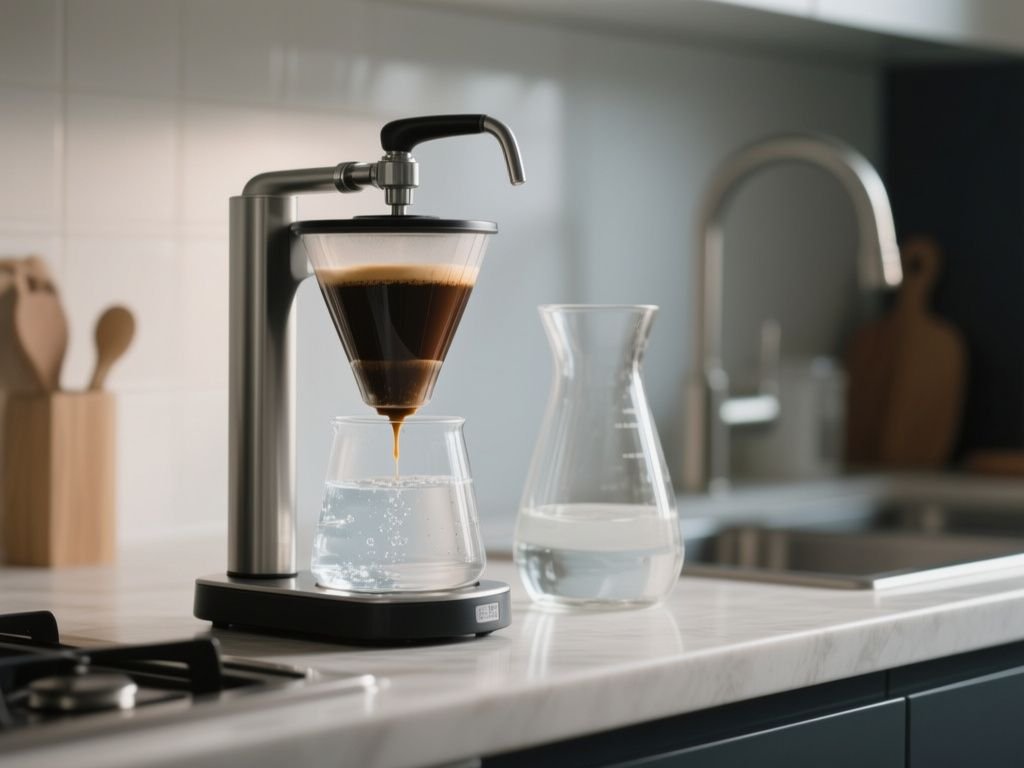
Ignoring the water in your coffee maker can leave you with bitter-tasting coffee, mineral scale, restricted water flow, and more cleaning work than the machine deserves. The key distinction is between water that is safe to drink and water that is ideal for a coffee maker: ordinary tap water is usually compatible, but its hardness, chlorine, and mineral balance determine taste and scale buildup. An accurate guide should separate filtration for taste from softening or mineral reduction, then connect each water choice to the machine’s descaling needs rather than treating all filtered or bottled water as equivalent.
So, can you use tap water in a coffee maker? Usually, yes. Use potable cold municipal tap water, not questionable water and not hot water drawn from the household tap. A counter-space realist’s answer is simple: the right water should keep the machine dependable without turning routine coffee into a maintenance project. If you are also deciding how much machine to keep on the counter, our Cuisinart coffee maker coverage for 2026 can help you compare features separately from water quality.
Key Takeaways
- Potable cold tap water is generally safe for a compatible coffee maker.
- Hard water can leave calcium and magnesium scale inside the machine.
- Activated-carbon filtration improves chlorine taste but usually does not soften water.
- Descale according to local hardness, usage, and the machine’s instructions.
Can you use tap water in a coffee maker safely?
Ordinary municipal tap water is generally suitable if the water is safe to drink and the coffee maker’s instructions do not specify a different requirement. Coffee is mostly water, so the water entering the reservoir becomes part of the finished drink rather than a neutral background ingredient.
Use only potable cold tap water from a reliable source. Do not fill the reservoir from a questionable source, and do not use hot water from the household tap. Hot tap water can pick up more material from plumbing, while the coffee maker is designed to heat the water through its own brewing system.
Safe to drink does not mean ideal for brewing
Municipal water supplies may use chlorine to eliminate viruses, bacteria, and parasites. That treatment supports water safety, but chlorine can also affect the smell and taste of coffee, especially when the water has a noticeable pool-like odor.
Water hardness matters for a different reason. Hard water contains calcium and magnesium minerals. During heating, those minerals can form scale inside the reservoir outlet, heating system, pump, and internal tubing, reducing performance and increasing maintenance.
Municipal tap water is usually safe for a coffee maker when the water is potable and the machine accepts ordinary water. The practical question is not only safety; it is whether the local mineral balance and chlorine level suit the machine and the flavor you want.
Why baristas may avoid ordinary tap water
A café or espresso professional may filter water because repeatability matters. If the local supply changes in mineral balance or carries a strong chlorine taste, the same coffee can taste different from one location to another. Filtration gives the operator more control, but that does not mean every home coffee maker requires bottled or specially treated water.
Home brewing has a smaller decision to make. If your tap water smells clean, tastes acceptable, and does not leave heavy scale around faucets or kettles, using it may be the most sensible use of limited counter space. A filter becomes worthwhile when it solves a specific problem, such as chlorine odor or repeated scale.
Causes: what tap water does inside a coffee maker
Hard water and mineral scale
Hard water commonly contains calcium carbonate and minerals associated with calcium and magnesium bicarbonate. Heating changes the balance of dissolved minerals, allowing scale to collect on surfaces that contact heated water. The visible result may begin as a pale film around the reservoir or outlet, but buildup can also occur where the internal tubing and heating system are hidden.
Scale is a maintenance issue rather than a reason to panic. A coffee maker that uses hard water may need descaling more often, and neglected deposits can restrict the path water takes through the machine. The listing or manual may not identify the exact internal component layout, so follow the manufacturer’s cleaning procedure instead of assuming that every model can be treated the same way.
Hard water deposits can reduce water flow through a coffee maker’s reservoir outlet, heating system, pump, and internal tubing. That is why the water choice belongs in the maintenance plan, not only in the flavor discussion.
Chlorine, odor, and coffee taste
Chlorine can remain noticeable even when tap water is safe to drink. Coffee contains a large proportion of water, so an odor that seems mild in a glass can become easier to notice in a hot brewed drink.
A basic activated-carbon filter can improve chlorine taste and odor. Carbon filtration is therefore mainly a taste and smell tool. It generally does not remove the calcium and magnesium responsible for hardness, so filtered water can still create mineral scale.
That distinction prevents a common mistake: assuming that a water-filter pitcher has solved every water problem. The pitcher may make the coffee taste cleaner while leaving the machine’s descaling schedule largely unchanged.
How water affects the heating system and pump
Mineral deposits can accumulate wherever water is heated or pushed through a narrow passage. The affected areas may include the reservoir outlet, heating system, pump, and internal tubing. Restricted flow can increase the machine’s maintenance burden and may reduce how consistently water moves through the brew path.
The precise effect depends on the water, the machine’s design, how often the machine runs, and whether the manufacturer’s cleaning instructions are followed. A responsible guide cannot provide one universal descaling interval for every household because local hardness and usage differ.
Solutions: choosing tap, filtered, bottled, distilled, or reverse-osmosis water
Ordinary cold tap water
Cold potable tap water is the default choice for most compatible coffee makers. It costs no extra counter space, needs no separate container, and avoids the waste of repeatedly carrying water home. From a practical kitchen perspective, that simplicity matters.
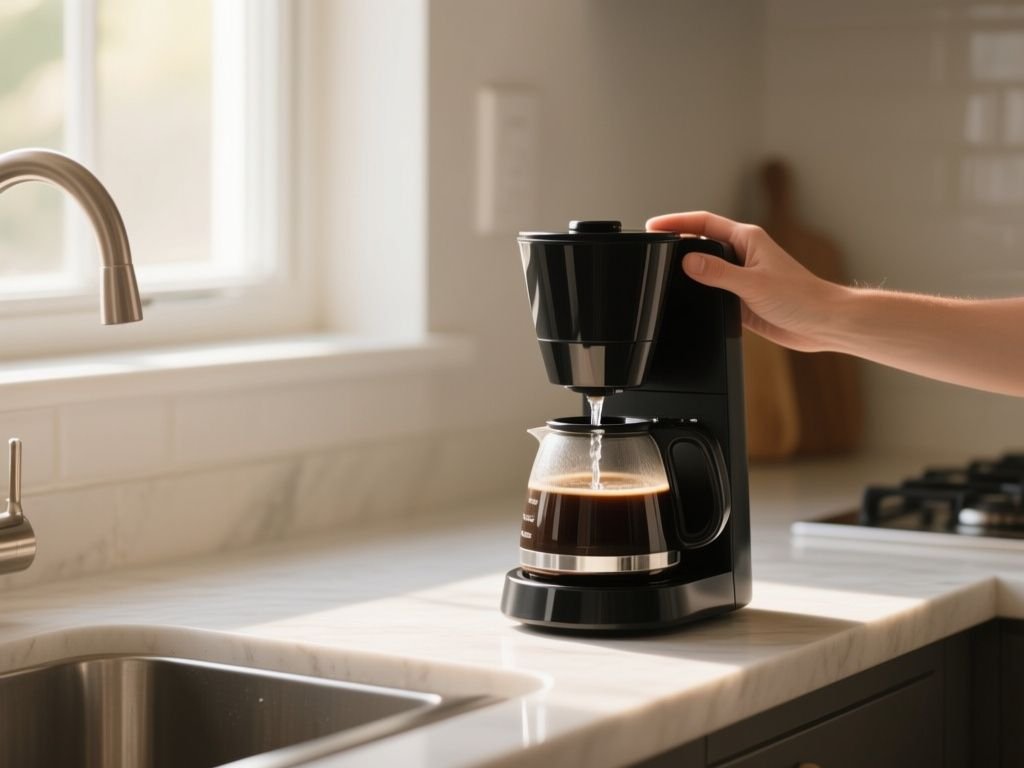
Fill the reservoir with fresh cold water from the tap. Do not use water that has been sitting in the coffee maker for an extended period, and do not add water from a source that is not suitable for drinking. The machine should do the heating; the household tap should supply cold water.
Cold potable tap water is the correct starting point for a coffee maker unless the manufacturer specifies another water type. Local taste and hardness determine whether a filter or different treatment is useful.
Filtered water from a pitcher or faucet
Activated-carbon filtration can reduce chlorine taste and odor, making coffee taste cleaner when the unfiltered supply is noticeably unpleasant. Check the filter’s replacement instructions, because a carbon filter is useful only while it is maintained as directed.
A basic carbon filter generally does not remove the calcium and magnesium that create hard-water scale. Some filtration systems reduce minerals, but the word “filtered” alone does not identify what the system removes. Read the filtration claim rather than assuming that every pitcher softens water.
NSF/ANSI 42 covers aesthetic effects such as chlorine taste and odor for certified drinking-water treatment products; certification information can be checked through NSF. That standard is useful for understanding taste and odor claims, but it should not be treated as proof that a filter removes hardness.
Bottled water
Bottled water is not one uniform category. Mineral content varies, so one bottle may behave differently in a coffee maker from another. The label may provide clues about mineral content, but the word “bottled” by itself does not tell you whether the water is hard, low in minerals, or balanced for brewing.
For a machine that occupies valuable counter space, bottled water also creates an ongoing storage and handling task. I would use it only when local tap water is unsuitable, has an objectionable taste, or the manufacturer’s instructions point that way. Buying bottled water is not automatically a maintenance shortcut.
Distilled water
Distilled water contains very little mineral content compared with ordinary hard water. That may reduce the minerals available to form scale, but very low-mineral water can produce flatter-tasting coffee and may be unsuitable for some coffee makers or their sensors.
Check the machine’s water requirements before using distilled water regularly. A coffee maker is a system, not simply a heated container, and the manufacturer may specify a water range or caution against very low-mineral water.
Reverse-osmosis water
Reverse-osmosis water is treated to reduce dissolved substances, including minerals, but its final mineral balance depends on the system and any later treatment. It should not be treated as identical to distilled water or ordinary filtered tap water.
The brewing question is therefore practical: does the water taste good, suit the machine, and leave a manageable amount of scale? If reverse-osmosis water tastes flat or the coffee maker’s instructions call for mineral content, another water source may make more sense.
Preventive measures: matching water choice to maintenance
Step 1: identify your local water conditions
Start with your local water-quality report when municipal water is involved. Water hardness testing can provide a more direct answer for the household, especially if scale appears quickly on faucets, kettles, or the coffee maker’s reservoir.
Do not rely on taste alone. Hardness is not always obvious in a cup, and water that tastes pleasant can still contain minerals that form scale during heating. Conversely, unpleasant chlorine odor does not automatically mean the water is hard.
A local water-quality report or hardness test is more useful than the word “filtered” for estimating scale risk. The result helps you decide whether your priority is carbon filtration, mineral reduction, or simply a more regular cleaning routine.
Step 2: fill the reservoir correctly
Use fresh, cold, potable water. Avoid hot household tap water, questionable sources, and water that has been left in the reservoir for an extended period. Keep the water below the reservoir’s stated maximum line if the machine has one.
Use the machine’s own markings or instructions for the amount needed. Adding extra water does not compensate for hard water, and a fuller reservoir does not reduce mineral buildup. It only changes how much water the machine must process.
Step 3: separate cleaning from descaling
Routine cleaning removes coffee residue and general grime. Descaling removes mineral deposits. Those jobs may use different procedures, and a coffee maker’s manual should determine which parts are removable, which solution is approved, and how the rinse cycle is performed.
Citric acid is used in some descaling products, but the correct concentration and procedure depend on the coffee maker. Do not improvise a strong mixture or leave a descaling solution in the machine longer than the instructions state. A manufacturer-approved descaling agent and procedure are the safer basis for maintenance.
After descaling, follow the manufacturer’s rinsing directions before brewing coffee. The manual may specify water volumes or repeated rinse cycles; those details matter because the internal water path is not visible.
Step 4: set a realistic descaling schedule
There is no single correct interval for every coffee maker using tap water. Descaling frequency depends on local water hardness, how often the machine is used, and the machine’s instructions.
Hard water and frequent brewing justify closer attention than soft water and occasional use. Warning signs can include visible mineral deposits, altered water flow, or a machine instruction that calls for descaling. These signs should prompt a manual check rather than a guess about the exact chemistry inside the machine.
Coffee-maker descaling frequency depends on water hardness, usage, and the manufacturer’s instructions. A fixed calendar reminder can be useful, but it should not replace the guidance supplied for the specific machine.
Step 5: replace filters on schedule
If the coffee maker uses a water filter, replace it according to the manufacturer’s stated interval. A filter that has reached the end of its service period may no longer address chlorine taste and odor as intended.
Filter replacement does not eliminate the need to descale unless the filtration system specifically reduces the minerals responsible for hardness and the manufacturer says otherwise. Keep the two maintenance tasks separate in your kitchen routine.
Advanced guidance for better coffee without wasting counter space
Use water to solve the actual complaint
If the coffee tastes like chlorine or the water smells unpleasant, begin with activated-carbon filtration. If the machine develops mineral deposits, investigate hardness and descaling. If the flavor seems flat after switching to distilled or very low-mineral water, check the manufacturer’s requirements and consider a water source with a more suitable mineral balance.
That decision tree keeps the fix proportional. There is no reason to install a mineral-reduction system for a taste problem that carbon filtration can address, and there is no reason to expect a basic carbon pitcher to solve heavy scale.
Understand extraction and mineral balance
Water is the main ingredient in brewed coffee, so its mineral balance affects extraction and flavor. Minerals can contribute to the character of the cup, while a very low-mineral source may taste flatter. The goal is not to remove everything from the water; the goal is to use water that produces acceptable coffee without creating an unreasonable maintenance burden.
The Specialty Coffee Association publishes water-quality guidance for coffee brewing through its SCA Water Quality Standards. That resource gives coffee professionals a framework for discussing brewing water, but home users should still follow the coffee maker’s own requirements.
Do not confuse machine size with water tolerance
A larger reservoir does not make a coffee maker more resistant to hard water. More stored water may simply mean more water passes through the heating system before the reservoir needs filling again. The machine’s maintenance instructions remain the deciding reference.
Counter space is part of the calculation. A pitcher, bottled-water storage, replacement filters, and descaling supplies all occupy room or add handling. A separate treatment system is worth keeping only when it solves a clear taste, hardness, or machine-care problem.
If the choice of machine is still open, the Moccamaster coffee maker comparison is a separate place to assess machine design; water quality remains a household variable regardless of the model.
What tap water does not do
A coffee maker heats water, but that does not turn questionable water into a reliable drinking source. Do not use unsafe or uncertain water simply because the machine will heat it. Use potable cold water at the reservoir and treat the coffee maker as a brewing appliance, not as a water-purification device.
Similarly, a pleasant cup does not prove that the machine is free of scale. Flavor and internal cleanliness are related only in part. The water can taste fine while minerals collect in the hidden water path.
Common mistakes to avoid with tap water
- Using hot household tap water: Fill with cold potable water and let the coffee maker perform the heating.
- Assuming filtered means softened: Activated carbon can improve chlorine taste while leaving hardness minerals in the water.
- Using distilled water without checking the manual: Very low-mineral water may taste flat or may not suit some machines or sensors.
- Waiting for a serious performance problem: Visible scale or altered flow is a reason to review the descaling instructions.
- Using an improvised descaling mixture: Follow the manufacturer’s approved agent, concentration, contact time, and rinsing procedure.
- Leaving old water in the reservoir: Empty and refill according to the machine’s care instructions rather than treating the reservoir as long-term storage.
- Choosing bottled water by category alone: Bottled water varies in mineral content, so “bottled” does not guarantee low scale or ideal extraction.
Using hot household tap water is an avoidable coffee-maker mistake. Cold potable water gives the appliance control over the heating stage and avoids relying on water that has traveled through household plumbing after being heated.
Frequently Asked Questions
Can you use tap water in a coffee maker without filtering it?
Yes, ordinary potable cold tap water can usually be used without filtering when the coffee maker permits it and the water tastes acceptable. Unfiltered water may still contain chlorine that affects flavor or calcium and magnesium that create scale. Check your local water information, watch for mineral deposits, and follow the machine’s descaling instructions rather than treating unfiltered water as automatically harmful.
Should I use cold tap water or hot tap water in the coffee-maker reservoir?
Use cold potable tap water. Do not fill the reservoir with hot water from the household tap, because hot tap water can pick up more material from plumbing. The coffee maker is designed to heat the water through its brewing system. Use the reservoir’s markings and the manufacturer’s instructions for the amount of water, and do not use a questionable water source.
Will a water-filter pitcher remove the minerals that cause coffee-maker scale?
A basic activated-carbon pitcher generally improves chlorine taste and odor but does not remove the calcium and magnesium responsible for hard-water scale. Some systems reduce minerals, but “filtered” does not identify the treatment method. Check the filtration claim, continue descaling as directed, and use local hardness information to decide whether carbon filtration is enough.
How can I tell whether my tap water is too hard for a coffee maker?
Use a local water-quality report or a water-hardness test rather than relying only on taste. Scale around faucets or other heated-water equipment can also signal mineral buildup, but it does not provide a precise hardness result. The coffee maker’s instructions should guide the cleaning response. Hardness, frequency of use, and the machine’s design all affect descaling needs.
Does filtered water make coffee taste better than unfiltered tap water?
Filtered water can taste better when unfiltered tap water has noticeable chlorine taste or odor. Activated carbon is especially relevant to that problem. Filtered water is not automatically better for every cup, though, because filtration may leave hardness minerals in place or remove more mineral content than the coffee benefits from. Taste, local water quality, and machine requirements should guide the choice.
Is distilled water suitable for every coffee maker?
No. Distilled or very low-mineral water may produce flatter-tasting coffee and can be unsuitable for some machines or sensors. Read the manufacturer’s water guidance before using it regularly. Reverse-osmosis water also varies according to the treatment system, so it should not be assumed to behave exactly like distilled water or ordinary activated-carbon-filtered tap water.
How often should I descale a coffee maker that uses tap water?
The correct schedule depends on local water hardness, usage, and the manufacturer’s instructions. Hard water and frequent brewing can increase the need for mineral-scale removal, while softer water may create less buildup. Use the approved descaling agent and procedure, including the specified contact time and rinsing steps. Do not substitute a universal timetable for the machine’s own directions.
Does a coffee maker kill bacteria in tap water?
A coffee maker is not a certified water-purification device, so it should not be used to make questionable water safe. Use potable cold water from a reliable source. Municipal treatment may use chlorine to eliminate viruses, bacteria, and parasites, but that safety treatment does not make every household water source suitable or remove the need for proper coffee-maker cleaning.
What water do baristas use for coffee?
Professional coffee preparation often uses water selected for consistent taste and mineral balance, but there is no single bottled-water category that suits every setup. A home user can make good coffee with potable tap water when the taste is acceptable and the machine is maintained. If chlorine or hardness causes trouble, choose filtration or mineral reduction for that specific problem.
Can I make great coffee at home with tap water?
Yes. Good home coffee depends on more than the water source, and potable tap water can be a sensible choice when it tastes clean and does not create excessive scale. Use cold water, keep the reservoir clean, replace filters as directed, and descale according to local hardness and the machine’s instructions. The best setup is the one that earns its counter space by solving a real problem.