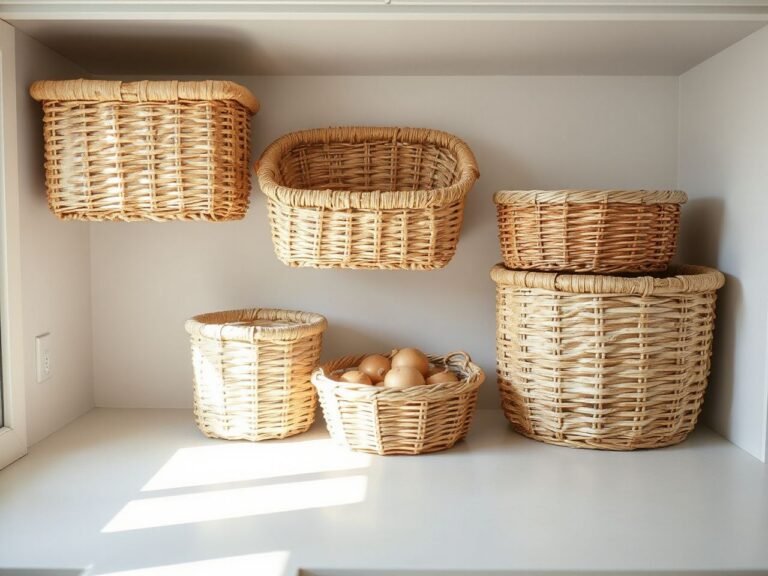
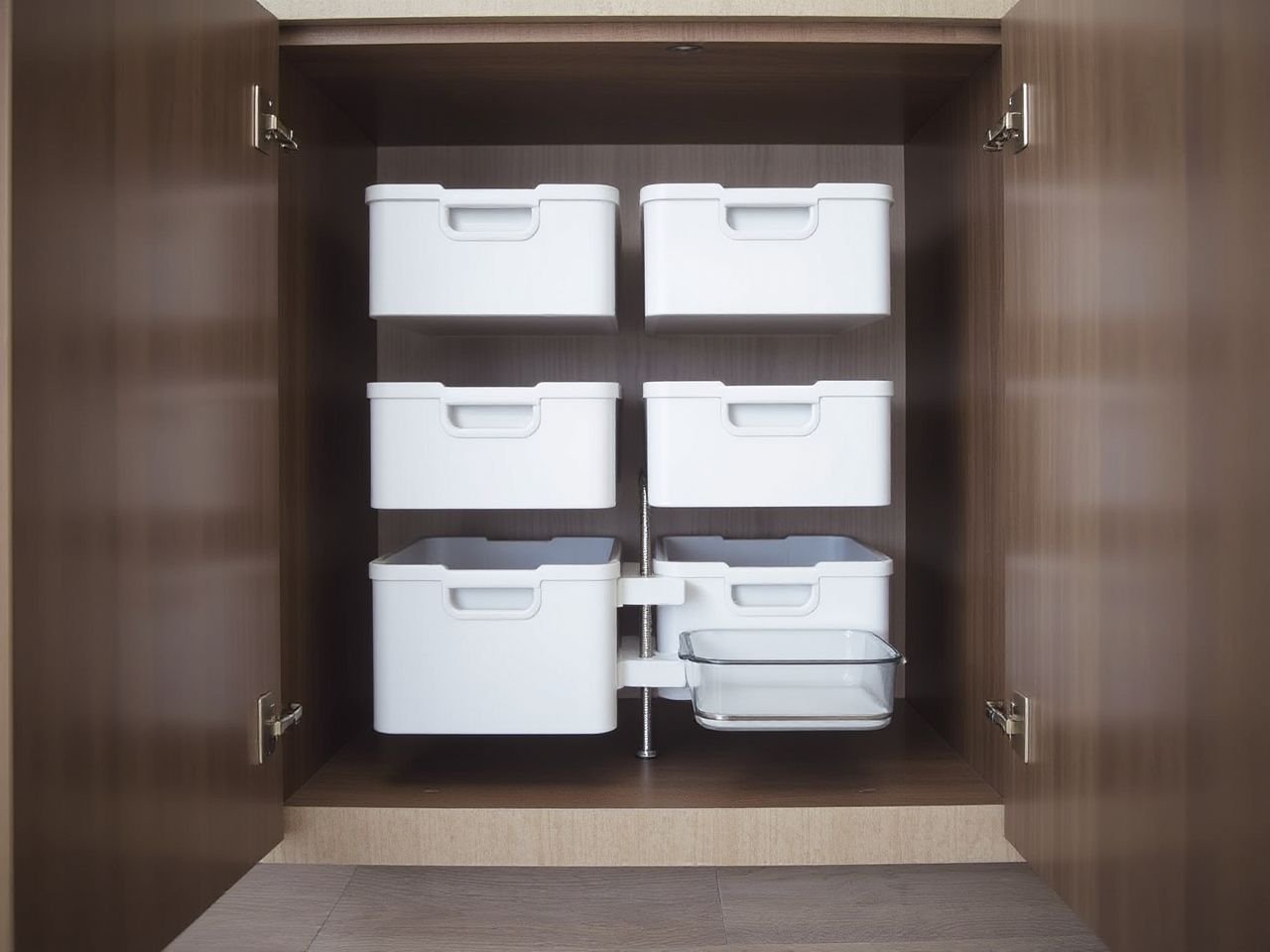
A cabinet organizer can fit its advertised width and still make the cabinet harder to use. A pull-out shelf may improve access, while a fixed deep shelf may hold more, and a door rack can collide with hinges or a neighboring door. This cabinet organizers buying guide starts with the useful distinction between an organizer’s storage capacity and its usable access: a deep shelf may hold more, while a pull-out shelf can make the rear contents reachable without unloading the front. Fit also depends on the cabinet as a system—opening, interior walls, frame, hinges, shelf supports, door swing, and load path—not merely on the organizer’s stated dimensions.
Start with stack height and fridge-door clearance in mind. Pantry containers that fit neatly on a shelf can still block a nearby appliance door, catch on a cabinet hinge, or prevent the cabinet itself from closing.
Key Takeaways
- Measure the opening, cavity, depth, height, shelf position, and nearby clearances before choosing an organizer.
- Choose pull-out shelves for reach, risers for vertical visibility, Lazy Susans for corner access, and door racks only for loads the door and hinges can safely carry.
- Check the cabinet floor, walls, shelf pins, slides, fasteners, and moving clearances as one connected support system.
Beginner: Start with the cabinet, not the organizer
Measure the opening first
The cabinet opening is the visible space between the door edges or face frame. The interior cavity is the actual space available behind that opening. Those dimensions can differ, so a tape measure belongs on the cabinet before any organizer is selected.
Record the following separately:
- Opening width: Measure the clear passage where the organizer must enter.
- Interior width: Measure between the cabinet walls, not from the outside edges.
- Usable depth: Measure from the front obstruction to the back wall, then account for hinges, door hardware, and any fixed shelf.
- Clear height: Measure from the cabinet floor or shelf surface to the lowest obstruction above it.
- Shelf position: Note the shelf pins, supports, and the space above and below each shelf.
- Nearby clearance: Open the cabinet door fully and check adjacent doors, drawers, appliances, and the swing of a refrigerator door.
The cabinet opening determines whether an organizer can pass through the front, while the interior cavity determines whether the organizer can operate after installation. A cabinet organizer must fit both the entry path and the working space.
Do not assume a cabinet’s advertised size describes its usable interior. Face-frame cabinets have a front frame that narrows the opening, while frameless cabinets generally present the cabinet box more directly at the front. The mounting approach can therefore differ even when the outside cabinet dimensions look similar.
Map the obstructions
Open the door and inspect the hinge arms, hinge plates, shelf pins, cabinet walls, and door edge. Mark any point that projects into the travel path. A full-extension drawer slide needs room to move without striking a hinge or neighboring cabinet.
Door swing deserves its own check. An organizer that clears the cabinet wall may still push against the door, while a door-mounted rack can collide with the frame when the door closes. Nearby cabinet doors can also become blocked when a rack or pull-out shelf projects beyond the cabinet front.
A face-frame cabinet needs a mounting plan that accounts for the front frame. A frameless cabinet needs a plan that accounts for the uninterrupted cabinet box and the position of its walls. The correct approach depends on the actual mounting surface rather than on the organizer’s label alone.
Plan around stack height
Stack height is the vertical space occupied by the stored items, not merely the height of the shelf or basket. A shelf riser can create a second visible level, but the lower level must still leave enough room for the items above it. Tall food containers may make a riser waste space if the cabinet has limited height.
Group items by the height they actually need. Short containers can occupy a lower level beneath a riser, while taller bottles or boxed foods may need an unobstructed shelf. Cabinet shelf adjustment can help, but moving a shelf changes the space above and below it, so check both zones rather than optimizing only one.
A shelf riser separates vertical layers, while a pull-out shelf changes horizontal access. Those functions solve different problems and should not be treated as interchangeable.
Intermediate: Match the organizer to the access problem
Pull-out shelves and full-extension drawer slides
A pull-out shelf brings the stored surface toward the user. That matters in a deep cabinet because the rear items can become reachable without removing everything in front. Full-extension drawer slides support the moving shelf and guide its travel, so the cabinet floor and mounting fasteners must carry the combined load of the shelf and its contents.
Pull-out mechanisms need an unobstructed path. Hinges, shelf pins, cabinet walls, door frames, and objects that overhang the shelf can stop the movement or make the shelf rub. A pull-out shelf that reaches the rear contents but cannot travel smoothly has solved visibility without solving access.
Load placement also affects alignment. Heavy jars placed toward one side can put uneven force on the slides and mounting points. Keep dense items low and centered where the organizer’s construction and the cabinet support allow it, and follow the capacity information supplied by the manufacturer. If no capacity is listed, do not invent one.
The cabinet floor must support the organizer and its contents without flexing or splitting around the fasteners. Heavy loads can pull out fasteners, bend slides, or damage the cabinet floor, so a stated organizer capacity does not replace an assessment of the cabinet structure.
Drawer organizers
A drawer organizer divides an existing drawer into zones. It suits utensils, tools, and smaller items that are already stored in a drawer, but its value depends on the drawer’s clear height and the amount of space lost to dividers.
Standard utensil dividers are commonly associated with a width of 2.5 inches. Treat that figure as a reference for the divider format, not as proof that every drawer or utensil will fit. Measure the drawer box, the opening, and the clearance beneath the countertop or drawer above it.
Drawer and hinge clearance can change how a cabinet feels in daily use. A divider that fits the drawer box may still interfere with the drawer front, nearby handles, or a drawer below. Test the drawer through its full movement before assigning a tall item to a compartment.
Shelf risers
A shelf riser creates a raised platform so items behind or below it remain easier to see. It uses fixed shelf space rather than requiring a moving mechanism, which can make removal and cleaning straightforward.
The trade-off is access. A riser improves sightlines but does not bring rear items forward. It also depends heavily on stack height: if the upper level is too low, large containers will not fit; if the upper level is too high, the cabinet may lose useful vertical space.
Use risers for groups with similar heights and stable shapes. Do not place a container where its lid or cap presses against the shelf above, because that pressure can make removal awkward and reduce the value of the added level.
Lazy Susans
A Lazy Susan rotates stored items around a central area. It can help with small bottles and containers in a deep or corner zone, where turning the platform exposes items that would otherwise sit behind one another.
Rotation needs a clear circular path. Cabinet walls, hinges, shelf edges, and containers that extend beyond the platform can interrupt movement. Leave enough room for the stored items to turn without striking the cabinet, and keep the heaviest items positioned in a way that does not make the platform difficult to rotate.
A Lazy Susan improves access by changing direction, while a pull-out shelf improves access by changing position. The better choice depends on whether the obstruction is around a corner or toward the rear.
Door-mounted racks
A door-mounted rack uses the door surface as storage. It can free shelf space, but the door, hinges, frame, and fasteners must carry the added load as the door opens and closes.
Door-mounted racks are a poor choice for heavy jars, bottles, or frequently handled food when the door structure, hinges, or mounting points are not designed for that load. Repeated movement can make a heavy rack sag, collide with the cabinet frame, or prevent the door from closing.
Check the rack’s depth against the shelf contents behind it. A door rack may have enough room on the door but leave too little clearance for items inside the cabinet. This is where fridge-door clearance thinking helps: a moving door needs an unobstructed arc, not merely a place to store another container.
Intermediate: Understand support, alignment, and load
Follow the load path
The load path is the route by which weight travels from the stored food to the organizer, slides or brackets, fasteners, cabinet floor or walls, and finally the cabinet structure. Every part of that route must remain suitable for the load.
An organizer can be strong while the cabinet floor is weak. A cabinet floor can be sound while the fasteners are poorly placed. A slide can move correctly when empty and bind after heavy containers are added. Check the entire path.
The cabinet structure and mounting hardware must support the organizer and its contents. A heavy load can pull out fasteners, bend slides, or damage the cabinet floor, so the organizer’s stated capacity cannot be considered in isolation.
For elongated shelves made from typical household materials, the distance between supports should not exceed four times the shelf breadth. Use that principle as a prompt to inspect support spacing, not as permission to load a shelf without checking its material, fasteners, and condition.
Wood, bamboo, or steel are commonly used for sturdy shelves, while plastic or glass may suit lighter storage. The material alone does not establish a safe load. Thickness, support position, mounting method, and cabinet condition all affect the result.
Check shelf pins and fixed shelves
Shelf pins hold adjustable shelves in position, but they may obstruct an organizer’s side clearance or sit directly in the intended slide path. Remove or reposition a shelf only if the cabinet’s construction and the organizer’s instructions allow it.
Fixed shelves can divide the cabinet into useful zones, yet they may prevent a tall pull-out unit from reaching the floor. Measure each compartment separately. A cabinet with one deep cavity is not equivalent to a cabinet split by fixed shelves.
Fixed shelves often hold more in a compact footprint because they have no slide hardware or travel clearance. Pull-out shelves often provide better rear access. Compare the storage surface you gain with the clearance and hardware space you give up.
Diagnose wobble, sag, and sticking
Wobble usually points to movement between the organizer and its mounting surface, uneven support, loose fasteners, or a load that is not centered. Sag can come from an overloaded shelf, inadequate support spacing, or a cabinet floor that is not carrying the load evenly.
Sticking can result from a hinge or wall entering the travel path, a slide mounted out of alignment, an overhanging container, or uneven loading. Stop forcing the organizer. Remove the contents, inspect the travel path, and check the mounting points against the installation instructions.
A pull-out shelf should remain aligned with its mounting hardware throughout its travel. If the shelf shifts sideways, rubs against the cabinet, or stops before the intended rear position, the problem needs correction before more weight is added.
Use safety information carefully
The U.S. Consumer Product Safety Commission publishes consumer product safety information and recall notices, so its site is a useful place to check for a safety notice involving a storage product or mounting component.
The NSF develops standards and certification programs for products and systems, but a general mention of certification does not establish that a particular cabinet organizer has been certified. Read the organizer’s actual label and documentation rather than treating a vague safety claim as proof.
Advanced: Install for usable access and future maintenance
Prepare a face-frame cabinet
A face-frame cabinet has a front frame around the cabinet box. That frame can reduce the entry opening and can place the mounting surface farther behind the front edge. Measure the clear opening separately from the interior width, then confirm that the organizer can pass through the opening and operate behind the frame.
Check whether the frame blocks a slide, bracket, or fastener. The organizer may need a mounting approach that accounts for the frame instead of being fastened as though the cabinet were a plain box.
A face-frame cabinet can require different mounting treatment from a frameless cabinet even when both cabinets have similar outside dimensions. The front frame is part of the fit calculation.
Prepare a frameless cabinet
A frameless cabinet does not present the same front-frame obstruction, but the cabinet walls, floor, doors, hinges, and shelf supports still control the installation. Measure the cavity and confirm where the organizer’s hardware will sit.
Do not drill into a location simply because it is open. Check the fastener length against the cabinet panel, the organizer’s mounting pattern, and any concealed hardware. If the instructions call for a specific mounting surface or fastener, follow them rather than substituting a convenient location.
Cabinet box panels commonly range from 5/8 to 3/4 inch, or 15 to 20 mm, in thickness. Measure the actual cabinet or consult its documentation before relying on a general panel range.
Preserve removal and cleaning access
Flour, crumbs, and spills can collect beneath moving parts. An organizer that cannot be removed or reached underneath will take more effort to clean and inspect.
Removable baskets, accessible fasteners, and detachable shelves make routine cleaning easier. Before installation, check whether the moving section can come out without removing the entire mounting frame. This matters for pantry zoning because a spill in one area should not require dismantling unrelated storage.
Cleaning access also supports pest prevention. Keep food residue from accumulating in hidden corners, and inspect the area beneath slides, brackets, and shelf edges during ordinary pantry cleaning.
Account for replacement and alteration costs
The ongoing cost of an organizer is not limited to its initial purchase. Possible future work includes replacing damaged slides, tightening or replacing fasteners, changing shelf positions, repairing a cabinet floor, or altering a door-mounted rack that blocks nearby storage.
Removable components may reduce the effort of cleaning or repair, while permanently fixed parts may require more cabinet access. Ask whether a worn moving component can be replaced without rebuilding the cabinet arrangement. If the manufacturer does not list replacement parts or capacity, record that uncertainty before committing to a complicated installation.
Use a practical selection sequence
- Define the access problem. Decide whether the rear is hard to reach, the vertical space is poorly used, the cabinet turns a corner, or the door needs a storage zone.
- Measure the cabinet system. Record the opening, cavity, depth, height, shelf position, frame, hinges, door swing, and neighboring clearances.
- Choose the simplest mechanism. Use a riser for vertical visibility, a Lazy Susan for rotational access, a pull-out shelf for rear reach, or a drawer organizer for compartmentalizing a drawer.
- Check the load path. Match the expected contents to the cabinet floor, walls, shelf pins, slides, brackets, and fasteners.
- Test the travel before loading. Operate the door, drawer, or pull-out shelf empty and inspect every point where rubbing or collision could occur.
- Plan cleaning access. Confirm that crumbs and spills can be reached and that removable parts can be taken out without unnecessary disassembly.
A careful sequence prevents wasted pantry space because every choice is tied to a physical constraint.
For baking shelves, tray dividers and vertical storage need the same stack-height check. The guide to organizing around budget baking pans can help with the cookware side, while the cabinet itself still needs to be measured before storage hardware is installed.
Advanced: Compare access without losing storage
Fixed shelf versus pull-out shelf
A fixed shelf has a simple storage surface and no travel clearance. That can preserve usable depth and reduce moving hardware, but the rear contents remain behind the front contents.
A pull-out shelf uses some space for slides and movement, yet it can make the full depth reachable. The right comparison is not capacity alone. Compare how much can be stored, how much can be seen, how much must be moved to reach the rear, and whether the cabinet can support the moving load.
For pantry zoning, a fixed shelf can work well for shallow groups that are used together. A pull-out shelf has a stronger case where deep storage would otherwise become a layered stack of containers.
Decide what belongs on the door
Door-mounted storage is useful for light, frequently reached items when the door and hinges have adequate clearance. It becomes less suitable as jars and bottles grow heavier or as the rack projects farther into the cabinet.
Keep door storage away from contents that could collide with it during closing. Check the door edge, frame, shelf fronts, and nearby cabinet doors each time the rack is adjusted.
Control stack height in everyday use
Arrange containers so labels remain visible and the tallest item does not block the shelf above. A shelf riser can separate short containers from taller ones, but a raised level should not force food into an unstable or inaccessible stack.
Food container storage works best when lids, bases, and heights have a defined zone. Leave enough clearance to lift the container straight out rather than scraping it against the shelf above or pulling neighboring items forward.
Frequently Asked Questions
How do I choose an organizer without wasting cabinet space?
Measure the opening, interior cavity, depth, height, shelf position, door swing, hinges, and nearby clearance first. Then identify the access problem. A riser improves vertical visibility, a pull-out shelf reaches the rear, and a Lazy Susan changes access around a corner. Select the simplest mechanism that solves the actual obstruction, then verify its load path and cleaning access.
How much weight can a cabinet organizer safely support?
The answer depends on the organizer, cabinet structure, mounting hardware, slides, shelf pins, and cabinet floor. Use the manufacturer’s stated capacity when one is provided, but do not treat it as a guarantee for a weak cabinet. Heavy loads can pull out fasteners, bend slides, or damage the floor. If no capacity is listed, avoid guessing.
Why does a pull-out shelf wobble, sag, or stick?
Possible causes include uneven mounting, loose fasteners, an obstructed travel path, uneven loading, inadequate support, or a cabinet floor that flexes. Remove the contents and inspect the slides, brackets, hinges, shelf pins, and cabinet walls. A pull-out shelf should not be forced while loaded, because resistance can conceal a mounting or alignment problem.
Are door-mounted racks suitable for jars and bottles?
Door-mounted racks can suit lighter items when the door, hinges, frame, and fasteners support the added load and the rack has clearance behind it. Heavy jars and bottles place greater demand on the moving door and mounting points. Check the rack’s projection, the closing path, and nearby cabinet doors before assigning dense or frequently handled food to the door.
Which organizer types are easiest to clean?
Removable baskets, shelves, and accessible hardware generally make cleaning simpler because crumbs and spills can be reached beneath or around the storage surface. Pull-out mechanisms need inspection beneath moving parts, while Lazy Susans need a clear rotation path and clean platform edges. Choose an arrangement that can be removed or wiped without dismantling unrelated cabinet storage.