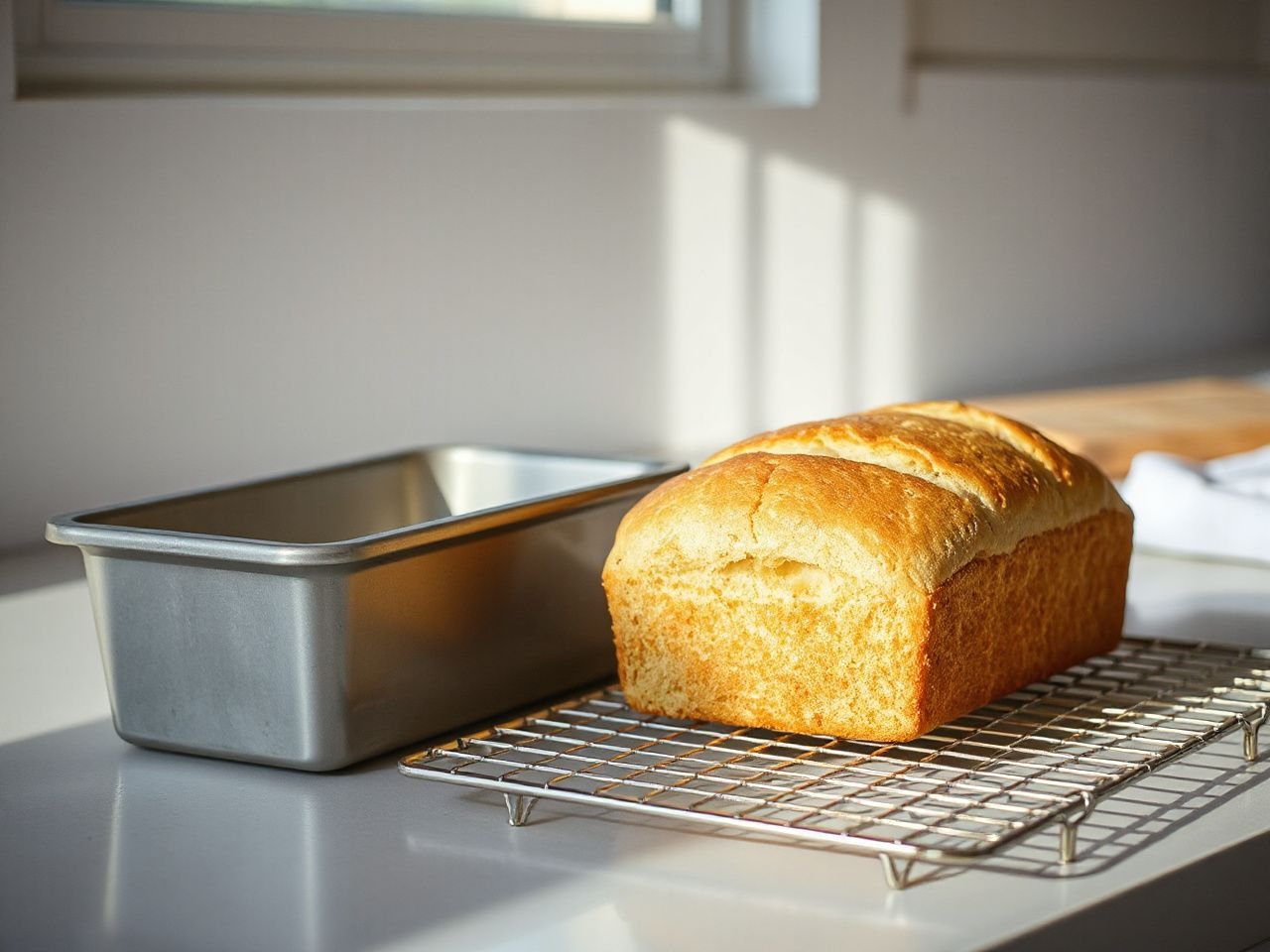
There is a particular satisfaction in pulling a loaf from the oven with straight sides, a deep golden crust, and a bottom that releases without a fight. That result almost never comes down to the recipe alone—the pan is doing invisible work. Among the best budget loaf pans available in 2026, the right pick makes the difference between bread that thumps out easily and a stuck, misshapen mess. After you nail the perfect loaf, a bowl of our easy chicken dumpling soup is a natural next step.
If you want one straightforward recommendation, go with the Farberware Bakeware Nonstick Loaf Pan. Its heavy-gauge steel resists warping, the PFAS-free nonstick coating is genuinely reliable for release, and the wide rim handles make hot transfers far less nerve-wracking than any straight-sided competitor here.
Our team compared six affordable loaf pans across glass, stainless steel, and silicone. Two of them stand out as genuinely smart buys; the rest fill specific needs but come with real trade-offs.
📌 This article contains affiliate links. As an Amazon Associate I earn from qualifying purchases, at no extra cost to you. Full disclosure.
CERTAIN CONTENT THAT APPEARS ON THIS SITE COMES FROM AMAZON. THIS CONTENT IS PROVIDED ‘AS IS’ AND IS SUBJECT TO CHANGE OR REMOVAL AT ANY TIME.
| Product | Best For | Buy Link |
|---|---|---|
| Razab 2 Pack Glass Loaf Pans with Lids | Baking & storage | Check Price |
| JinhzWin Large Loaf Pans | Bare-metal value | Check Price |
| 4 Pack Mini Loaf Pans | Small batch gifting | Check Price |
| Farberware Bakeware Nonstick Loaf Pans | Everyday nonstick | Check Price |
| Vinino Mini Silicone Loaf Pans | Batch mini desserts | Check Price |
| E-far Loaf Pan for Homemade Bread | Large 2lb loaves | Check Price |
How We Chose These Budget Loaf Pans
A budget pan is a waste of money if it can’t do the one job it’s bought for. Our shortlist narrowed based on published specifications and documented material properties, not marketing copy. The decisive criteria were material thermal behavior, dimensional accuracy of the pan cavity, sturdiness of the walls and rim, and the reliability of nonstick or release properties. A good cheap loaf pan must distribute heat evenly to prevent burnt bottoms and doughy centers, resist warping at high heat, and hold its advertised dimensions. Heat distribution and release performance are more important than extras like lids or color. Before ordering any of these, check the true cavity size with a ruler and pour water to confirm capacity; some budget pans run small against the listing.
Razab 2 Pack Glass Loaf Pans with Lids (Best for Freezer-to-Oven Versatility)


Razab 2 Pack Glass Loaf Pans with Lids (Best for Freezer-to-Oven Versatility)
Quick take: The Razab set is the pick for bakers who want one dish that moves from bake to fridge to freezer without transferring food.
Borosilicate glass is the material that separates this pan from everything else on the list. It resists heat up to 500°F, which covers most bread and meatloaf recipes, but more importantly it heats slowly and holds that heat long after the oven door opens. That retention tends to deepen browning on the sides and bottom, though it also means you may want to drop the oven temperature by about 25°F compared to a metal pan. The 7.6-cup / 1.9-quart cavity is larger than a standard 9×5 metal loaf pan, so check your recipe volume before pouring.
The included gray BPA-free lid snaps on leakproof, making this useful for refrigerating a batch of meatloaf or freezing banana bread after it cools. If you have ever wrestled plastic wrap over a loaf, that lid alone justifies the second pan in the set. The main worry with any glass loaf pan is thermal shock: never move it straight from the fridge or freezer into a fully preheated oven. The US Consumer Product Safety Commission has long warned about sudden temperature swings shattering glass bakeware.
Pros:
- Borosilicate glass to 500°F — resists heat better than standard tempered glass loaf pans.
- Leakproof BPA-free lid — no more plastic wrap wrestling when storing or freezing.
- 7.6-cup capacity — slightly larger than typical metal loaf pans, good for casseroles and pasta bakes.
- Two pans included — bake two loaves at once or alternate freezer storage.
Cons:
- Thermal shock risk — going from cold to hot too fast can crack any glass pan.
- Slower heat response — bake times and temperatures need adjustment versus metal.
- No nonstick surface — glass still needs greasing or parchment for yeast breads.
Our Verdict
Best for: bakers who prioritize storage and reheating versatility. Skip if: you want a dark, crisp bread crust—metal pans do that better.
JinhzWin Large Loaf Pans (Best Bare-Metal Value Set)
In a nutshell: If you are tired of coatings peeling into your food, this two-pack of commercial-grade stainless steel is the honest, low-tech answer.
The 12″ x 5″ x 2.5″ dimensions put these on the larger side for a standard one-pound loaf, so a typical 9×5 recipe will spread thinner and bake faster. That is not a flaw; it just means you should scale recipes up or watch the clock a little more closely. Stainless steel does not have a chemically bonded nonstick layer, which is exactly why I like it for long-term durability. There is no coating to scratch, flake, or wear off, but the trade-off is real: butter or oil and a dusting of flour are non-negotiable if you want clean release.
Heat distribution on stainless is often uneven compared to heavy aluminum or steel with a nonstick coating, but the manufacturer explicitly calls out thickened stainless steel that resists warping up to 450°F. That matters for a pan this long. Thin stainless will bow in the middle after a few high-heat meatloaf sessions, and then your loaf bakes lopsided. The set is space-saving, which in practice means these stack flat without handles sticking out. The downside is the same straight sides: with no wide rim, pulling a hot pan with bulky mitts demands more care.
Pros:
- Commercial-grade stainless steel — rust and corrosion resistant even with acidic fillings.
- Set of two 12×5 pans — bigger cavity than standard loaf pans, good for sandwich loaves.
- No coating to peel — survives metal utensils and abrasive scrubbing indefinitely.
- 450°F warp resistance — thickened walls hold shape better than flimsy steel pans.
Cons:
- No nonstick surface — must grease and flour heavily or bread will stick.
- Ungrippable straight rim — no wide handles; hot transfers are less secure.
- Oversized for standard recipes — one-pound bread dough may bake thin and dry if not scaled up.
Final Thoughts
Best for: bakers who want bare-metal durability and a larger loaf. Skip if: you rely on nonstick convenience.
4 Pack Mini Loaf Pans (Best for Small Batch Gifting)
Quick take: These flexible silicone minis are the right tool when you want four little loaves for gifting, meal prep, or portion control—and nothing else.
The dimensions here are tiny: 5.7″ x 2.5″ x 2.2″ per cavity, and you get four of them. That is roughly one-third of a standard loaf pan, which makes portioning banana bread or pumpkin bread easy. Silicone’s natural flexibility means the finished loaves pop out with almost no effort, but it also means the pan will flop if you lift it with one hand. The best practice with any silicone bakeware—this set included—is to place it on a flat baking sheet before filling and keep it there through the oven.
Food-grade silicone is rated here from -40°F to 450°F, so freezer-to-oven is technically possible, though I would not push it to the absolute top end for long bakes because prolonged high heat can degrade cheaper silicone over time. The main annoyance with any mini silicone loaf pan is the softness of the cavities: they bulge outward when filled with heavy batter, which can create lopsided loaves unless the pan sits on a rigid sheet. And because silicone is an insulator rather than a conductor, expect a paler, softer crust than metal or glass would produce.
Pros:
- Four nonstick mini cavities — easy release without grease, great for small batches.
- Food-grade silicone, -40°F to 450°F — safe for freezer and standard oven use.
- Space-friendly size — each pan is under 6 inches, easy to store in a drawer.
- Bright finish — color makes it easy to distinguish from other bakeware.
Cons:
- Floppy without support — must sit on a baking sheet or batter will slosh.
- Poor crust development — silicone insulation yields pale, soft exteriors on bread.
- Mini capacity only — useless for a full-size sandwich loaf or meatloaf.
The Real Deal
Best for: small-batch bakers and gift loaves. Skip if: you want one full-size pan for weekly bread baking.
Farberware Bakeware Nonstick Loaf Pans (Our Overall Pick)

Why it made our list: The Farberware nonstick loaf pan is the strongest all-rounder among the best budget loaf pans we considered: heavy-gauge steel, a safer nonstick surface, and actual wide handles.
Heavy-gauge steel is the material to look for in a budget nonstick pan because it resists the warping that turns cheap loaf pans into trapezoids after a handful of uses. A flat, true cavity is what keeps a sandwich loaf rectangular instead of bulged in the middle, and the steel construction here is the right foundation. The wide rim handles are also a feature I take seriously. A 9×5 pan filled with batter is not hard to lift, but a pan of meatloaf with hot drippings is a different story. Wide, flat handles give a pot holder something to grab.
The nonstick coating is the part that usually fails on budget pans, so the fact that Farberware states it is made without PFAS, PFOA, lead, or cadmium is meaningful. It should release quick breads and meatloaf with almost no oil. But nonstick is still a coating; avoid metal spatulas or knives, and hand-wash it with a soft sponge. No dishwasher, no abrasive scrub pads. The listing does not state exact cavity dimensions, which is the one gap I noticed. Before you buy, measure your own baking space and confirm the pan size against the retailer’s specs, because some nonstick loaf pans run small.
Pros:
- Heavy-gauge steel — resists warping far better than thin aluminum loaf pans.
- PFAS/PFOA/lead/cadmium-free nonstick — safer coating without the usual chemical concerns.
- Wide rim handles — confident grip when moving a hot, full pan.
- Even heating design — heavy steel minimizes hot spots that scorch crust bottoms.
Cons:
- Coating longevity unknown — nonstick will wear eventually, especially with daily use.
- No lid included — not useful for fridge storage or transporting baked goods.
- Dimensions not listed clearly — need to verify it fits your standard recipe volume.
Our Take
Best for: home bakers who want an affordable nonstick loaf pan that won’t warp after a few loaves. Skip if: you prefer bare metal or need a lidded storage container.
Vinino Mini Silicone Loaf Pans with Metal Reinforced Frame (Best for Batch Mini Desserts)

Here’s the deal: The Vinino is the only option here with a metal-reinforced structure, which solves the biggest flaw of silicone bakeware: the flop.
Silicone pans usually feel like giant Jell-O molds. The metal-reinforced rim on this eight-cavity tray gives it enough rigidity that filling, lifting, and placing the pan feels closer to a standard metal bakeware piece. Each cavity creates a small loaf-shaped portion—think banana bread, egg bites, or individual pound cakes—so it works as a batch-testing tool if you divide one batter across multiple flavor variations. But the center of the tray is still silicone, so you cannot treat it like a rigid metal sheet. Keep it supported underneath.
The nonstick nature of food-grade silicone means unmolding is nearly effortless, which is where this pan shines for delicate individual desserts that would crumble in a metal pan. One honest annoyance: cleaning eight tiny loaf cavities takes time, especially if batter rises over the dividers and bakes into the crevices. A good soak and a bottle brush get it done, but this is not a wipe-and-go pan. And like all silicone, it will not give you the browned, crisp crust that a metal loaf pan delivers. Plan for softer, paler edges.
Pros:
- Metal-reinforced frame — adds much-needed rigidity to a flexible silicone tray.
- Eight-cavity configuration — efficient for small portions, meal prep, or party desserts.
- Silicone nonstick release — delicate cakes and egg bites slide out without greasing.
- Compact one-piece design — no separate pans to store or lose.
Cons:
- Soft center still flexes — heavy batter can distort cavities without a sheet underneath.
- Poor browning — silicone insulation leaves crusts pale and soft.
- Cleaning crevices is tedious — batter between eight dividers demands patience.
Why It Stands Out
Best for: bakers making mini loaves in batches. Skip if: you care at all about crust color and texture.
E-far Loaf Pan for Homemade Bread (Best Deep-Bodied Stainless for 2-Pound Loaves)

What stood out: The E-far’s 3.03-inch depth is the real story. It builds a taller, more traditional loaf than almost any other pan on this list.
At 12.28″ x 5.35″ x 3.03″, each of the two stainless steel pans in this set is built for 2-pound and larger bread recipes. That deep cavity gives dough room to climb without spilling over the rim, and the extra height is especially useful for sourdough with high hydration. Food-safe stainless steel means there is no flaking coating to worry about, but the trade-off is the same as the JinhzWin: this pan demands thorough greasing and flouring before every single bake. Skipping that step will weld a crust to the metal.
Heat distribution with stainless can be uneven, and the manufacturer’s claim of withstanding 450°F without warping matters most at this larger footprint. A thin stainless pan of this length would twist in the oven, making the loaf bake taller on one end. The rust-resistant construction also extends to acidic ingredients like tomato-based meatloaf glazes, which can eat through inferior bakeware. The only real gap is the lack of handles: like the JinhzWin, this pan has straight sides with no wide rim, so hot handling requires two hands or a lip-grip mitt.
Pros:
- 12.28″ x 5.35″ x 3.03″ cavity — large enough for true 2-pound loaves without overflow.
- Food-safe stainless steel — no coating, no flaking, no chemical concerns.
- Set of two pans — bake two large loaves at once for weekly bread rotation.
- 450°F warp resistance — heavy-duty metal holds its shape over time.
Cons:
- No nonstick surface — bare steel requires generous greasing or it will stick badly.
- No rim handles — straight sides are harder to grip with bulky oven mitts.
- Larger footprint may not fit compact ovens — measure your rack before ordering.
The Real Story
Best for: serious home bread bakers who want a deep, uncoated stainless pan for big loaves. Skip if: you bake small one-pound recipes or hate hand-washing.
How to Choose a Budget Loaf Pan That Won’t Let You Down
The right loaf pan is less about brand loyalty than about matching the material to what you actually bake. I see three decisions that matter more than price tag.
What to Look For in the best budget bread pans
Material is the first fork in the road. Glass heats slowly and holds heat, so it works for casseroles and sweet quick breads but can produce a softer crust. Stainless steel is durable and rust-resistant but bare and unforgiving without proper greasing. Nonstick steel offers easy release but the coating is finite. Silicone is almost foolproof for release but robs bread of color. None of these is universally better; the Farberware wins for most bakers because its heavy-gauge steel and nonstick coating balance release and browning, while the JinhzWin and E-far appeal to purists who don’t want a coating at all.
Size matters just as much. A standard one-pound bread recipe expects about a 6-cup pan. The Razab’s 7.6 cups over-delivers, which gives a shorter loaf; the JinhzWin and E-far run long and deep, perfect for doubled recipes. Silicone minis are a different category entirely. But if you’re baking a meatloaf in the JinhzWin or E-far, a quick rotisserie chicken mushroom soup on the stovetop makes the meal complete.
Warping Is the Budget Pan Killer
Thin metal pans twist under high heat, and a warped loaf pan bakes uneven bread that looks like a skateboard ramp. Heavy-gauge steel and thickened stainless, as claimed by Farberware, JinhzWin, and E-far, resist that failure. Glass and silicone never warp the same way, but each has its own vulnerability: glass to thermal shock, silicone to distortion under heavy batter. Check the pan’s listed maximum oven temperature before buying; anything below 450°F is a red flag for bread baking.
Release Properties Decide Your Morning Mood
Nothing ruins a bake faster than a stuck loaf. Nonstick coatings solve this with almost no effort, but they scratch and wear. Glass and stainless demand a proper fat-and-flour barrier or parchment sling. Silicone releases effortlessly but gives up crust. The most common buyer failure is bread that sticks despite greasing—that usually happens on bare metal when the coating of fat is too thin or the dough is too wet. Use a pastry brush, get into the corners, and dust with flour before adding sticky dough.
Our Final Recommendation
For most home bakers, the Farberware Bakeware Nonstick Loaf Pan is the clear overall winner: heavy-gauge steel for flat sides, PFAS-free nonstick for reliable release, and wide rim handles for safe lifting. If you prefer bare metal and larger loaves, the JinhzWin set is the best budget stainless choice, while the E-far wins for deep 2-pound sourdough-style loaves. Glass purists and meal preppers should grab the Razab with lids. Whichever you pick, match the material to the crust and cleanup you actually want.
Frequently Asked Questions
What are the best budget bread pans for a standard one-pound loaf?
Most standard sandwich bread recipes call for a 9 x 5 inch loaf pan with about a 6-cup capacity. The Razab glass pan at 7.6 cups is slightly larger, so your loaf may be shorter; the JinhzWin and E-far are longer and deeper, meant for 1.5 to 2-pound breads. Always check the true cavity dimensions with a ruler and pour water to confirm capacity before committing.
Which material gives the best crust: glass, metal, or silicone?
Metal pans—whether bare stainless or nonstick steel—produce the darkest, crispiest crust because they conduct heat most efficiently. Glass comes close on the bottom and sides but responds more slowly. Silicone sits at the opposite end; it insulates rather than conducts, leaving bread pale and soft. If crust matters most to you, skip silicone for yeast breads.
Why does my bread stick to the pan even when I grease it?
Grease alone is rarely enough on bare stainless or glass. You need a barrier of fat plus flour or a parchment sling. For the JinhzWin or E-far, butter the inside, dust with flour, tap out excess, then add parchment if the dough is sticky. Nonstick coatings help, but they fail if scratched by metal utensils or abrasive scrubbers.