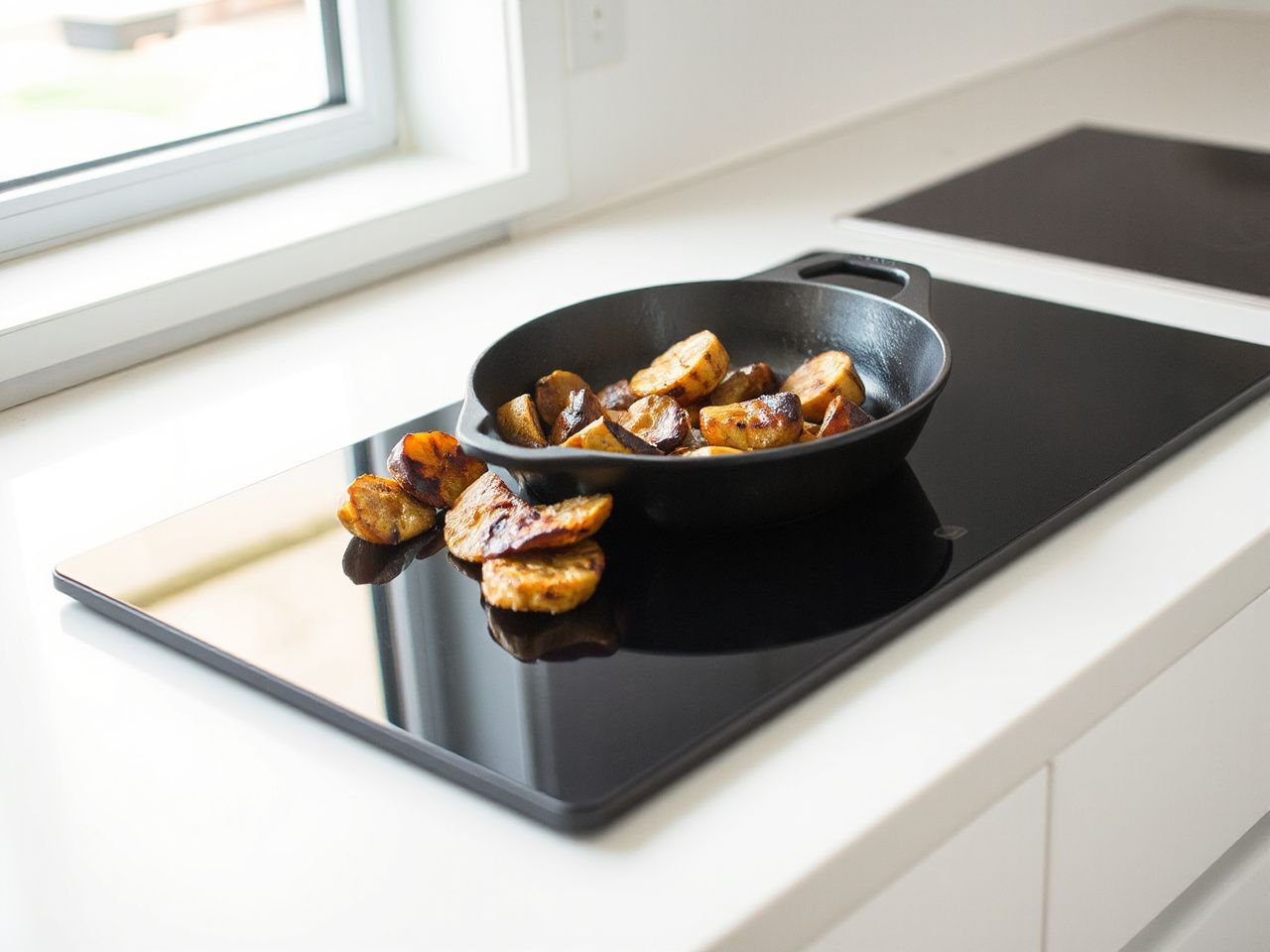
For the best cast iron skillets for an induction cooktop, the magnet test is only the starting point. A pan also needs a stable base, a cooking surface that matches the zone, and handling that won’t tempt you to drag heavy iron across glass.
My overall pick is the WANGYUANJI 11 Inch Cast Iron Skillet with Glass Lid because it is the only straightforward everyday skillet here with a useful 11-inch format and a documented lid. The listing leaves the base and weight unstated, so check those details with the seller before ordering.
Home Fresh Eats is funded by affiliate commission. Our picks come from comparing published specifications and documented features against what matters in the category — no brand pays for a place on this page. If you buy through a link here we may earn a commission at no extra cost to you, and it pays for the research behind the next guide. Full disclosure.
As an Amazon Associate we earn from qualifying purchases. This does not affect the price you pay.
CERTAIN CONTENT THAT APPEARS ON THIS SITE COMES FROM AMAZON. THIS CONTENT IS PROVIDED ‘AS IS’ AND IS SUBJECT TO CHANGE OR REMOVAL AT ANY TIME.
WANGYUANJI 11 Inch Cast Iron Skillet (Everyday Cooking)
The short answer: best cast iron skillets for an induction cooktop
- Best overall: WANGYUANJI 11 Inch Cast Iron Skillet — everyday skillet shape with a glass lid
- Best value: NutriChef Cast Iron Reversible Grill Plate — large reversible surface for griddling
- Best for eggs: Anu Limen 4-Cup Egg Pan — four separate cooking wells in a compact format
- Best for grill marks: Davnjcka Cast Iron Square Grill Pan — ribbed surface for stovetop grilling
- Best enameled option: Leonyo 3.6QT Enameled Braiser — lidded cooking without seasoning
How We Chose These Induction-Ready Cast Iron Picks
These recommendations come from comparing published specifications, listed materials, and documented features against the things that matter on induction. Cast iron is generally compatible because its composition is ferromagnetic, but compatibility alone doesn’t prove that a particular base is flat, stable, or correctly sized for your induction zone. The stated cooking-surface dimensions, overall dimensions, listed weight, coating type, lid inclusion, and product shape are important factors. A genuinely flat base should make reliable contact without requiring a heavy pan to slide across a glass-ceramic cooktop; none of the supplied listings confirms base flatness, so that remains a buyer check. The distinction between uncoated iron and enamel also matters: uncoated iron brings seasoning and rust control, while enamel avoids seasoning but needs protection from chips, abrasive cleaning, and thermal shock. The shortlist includes useful specialist shapes, but the buyer should confirm the base profile, handle clearance, induction compatibility, and lid fit before paying.
| Product | Best for | Key category spec | Second decisive spec |
|---|---|---|---|
| WANGYUANJI 11 Inch Cast Iron Skillet | Everyday frying | 11-inch size | Glass lid included |
| NutriChef Cast Iron Reversible Grill Plate | Large griddling | 18.0 x 10.0 inches | 9.78-pound weight |
| Anu Limen 4-Cup Egg Pan | Egg portions | 6.69 x 6.69 inches | 2.65-pound weight |
| Davnjcka Cast Iron Square Grill Pan | Grill marks | 16.2 x 10.0 inches | 1.5-inch height |
| Leonyo 3.6QT Enameled Braiser | Covered dishes | 3.6QT capacity | Lid included |
WANGYUANJI 11 Inch Cast Iron Skillet (Everyday Cooking)
Quick take: This is the best match for shoppers who want a conventional everyday skillet and can verify the missing base details before purchase.
The WANGYUANJI listing describes an uncoated cast iron skillet with an 11-inch size and a glass lid. Its stated dimensions are 9.06 inches x 11.02 inches x 2.17 inches, while weight, warranty, and material details beyond the cast-iron product description are not listed. That 11-inch format gives it a more practical general-purpose brief than the 6.69-inch Anu Limen egg pan, while the included lid makes covered cooking possible without buying another accessory.
Uncoated iron can build a glassy release surface through polymerized layers of oil, but that benefit comes with maintenance. The WANGYUANJI listing specifically presents a traditional cast texture and says natural release improves over time; those are manufacturer claims, not independently verified outcomes. The important omission is the base: induction needs stable contact, and the listing does not establish whether the bottom is completely flat. This product suits frying, sautéing, and general skillet work, but the base flatness should be confirmed before purchase.
Pros:
- 11-inch skillet format — better suited to everyday frying and sautéing than the four-well egg pan
- Glass lid included — useful for covered cooking without adding a separate lid to the order
- Uncoated surface — supports a seasoning routine rather than imposing an enamel-care routine
Cons:
- Base flatness not listed — induction contact cannot be judged from the supplied specifications
- Weight not listed — buyers cannot assess handling or storage demands before ordering
Why It Stands Out
Ideal for: cooks seeking one conventional 11-inch pan for daily stovetop work. Pass on this if: you need published base measurements, a stated weight, or seasoning-free care.
NutriChef Cast Iron Reversible Grill Plate (Large Griddle)

In a nutshell: The NutriChef is the practical choice for a large induction zone, provided your cooktop can accommodate its long footprint.
This reversible grill plate is listed under model NCCIRG59.5 and measures 18.0 inches x 10.0 inches x 0.6 inches. The listing gives a weight of 9.78 pounds, calls the colour black, and documents a smooth side for eggs, pancakes, or grilled sandwiches alongside a ridged grilling side. Material and warranty are not listed separately, although the product name and marketing description identify it as cast iron.
The 18-by-10-inch footprint is the deciding detail. It offers much more surface than the WANGYUANJI, yet a long plate can extend beyond a single induction zone or fail to heat evenly where the magnetic field doesn’t match the base. At 9.78 pounds, this is also the heaviest product here with a stated weight, so it should be placed carefully rather than slid over glass. The reversible design is useful, but it is a poor substitute for a deep skillet: raised ribs, shallow depth, and a broad profile limit sauces and liquid-heavy cooking.
Pros:
- Reversible cooking sides — smooth and ridged surfaces cover separate breakfast and grilling jobs
- 18.0-inch length — gives a broad cooking area where the induction zone and storage space suit it
- 9.78-pound stated weight — signals a substantial piece that needs a dedicated storage plan
Cons:
- Large footprint — may not match a single induction zone or fit comfortably beside other pans
- Not a deep skillet — the 0.6-inch listed thickness and grill-plate format favour flat foods over braises
The Real Deal
Great match for: pancakes, eggs, grilled sandwiches, and foods that benefit from grill marks on a compatible broad zone. Think twice if: you want a one-pan replacement for a standard skillet or dislike moving nearly ten pounds of iron.
Anu Limen 4-Cup Egg Pan (Compact Portion Pan)

Here’s the deal: This is a specialist egg pan for cooks who value four separate wells more than a continuous skillet surface.
The Anu Limen 4-Cup Egg Pan has model 7db-dc-aaa and measures 6.69 inches x 6.69 inches x 1.4 inches. Its listed weight is 2.65 pounds, and the listing describes an uncoated cooking surface with four individual 8 cm wells. The manufacturer identifies the construction as cast iron, while the listing does not provide a separate material specification or warranty.
That compact square shape is easy to understand on paper: four eggs can be separated, and the 2.65-pound stated weight is far more manageable than the NutriChef’s 9.78 pounds. The trade-off is serious for induction. Each well interrupts the cooking surface, and the small 6.69-inch footprint needs to match the active induction area; a compatibility claim alone cannot tell you whether every well will heat as intended. Seasoning also becomes more fiddly because each cup must be cleaned, dried, and protected.
Pros:
- Four 8 cm wells — separates portions without requiring rings or a separate egg mould
- 2.65-pound listed weight — easier to store and position than the large grill plates
- 6.69-inch footprint — makes sense for compact cooking areas when the zone matches
Cons:
- Interrupted cooking surface — unsuitable for pancakes, sautéing, or foods needing a broad uninterrupted base
- Uncoated multi-well care — seasoning and drying require attention in four separate recesses
Who Should Buy This
Perfect for: egg-focused breakfasts and small portions on a correctly sized induction zone. Not great if: you want a versatile skillet, need to toss food, or prefer simple cleanup.
Davnjcka Cast Iron Square Grill Pan (Ribbed Searing)

Why it earns a spot: The Davnjcka is aimed at steak and vegetable cooks who want raised grill ribs rather than a smooth frying surface.
Listed as model PSN-GHR05, the Davnjcka measures 16.2 inches x 10.0 inches x 1.5 inches and is identified as a 10-inch black cast iron grill pan. The listing says the pan works with electric, gas, and induction cooktops and can be used in an oven, broiler, or outdoors. Weight, warranty, and a separate material specification are not listed.
Deep ribs are the defining feature: they create grill marks and leave excess oil below the food, but they reduce the uninterrupted contact area available for eggs or delicate frying. The 16.2-inch overall length also makes handle clearance and zone alignment worth checking before purchase. Compared with the NutriChef, this pan is described as a square grill pan rather than a reversible plate, so it is the more focused option; compared with the WANGYUANJI, it gives up smooth-surface versatility for grill texture.
Pros:
- Deep grill ribs — designed for marked surfaces on meats and vegetables
- 1.5-inch listed height — gives more structure than a very shallow flat plate
- Induction compatibility stated — the listing directly identifies induction among its supported cooktops
Cons:
- Ribbed cooking surface — makes eggs, sauces, and flat frying less convenient than a smooth skillet
- Weight not listed — handling and storage cannot be judged as precisely as with the NutriChef or Anu Limen
Our Take
Best for: cooks who specifically want grill marks on steak, chicken, or vegetables. Skip if: your main jobs are scrambled eggs, hash browns, or sauce-making on a smooth base.
Leonyo 3.6QT Enameled Braiser with Lid (Seasoning-Free Cooking)
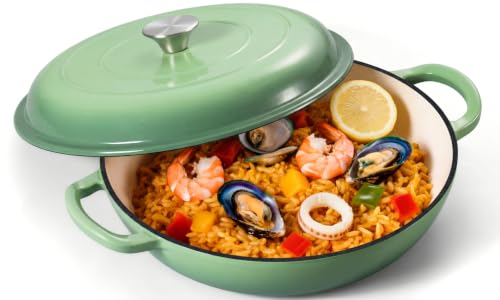
Short version: Leonyo is the strongest fit for covered, moisture-rich cooking if you prefer enamel care to maintaining bare iron.
The Leonyo listing describes a 3.6QT enameled cast iron skillet braiser with lid in pistachio green. Its stated dimensions are 15.16 inches x 15.16 inches x 3.86 inches; weight and warranty are not listed. The manufacturer describes a thick, well-sealed lid and a cast-iron core with heat retention, but those performance descriptions remain marketing claims rather than verified test results.
Enameled cast iron does not need the seasoning and rust-prevention routine required by uncoated iron, which makes this a better match for cooks who want less maintenance. It also demands a different kind of care: chips, abrasive cleaning, and thermal shock are concerns, especially with a lidded braiser that may move between cooking tasks. The 3.6QT capacity is useful for covered meals, but the 15.16-inch square dimensions are substantial, and the listing does not confirm the base shape or induction-zone match. Acidic foods are generally a better fit for enamel than bare seasoning, but enamel still isn’t permission for careless heating or abrasive scrubbing.
Pros:
- Enameled cooking surface — avoids the seasoning routine required by the three uncoated pans above
- 3.6QT listed capacity — gives this pan a braiser role rather than a narrow egg-pan role
- Lid included — supports covered cooking and moisture retention without a separate lid purchase
Cons:
- 15.16-inch square dimensions — may be awkward on a small induction surface or in a crowded cupboard
- Enamel vulnerability — chips, abrasive cleaning, and thermal shock remain care concerns
Final Thoughts
Ideal for: cooks making covered dishes who want to avoid bare-iron seasoning. Pass on this if: you want a lightweight, quick-grab frying pan or need published weight and base details.
Comparison of These Cast Iron Induction Picks
Buying Guide: Choosing the Best Cast Iron Skillets for an Induction Cooktop
Choosing the best cast iron pans for an induction cooktop
Start with the base, not the colour or lid. Induction cooktops use magnetic fields to heat ferrous cookware, and cast iron is generally ferromagnetic, but a pan still needs enough stable contact with the active zone. Ask the seller whether the bottom is completely flat and confirm the base diameter against your cooktop manual. The supplied listings do not provide that information for the WANGYUANJI, Leonyo, or NutriChef, so induction wording alone should not end your research. The Davnjcka listing does state induction compatibility, but its base profile still deserves confirmation.
Flatness, size, and glass protection
A completely flat bottom is the sensible target for predictable contact and even heating. Large cookware can be a poor match for a small induction zone: the NutriChef measures 18.0 by 10.0 inches, while the Davnjcka’s overall dimensions reach 16.2 by 10.0 inches. Those shapes may work well on a broad compatible zone, but they are not automatically better than an 11-inch skillet.
Heavy cast iron should be lifted and placed rather than dragged across a glass-ceramic cooktop. Sliding or grit trapped beneath the pan can scratch the surface, and a heavy object deserves careful handling around glass. For current consumer safety information about cookware and household products, the U.S. Consumer Product Safety Commission is the proper place to check alerts rather than relying on a seller’s broad safety language.
Uncoated iron versus enamel
Uncoated pans such as the WANGYUANJI and Anu Limen require seasoning, thorough drying, and a light protective oil layer after cleaning. Polymerizing thin oil layers creates the glassy surface associated with cast-iron release, but the process does not remove the need for rust control. Acidic foods can challenge seasoning, so long simmering jobs are a better fit for the Leonyo’s enamel than for a bare surface.
Leonyo avoids seasoning, but enamel brings its own limits. Chips, abrasive cleaning, and thermal shock can damage the coating, so avoid treating an enameled braiser like a bare camp pan. The included lid is useful for its stated braiser role, yet accessories only justify extra ownership complexity if covered cooking is actually part of your routine.
Match the shape to the food
For steaks and marked vegetables, the Davnjcka’s deep ribs are more relevant than a smooth base. Everyday frying and sautéing favour the WANGYUANJI’s conventional 11-inch skillet format, while the Anu Limen is a niche tool for four eggs in individual 8 cm wells. The NutriChef handles broad flat cooking, but its 9.78-pound stated weight makes storage and careful placement part of the decision.
Our cast iron skillet buying guide covering common mistakes is useful if you are still weighing handle clearance, base shape, and care demands. Cooks focused specifically on ribbed surfaces can also compare the trade-offs in our guide to cast iron grill pans for induction cooking.
Our Final Recommendation
The WANGYUANJI 11 Inch Cast Iron Skillet is our overall winner because its conventional 11-inch format and included glass lid make the most sense for everyday cooking, provided the seller confirms a flat induction-friendly base. For a budget-friendly broad griddle, choose the NutriChef, but respect its 9.78-pound weight. The premium-style choice here is the Leonyo 3.6QT Enameled Braiser with Lid, especially for covered cooking without seasoning. The Anu Limen and Davnjcka are specialists, not universal replacements.
Frequently Asked Questions
How do I maintain an uncoated cast iron skillet after induction cooking?
Clean the uncoated surface without leaving it wet, dry it thoroughly, and apply a light protective oil layer. Seasoning forms when thin oil layers polymerize into a glassy surface, but seasoning is maintenance rather than a permanent finish. The WANGYUANJI and Anu Limen both require this approach. Acidic foods can challenge bare seasoning, so use the Leonyo’s enamel for covered acidic cooking when that better suits the recipe.
Can heavy cast iron damage a glass-ceramic induction cooktop?
Heavy cast iron should not be dragged across glass-ceramic surfaces because sliding or trapped grit can scratch the glass. Lift and place the pan carefully, particularly with the 9.78-pound NutriChef Reversible Grill Plate. Check the cooktop manufacturer’s instructions for any additional cookware restrictions.
Is an enameled skillet better than an uncoated pan for induction?
Neither coating is automatically better. Uncoated iron supports traditional seasoning but needs drying and rust prevention; enamel avoids seasoning and is more suitable for foods that challenge bare seasoning, yet chips, abrasive cleaners, and thermal shock can damage it. The Leonyo is the enameled choice here, while WANGYUANJI and Anu Limen are uncoated. Base flatness and zone fit still matter more than coating alone.