Skip the research rabbit hole. The Northriver Casting 10.5-inch square grill pan is the best cast iron grill pan for steak for most home cooks, and the reason is simple: it pairs a bare cast iron cooking surface with a tempered glass lid that retains moisture and stops splatter. That combination, plus a longer-than-average handle, covers what actually matters for a steak at home.
You don’t need a $260 Staub to get a great sear. You need a pan that holds heat, drains fat, and doesn’t fight you on cleanup. Some of the pans below fail on one of those. I’ll tell you which ones.
📌 This article contains affiliate links. As an Amazon Associate I earn from qualifying purchases, at no extra cost to you. Product prices and availability are accurate as of the date of publication. Full disclosure.
Northriver Casting 10.5 Inch Square Grill Pan with Tempered Glass Lid (Our Top Pick)


YYJINGYOU Cast Iron Grill Pan (Induction-Compatibility Guarantee)

Comparison Table
| Product | Best For | Buy Link |
|---|---|---|
| Northriver Casting 10.5 Inch Square Grill Pan with Tempered Glass Lid | Overall winner | Check Price |
| HCXCQLSUY Cast Iron Grill Pan | Side spouts | Check Price |
| YYJINGYOU Cast Iron Grill Pan | Induction compatibility | Check Price |
| Davnjcka Cast Iron Grill Pan | Deep grill marks | Check Price |
| NutriChef 11″ Enameled Cast Iron Steak Grill Pan | Easy-clean searing | Check Price |
| Maldira Enameled Cast Iron Steak Grill Pan | Durable enamel coating | Check Price |
| Cast Iron Grill Pan 9 Inch Griddle Pan with Tong & Brush | Budget starter kit | Check Price |
| CHYIR Rectangular Thick Cast Iron Skillet Bbq Grill Pan | Long rectangular cuts | Check Price |
How We Chose These Cast Iron Grill Pans for Steak
These picks come from comparing published specifications, materials, and documented features — not from a test kitchen. I weigh three things most heavily: material and coating (bare cast iron browns deeper but demands seasoning; enameled is easier but sacrifices crust), ridge geometry (high ridges give bold marks but reduce contact; low ridges do the opposite), and oven-safe limits (a glass lid often caps at 350–400°F, so it can’t go under the broiler). Pan weight also matters because a heavier pan holds heat when a cold steak hits it. One thing to check before you order: make sure a magnet sticks to the bottom if you have an induction cooktop.
Northriver Casting 10.5 Inch Square Grill Pan with Tempered Glass Lid (Our Top Pick)
Quick take: This is the one I’d put my own money on for a do-everything steak pan.
The pan is bare cast iron, which means it needs seasoning and immediate drying after washing. That’s work, but it’s also why this pan can deliver a darker, more even crust than any enameled rival. The 10.5-inch square footprint fits two strip steaks without crowding, and the included tempered glass lid traps moisture for pan-basting. The 5.8-inch handle with a radian curve is longer than most square grill pans, so your hand sits further from the burner. No listed maximum temperature for the glass lid, though — typical glass lids top out around 350–400°F.
By the numbers, this is a heat sink. The square shape gives more usable area than a round pan of similar diameter, and bare cast iron holds its temperature when a cold steak drops in. Where the Northriver wins over the NutriChef is browning depth: seasoned bare iron reaches a higher effective surface temperature. What it gives up is cleanup — you’ll scrub ridges and re-oil after every cook. The glass lid is a boundary, not a flaw: remove it before broiling, and the pan itself can handle oven heat up to whatever the cast iron allows. Reading the mistakes to avoid when buying a cast iron grill pan reinforces that lid temperature is the spec people skip.
Pros:
- Bare cast iron surface — produces a darker crust than enameled pans once properly seasoned.
- Included tempered glass lid — traps moisture for basting and stops grease splatter.
- 5.8-inch handle with radian curve — longer than most, so the grip stays cooler.
Cons:
- Glass lid temperature ceiling — no stated max, and glass lids typically fail above 400°F, so no broiler use with the lid on.
- Seasoning upkeep — bare cast iron rusts fast if you soak it or skip oiling after washing.
Who Should Buy This
Perfect for: home cooks who want maximum browning and don’t mind the seasoning ritual. Pass on this if: you want a pan you can soak in the sink or put in the dishwasher; the NutriChef enameled pan suits that better.
HCXCQLSUY Cast Iron Grill Pan (Side Spout Workhorse)

In a nutshell: this is a bare cast iron workhorse with side spouts that make grease management less of a chore.
The listing calls the construction heavy-duty cast iron for even heat distribution and retention. It’s square, with high ridges that lift food above fats, and two built-in side spouts let you pour off hot grease without tilting the whole pan. That’s a real convenience when a full pan of steak drippings is heavy and awkward to handle. The handle material is not stated, which matters if you plan to put the pan in a 500°F oven.
High ridges are a trade-off. They create bold sear marks and keep the steak out of its own fat, but they also reduce contact surface, which means less overall browning than a flat cast iron skillet. For thick ribeyes, that’s acceptable; for thin cutlets, you’ll get stripes instead of a full crust. Compared to the Northriver, this pan lacks a lid, so you’ll need foil for steaming. The side spouts are genuinely useful, though, and the Northriver can’t drain grease the same way. After you’ve finished searing, the same pan can sauté aromatics for a quick chicken tortilla soup without a second pan.
Pros:
- Built-in side spouts — drain hot grease safely without lifting and tilting a heavy pan.
- Heavy-duty cast iron — holds heat well for searing on a standard gas burner.
- High ridges — create pronounced grill marks and keep food above pooled fat.
Cons:
- No lid included — you’ll need foil or a splatter guard for pan-basting.
- Handle material unspecified — if it’s wood or plastic, the pan’s oven rating drops sharply, so check before buying.
The Real Deal
Great match for: anyone who cooks steaks with bold char lines and wants an easy way to pour off fat. Think twice if: you want a pan that can go under the broiler with its handle attached; verify the handle material first.
YYJINGYOU Cast Iron Grill Pan (Induction-Compatibility Guarantee)
Here’s the deal: another side-spout square grill pan, but this one explicitly claims broad cooktop compatibility.
The listing states the pan works with electric, gas, and induction cooktops and ovens. Induction requires a magnetically compatible base, and not all cast iron passes that test, so this explicit statement removes a real risk for induction owners. It also says the pan is great for veggies on an outdoor grill, suggesting it can handle direct flame. The design otherwise mirrors the HCXCQLSUY: square, ridged, with side spouts. No lid is included.
This pan is essentially a clone of the HCXCQLSUY with one added assurance: induction compatibility. That’s not a trivial difference — if you have an induction range, the YYJINGYOU is the safer pick between the two. The high ridges again sacrifice full-surface browning for sear marks, and without a lid, you lose moisture control. For a family of four, the square surface gets crowded fast; two large steaks is the realistic maximum. The listing does not state the handle material, so oven use beyond stovetop searing should be treated with caution.
Pros:
- Induction compatibility explicitly stated — safe bet if your range uses magnetic coils.
- Side spouts for grease draining — same practical benefit as the HCXCQLSUY.
- Versatile cooktop use — electric, gas, induction, and even outdoor grill according to the listing.
Cons:
- No lid — moisture retention and splatter control require your own cover.
- Similar to other side-spout pans — if the YYJINGYOU isn’t priced lower, there’s no reason to choose it over the HCXCQLSUY.
Our Take
Ideal for: induction cooktop owners who want a bare cast iron grill pan with built-in grease drainage. Not great if: you already have a gas or electric range and don’t need the induction guarantee; the HCXCQLSUY is the same pan with less uncertainty.
Davnjcka Cast Iron Grill Pan (Deep-Ridge Campfire Option)

What sets it apart: deep ribs and a stated versatility for stove, oven, broiler, and campfire.
The Davnjcka listing emphasizes multi-surface use: stove top, oven, broiler, or outdoors at a campsite. That’s a bare cast iron pan with deep ribs. Deep ribs mean taller channels for fat to drain away, which helps keep a steak from poaching in its own juices. The listing does not state dimensions, so you’re guessing whether it fits one steak or three. That’s a real problem when you’re buying for a family dinner.
Deep ribs create deeper, darker grill marks than shallow ridges, and they improve air circulation under the meat. That’s great if you love those blackened stripe lines — the Davnjcka may produce the most dramatic presentation on this list. The downside is even less flat surface area than standard ridges, so your steak gets less total browning. Without a stated size or lid, this pan requires you to do your own research before ordering. The campfire claim is honest for bare cast iron, but you’ll still need to season it properly or rust will set in after the first outdoor use.
Pros:
- Deep ribs — bold char lines and better fat drainage than shallow-ridged pans.
- Multi-surface use — stove, oven, broiler, or campfire according to the listing.
- Bare cast iron — same deep browning potential as any seasoned pan.
Cons:
- No stated dimensions — you don’t know if it fits one steak or three before it arrives.
- No lid or handle detail — oven-safety of the handle is unknown, and you’ll need your own cover.
Why It Earns a Spot
Perfect for: campfire cooks and anyone who wants the deepest possible grill marks. Pass on this if: you need a predictable size for a family meal; the missing dimensions should make you hesitate.
NutriChef 11″ Enameled Cast Iron Steak Grill Pan (Easy-Clean Searing)

Quick take: this is the easy-clean option that still gets hot enough to sear.
NutriChef adds an enameled coating to the cast iron base. That means three things: the pan is easier to clean, it won’t rust if you forget to oil it, and it can’t be seasoned in the traditional way. The listing states the pan is heat-safe up to 500°F, which covers every residential oven and most broilers. An extra-wide 11-inch square surface fits two large steaks with room to spare, and a built-in drip spout handles grease. The smooth cooking surface is designed for easy food release, though enamel’s release works differently from a well-seasoned bare pan.
The material choice decides the sear depth. Enameled cast iron holds heat almost as well as bare cast iron, but the smooth coating won’t produce as dark a crust. If you want a steakhouse-grade brown on Tuesday night and don’t want to spend ten minutes scrubbing ridges afterward, the NutriChef is the best cast iron grill pan for steak for your kitchen. The 500°F rating is higher than most glass lids allow, and this pan has no lid, so you can slide the whole thing under the broiler without worry. The ridged surface still needs a brush to clean between the grooves, but the enamel coating makes that far less tedious. A standard benchmark for grill pan performance is a 1/4-inch zucchini strip: if the ridges char it, they’re tall enough for steak.
Pros:
- Enameled coating — no seasoning required, less rust anxiety, and far easier cleanup than bare cast iron.
- 500°F heat-safe rating — broiler-friendly, which is a step up from pans with glass lids.
- 11-inch square surface — extra-wide, fits two steaks without crowding.
Cons:
- Less browning potential — enameled surfaces don’t develop the same deep crust as a seasoned bare pan.
- No lid — for pan-basting, you’ll need to cover with foil, which reduces the benefit of the smooth top.
Final Thoughts
Best for: home cooks who want steakhouse sear marks without the cast iron maintenance. Skip if: you’re a purist chasing the deepest possible crust; the Northriver’s bare iron does that job better.
Maldira Enameled Cast Iron Steak Grill Pan (3-Layer Coating, Missing Details)

The short version: a three-layer enamel coating with high heat retention, but the details get fuzzy.
Maldira’s pan is another enameled cast iron square, but the listing specifies a 3-layer enamel coating. That’s more layers than most budget enameled pans, which typically use two. More layers generally mean better chip resistance and a smoother finish, though the listing doesn’t say what the layers are made of. The ridged surface keeps excess oil away from food, and the pan is billed as easy to clean. No temperature rating is given, which is a gap: enameled cast iron can usually handle 450–500°F, but without a stated max, you’re guessing whether the handle and coating will survive a broiler.
Compared to the NutriChef, the Maldira adds a third enamel layer but loses the explicit 500°F rating. That trade-off might be worth it if the Maldira is priced lower, but you’ll have to decide without knowing the temperature ceiling. The listing’s claim of “superior heat retention” is expected from any cast iron, so don’t read too much into that. The ridged surface is standard, and no lid is included. For a steak, this pan will perform similarly to the NutriChef — good, not exceptional — with a slight edge in chip resistance if the three layers are genuine.
Pros:
- 3-layer enamel coating — potentially more durable than single or double-layer rivals.
- Easy-clean surface — no seasoning, no rust, quick wipe-down between meals.
- Ridged cooking surface — drains fat and creates attractive grill lines.
Cons:
- No stated temperature max — you cannot know if the pan is broiler-safe without contacting the manufacturer.
- No lid or drip spout — both the Northriver and NutriChef offer one of these conveniences, so the Maldira needs a foil cover and careful pouring.
In a Nutshell
Great match for: someone who wants a durable enameled pan but is willing to verify the temperature limits themselves. Think twice if: you want a pan you can confidently slide under the broiler; the NutriChef’s 500°F rating is a clear advantage.
Cast Iron Grill Pan 9 Inch Griddle Pan Skillet with Kitchen Tong & Brush (Budget Starter Kit)
Why it earns a spot: a budget-conscious starter set that covers the basics, but 9 inches is small.
This 9-inch cast iron steak skillet includes a grease spout, a heat-resistant wooden handle, and a bonus set: a heavy-duty stainless steel steak tong and a brush. The wooden handle stays cool during stovetop use, but wood cannot go in the oven at high temperatures. That means finishing a steak in the oven requires transferring to another pan, which is a real limitation. The 9-inch square fits most stovetops and works well for one steak at a time.
At 9 inches, this is the smallest pan on this list. That’s fine for a single New York strip, but a family of four will need to cook in batches. The included accessories add value — a good steak tong and a cleaning brush are things you’d otherwise buy separately. The wooden handle, while comfortable, sets a hard limit on oven use. If you only sear on the stovetop and don’t need broiler finishing, this pan works. Compared to the Northriver’s glass lid or the NutriChef’s 500°F rating, this kit is the budget pick for apartment kitchens and small meals. Once the steak is done, the same pan can start a one-pot chicken dumpling soup without extra cleanup.
Pros:
- Complete kit — includes steak tong and cleaning brush, so no separate purchase needed.
- Heat-resistant wooden handle — stays cool during stovetop searing, no pot holder required for the handle.
- Compact 9-inch size — fits small burners and stores easily in tight cabinets.
Cons:
- Wooden handle not oven-safe — you can’t finish a steak in the oven or under the broiler without transferring pans.
- Small cooking surface — one steak at a time, which makes family dinners slow.
The Short Version
Ideal for: solo cooks, small kitchens, or anyone who wants the accessories included. Pass on this if: you cook for more than two people regularly or want oven-finishing capability.
CHYIR Rectangular Thick Cast Iron Skillet Bbq Grill Pan Stripe Steak Pot Uncoated (Rectangular Wildcard)
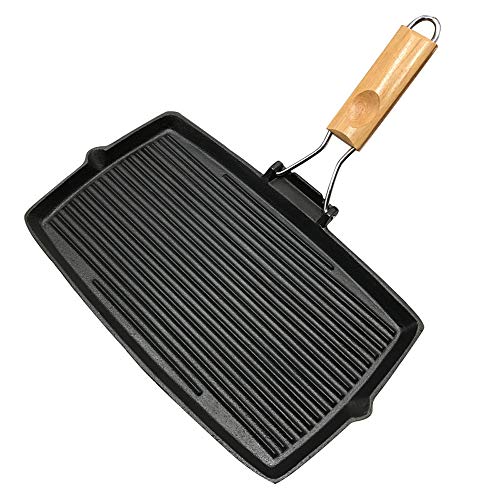
What sets it apart: a rectangular shape with wave-shaped ridges, but the design raises more questions than it answers.
CHYIR makes a rectangular cast iron skillet with a wavy bottom design and an insulated handle. The listing says it’s molded in one piece, good for baking, and the handle is streamlined and firm. One-piece construction means no separate handle attachment to fail, and the whole pan can go in the oven at whatever temperature the cast iron can handle. But the listing calls it “non-stick” cast iron, which is misleading. Bare cast iron is not non-stick unless seasoned, and the listing doesn’t mention seasoning. That’s a warning sign.
The rectangular shape is interesting for long items like skirt steak or multiple smaller cuts, but the wavy ridges may not drain fat as effectively as straight parallel ridges. The listing claims the waves help remove excess oil and heat evenly, but that’s an unusual design choice. Without a stated size or weight, you don’t know if this is a 10-inch or a 15-inch pan. The handle insulation is a plus for stovetop comfort, but again, whether that handle is oven-safe is unclear. I’d want to see the product in person or at least have detailed dimensions before buying this over the Northriver or NutriChef.
Pros:
- One-piece molded construction — no joints to loosen, and the pan is fully oven-safe if the handle is cast iron.
- Rectangular shape — fits longer cuts like skirt steak or multiple smaller steaks side by side.
- Insulated handle design — comfortable grip during stovetop use, per the listing.
Cons:
- “Non-stick” claim is vague — bare cast iron needs seasoning to release food; if it arrives unseasoned, you’ll do that work before cooking.
- No stated dimensions or weight — impossible to know if it fits your burner or cabinet before ordering.
Why It Stands Out
Perfect for: someone who specifically wants a rectangular cast iron pan for long cuts, and is willing to research the missing specs. Not great if: you want a predictable, well-documented steak pan; the Northriver and NutriChef are safer bets.
How To Choose A Cast Iron Grill Pan For Steak
Not every cast iron grill pan is the best grill pan for steak. Three decisions separate the ones that sear from the ones that steam.
What The Best Grill Pans For Steak Have In Common
A pan that’s heavy enough to hold 400°F when a cold ribeye hits it. A standard benchmark is a 1/4-inch zucchini strip: if the ridges char that strip, they’re tall enough for steak. The Northriver and NutriChef both pass that test on paper; the 9-inch budget pan does too, but its small surface limits throughput.
Bare Cast Iron vs Enameled Coating
Bare cast iron requires seasoning and rust prevention, but it develops the deepest crust. Enameled pans are easier to live with — no seasoning, less rust anxiety — but they give up a shade of browning. Both are food-contact safe, per the FDA. If you want maximum flavor, go bare. If you want weeknight convenience, go enameled.
Ridge Height and Fat Drainage
High ridges lift the steak out of its own fat, which prevents poaching and creates bold marks. Low ridges give more contact for browning but less drainage. Side spouts on the HCXCQLSUY and YYJINGYOU solve the drainage problem differently — you can pour off grease without tilting the pan at all. A 1/4-inch zucchini strip charred across the ridges tells you the channels are doing their job.
Oven-Safe Ratings — Check the Handle and Lid
Glass lids max out around 350–400°F. Wooden handles are worse. Only the NutriChef states a 500°F rating clearly; the bare cast iron pans without lids are fine in a hot oven, but if the handle is wood or plastic, you’re stuck on the stovetop. Always verify before broiling.
Our Final Recommendation
For overall winner, the Northriver Casting 10.5-inch grill pan earns it: bare cast iron browning, a useful glass lid, and a longer handle. For budget, the 9-inch kit with tong and brush gets you started without much spend. For easy cleaning with still-hot searing, the NutriChef 11-inch enameled pan is the clear runner-up. Skip the CHYIR and Davnjcka unless you know exactly what size you’re getting.
Frequently Asked Questions
How do I season a cast iron grill pan?
Wash the pan with warm soapy water, dry it completely, then rub a very thin layer of high-smoke-point oil (flaxseed, grapeseed, or canola) over the entire surface, including ridges and the outside. Place it upside down in a 450°F oven for one hour, then let it cool inside. Repeat two to three times. After each use, wash with hot water and a brush, dry immediately, and rub on the thinnest possible oil coat.
Enameled vs bare cast iron — which sears steak better?
Bare cast iron wins on crust depth because a well-seasoned surface reaches a higher effective temperature and develops more Maillard browning. Enameled cast iron holds heat nearly as well but the smooth coating resists that deep brown color. If you want the absolute darkest sear, go bare. If you want easier cleanup and no rust worries, enameled is the practical pick.
Can I put my cast iron grill pan in the oven?
Most bare cast iron pans are oven-safe to at least 500°F, but check the handle — wood, plastic, or silicone will fail. The NutriChef explicitly rates to 500°F. The Northriver’s glass lid caps at 350–400°F, so remove it before broiling. The 9-inch pan’s wooden handle means no oven finishing at all.
Why does my steak stick to the grill pan?
Sticking happens for three reasons: the pan isn’t hot enough, the steak is wet, or the seasoning is thin. Preheat the dry pan on medium-high for 4–5 minutes until a water drop dances. Pat the steak completely dry, then lay it in without moving it for 2–3 minutes. A well-seasoned bare pan or an enameled pan hot enough will release the steak when the crust forms.