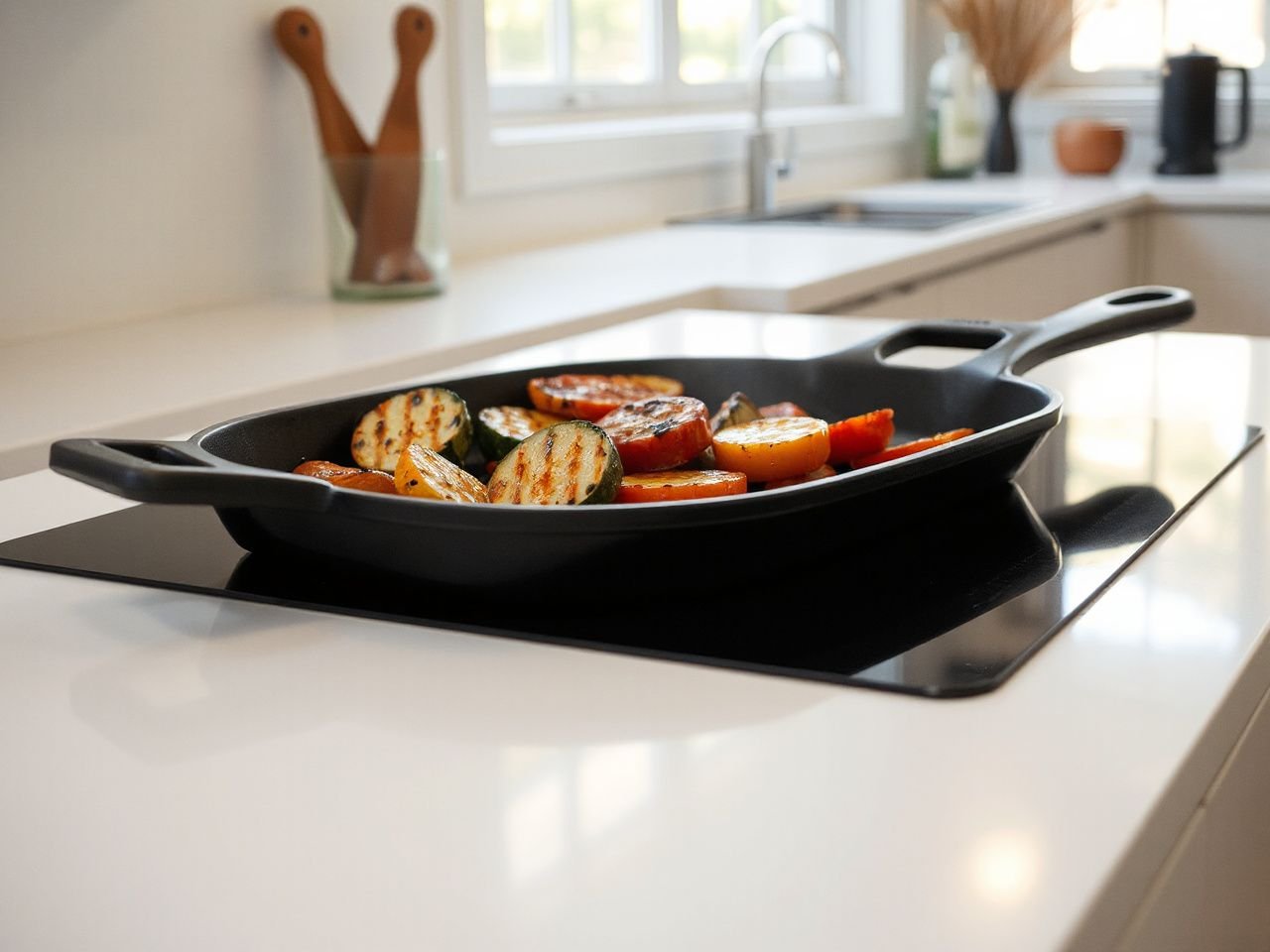
The moment you slide a properly seasoned, dead-flat cast iron grill pan onto your induction cooktop and hear that low hum as the coil locks onto the base — that’s the feeling you’re chasing. No hot spots, no warped center, just clean sear marks and a pan that sits there like it was made for your kitchen. But finding the best cast iron grill pans for an induction cooktop isn’t about grabbing any cast iron from the shelf; induction is picky, and the wrong pan turns dinner into a frustrating exercise in uneven browning. This list narrows things down to six pans that actually make sense on induction, and one stands out from the rest.
If you just want to skip the research, grab the Davnjcka Cast Iron Square Grill Pan — it couples reliably with induction coils, has deep ribs that drain fat properly, and its square base matches the burner zone better than most round pans. But the long answer involves base flatness, handle design, and whether you even need a reversible griddle. Keep reading for an honest look at which of these earns a spot in your kitchen and which one to pass on.
📌 This article contains affiliate links. As an Amazon Associate I earn from qualifying purchases, at no extra cost to you. Full disclosure.
CERTAIN CONTENT THAT APPEARS ON THIS SITE COMES FROM AMAZON. THIS CONTENT IS PROVIDED ‘AS IS’ AND IS SUBJECT TO CHANGE OR REMOVAL AT ANY TIME.


Comparison Table
| Product | Best For | Buy Link |
|---|---|---|
| NutriChef Cast Iron Reversible Grill Plate | Versatile two-sided cooking | Check Price |
| Davnjcka Cast Iron Square Grill Pan | Deep grill marks | Check Price |
| COVERCOOK Griddle Pan | No chemical coating | Check Price |
| Nuwave Cast Iron Grill Pan | Heavy-duty searing | Check Price |
| Viking Griddle | Reversible flat and ridged | Check Price |
| Cast Iron Reversible Grill Griddle | Budget double-sided option | Check Price |
How We Chose These Cast Iron Grill Pans for Induction
These picks come from comparing published specifications, materials, and documented features against what actually matters on an induction cooktop: the pan’s ability to couple with the coil. Base flatness and magnetic consistency are weighted above everything else, because induction doesn’t care how pretty your pan is if the center bows or the alloy won’t trigger the hob. Then consider rib depth — too shallow and you steam instead of sear, too deep and food burns before it colors. Handle design matters too: a short or metal handle that heats up directly over the coil is a burn waiting to happen, especially when working next to a cooktop lid. Before ordering any of these, run a quick magnet test on the pan’s base at the store or when it arrives; if a magnet sticks firmly across the entire bottom, the pan is suitable for induction heating. If it only grabs in spots, the alloy isn’t uniform enough for even induction heating. Also check the base diameter against your burner zone — a 12-inch pan on an 8-inch coil will leave cold corners, and that’s not something any seasoning will fix.
NutriChef Cast Iron Reversible Grill Plate
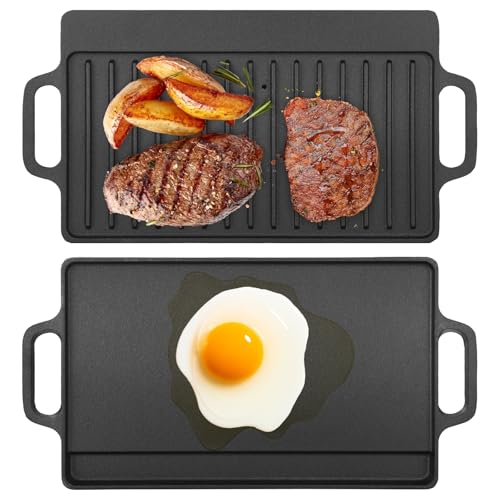
Quick take: This is the pan to grab when you want one piece of cast iron that does double duty without taking up two cabinets.
The NutriChef reversible plate is cast iron with a smooth side for eggs and pancakes and a ridged side for searing. It’s heat safe up to 480°F, which covers nearly every stovetop searing task you’d throw at it. The reversible design means you get two cooking surfaces from one hunk of iron, and the naturally nonstick surface develops over time with regular use and proper seasoning. On induction, the key is that both sides sit flat enough to make contact with the coil — no rocking, no high center. The smooth side works like a griddle for breakfast, while the ridged side handles steak and chops with distinct grill lines.
Where this design wins is versatility, but it gives up a little depth in the ribs compared to a dedicated grill pan. You can still get decent sear marks, though the ridges are moderate rather than deep. For induction specifically, the reversible plate’s dual-surface design means you’ll need to be careful which side faces down — the ridged side can trap a bit of air against the glass if it’s not machined perfectly flat, so a quick visual check for bowing before you buy is worth it. Compared to the Davnjcka square pan’s deep ribs, the NutriChef trades some grilling intensity for a smoother breakfast surface, so it’s for the cook who wants both functions but doesn’t need restaurant-grade char lines.
Pros:
- Reversible surfaces — smooth for pancakes, ridged for searing, one pan does both jobs.
- Heat safe to 480°F — high enough for serious stovetop browning without worrying about warping under normal use.
- Naturally nonstick cast iron — builds up a seasoning layer that releases food without chemical coatings, if you maintain it.
Cons:
- Rib depth is average — you’ll get grill marks, but not the deep char you’d get from a dedicated grill pan like the Nuwave.
- No stay-cool handle — the handle is cast iron and will get hot, so silicone oven mitts are mandatory on induction where the coil heats the entire pan fast.
Final Thoughts
Best for: Cooks who want a griddle and a grill pan in one compact piece and don’t mind seasoning both sides. Skip if: You prioritize deep sear marks and fat drainage over breakfast versatility — a dedicated square grill pan will serve you better.
Davnjcka Cast Iron Square Grill Pan
The short version: If you want a pan that screams induction compatibility and leaves proper grill marks, this square cast iron is a strong choice.
The Davnjcka is a square cast iron pan with deep ribs that drain excess oil to the bottom while leaving clear sear lines on meat and vegetables. The listing states it works with electric, gas, and induction cooktops, and it can also go in the oven, broiler, or over a campfire. The square shape matters on induction because most burner zones are round but the pan’s flat square base still covers more coil area than a round pan of similar dimensions, which means fewer cold spots in the corners as long as you center it properly. Deep ribs are the real selling point here: they hold food above rendered fat, so you get grilled texture instead of a braise.
This pan’s deep ribs are a double-edged sword. They’re excellent for searing thick steaks and courgettes that need that charred exterior, but they also produce more smoke than shallow ribs because fat drips onto the hot iron between the ridges. On induction, you’ll want good ventilation. The weight is on the heavier side for cast iron in this size, which is actually a plus for induction — heavier cast iron resists warping better than thin pans when the coil cycles on and off at high power. The main criticism is that the handle is not stay-cool by any stretch; on induction, the entire pan heats quickly, so plan to keep a silicone mitt or folded towel next to the hob. That said, Davnjcka’s explicit induction compatibility inspires more confidence on paper than pans that just assume cast iron works.
Pros:
- Explicit induction compatibility — the manufacturer states it works with induction, which is more than most listings bother to say.
- Deep ribs — produce pronounced grill marks and lift food out of grease, a healthier cooking method by default.
- Square base — matches the shape of many induction burner zones better than round pans, reducing unused coil area in the corners.
Cons:
- Smoke production — deep ribs plus rendered fat equals more smoke, so you’ll want a range hood or open window.
- All-cast-iron handle — no insulation, so it gets hot fast on induction; a silicone mitt is non-negotiable.
Why It Stands Out
Best for: Someone who wants deep grill marks, fat drainage, and a pan that won’t leave you guessing about induction compatibility. Skip if: You’re sensitive to smoke or prefer a reversible griddle for pancakes — this is a grill pan first and foremost.
COVERCOOK Griddle Pan
In a nutshell: A no-frills cast iron griddle with ribbed surface for anyone who wants a chemical-free pan that works on an induction hob without paying for a brand name.
The COVERCOOK is made from cast iron with a ribbed surface, and the listing is explicit that there’s no chemical coating — just bare, seasonable iron. It works on the induction hob and is described as having strong durability and thermal density, which is marketing speak for “heavy and holds heat well.” That thermal density is exactly what you want for slow cooking and even searing on induction, where a thin pan will cycle hot and cold as the coil pulses. The ribs on this pan are pronounced enough to give those charred stripes, but not so aggressive that you can’t cook vegetables without them falling into the troughs.
By the numbers, the COVERCOOK is the kind of pan that rewards patience with seasoning. Since there’s no factory chemical nonstick, you’re building a natural patina from day one, which means the first few cooks may stick slightly until oil polymerizes into the iron. That’s normal, not a defect, but it’s a commitment. On induction, the base needs to be flat and fully magnetic, and while the listing says induction hob compatible, I’d still do the magnet test because “cast iron” and “induction-ready alloy” are not always the same thing. Compared to the Davnjcka’s deep ribs, this pan’s ribs are slightly shallower, which means less smoke but also less dramatic grill marks. It’s a middle-of-the-road choice if you want ribbed cooking without the heaviest char.
Pros:
- No chemical coating — bare cast iron that you season yourself, so you control what’s on the cooking surface.
- Strong thermal density — holds heat well on induction, which means steadier temperatures for slow cooking and even browning.
- Induction hob compatible — the manufacturer states it works on induction, removing one layer of guesswork.
Cons:
- Requires diligent seasoning — without a factory coating, the first few cooks will stick more than a pre-seasoned pan, and you’ll need to oil it after every wash.
- Handle is cast iron — no stay-cool feature, so you’ll need a mitt; on induction the handle heats almost as fast as the cooking surface.
Our Take
Best for: Purists who want to build their own seasoning and avoid any chemical nonstick, even if it means extra maintenance. Skip if: You want something that performs well out of the box without a learning curve — this one asks for patience.
Nuwave Cast Iron Grill Pan

Here’s the deal: This is the heavy-duty option for people who want a grill pan that feels substantial on the hob and sears like a proper grill, not a compromise.
Nuwave’s grill pan is built from premium cast iron with side walls, a wide cooking surface, and deep grill ridges. The heavy-duty construction is the headline: heavier cast iron resists warping better than thin pans when induction coils cycle rapidly, which is a real concern if you crank the heat past medium. Deep ridges mean your steak sits above its own fat instead of simmering in it, and the wide cooking surface gives you room for a few chops without overcrowding. This pan is built for searing and browning, not for pancakes — there’s no flat side here, so it’s a dedicated griller.
What you give up with a pan this heavy is maneuverability. You will not be flipping this one-handed after a long day, and on induction, the entire mass soaks up heat quickly, so a two-handed grip with mitts is a must. The wide surface also means you need a burner zone that matches the base size; if your largest induction coil is 8 inches and this pan’s base is wider, the outer edges will stay cooler than the center. That’s not a defect, but it’s a sizing issue nobody talks about until the first burger comes out unevenly cooked. Compared to the Viking griddle’s reversible design, the Nuwave gives up versatility for pure grilling muscle. If you already have a flat griddle or just use a stainless skillet for eggs, this is the better searing tool.
Pros:
- Heavy-duty cast iron — the extra mass resists warping on induction and holds heat for a proper crust.
- Deep grill ridges — create genuine char lines and keep food elevated above rendered fat.
- Wide cooking surface — enough room for multiple portions without steaming them together.
Cons:
- Single-purpose — no flat side, so you can’t flip it over for pancakes or eggs; you’ll need another pan for breakfast.
- Weight — heavy enough that lifting it full of food requires two hands, and the cast iron handle gets very hot on induction.
The Real Deal
Best for: Serious grill marks and seared crusts without any compromise on rib depth or pan mass. Skip if: You want one pan that does everything or you have a small induction burner — this pan needs a large coil to heat evenly.
Viking Griddle

Why it earns a spot: A reversible design from a brand known for serious cookware, giving you a ridged grill surface and a flat griddle in one pre-seasoned piece.
The Viking griddle is a 2-in-1 cast iron pan with a ridged grilling side and a smooth flat side, pre-seasoned and ready to use. The listing says it’s compatible with gas, electric, and grill, and while it doesn’t explicitly name induction, most cast iron is magnetic enough to work — though I’d still do the magnet test since Viking’s wording is vague. Efficient heat retention is the selling point here: the pre-seasoned iron distributes heat evenly on the flat side, and the ridged side gives you those grilled stripes when you flip it over. On induction, the reversible design works as long as both sides sit flat against the glass; a slight bow on either surface means you’ll get uneven contact and hot spots.
This pan’s appeal is flexibility. One piece of cast iron replaces a griddle and a grill pan, which matters if your kitchen storage is tight. However, the reversible design often means neither side is as specialized as a dedicated pan: the ridges are typically moderate, and the flat side is smaller than a full griddle. For induction, the key is checking flatness before you commit — reversible pans are more prone to warping because they’re heated from both sides over time, and once a reversible pan bows even slightly, it becomes a pain on an induction hob. Weight is moderate, so it won’t strain your wrists, but the handle is cast iron and gets hot, so mitts remain non-negotiable.
Pros:
- Two cooking surfaces — ridged for grilling and smooth for pancakes, eggs, or flatbread, all in one pan.
- Pre-seasoned — ready to use immediately, with a natural nonstick surface that improves over time.
- Efficient heat retention — the cast iron holds and distributes heat well, which is exactly what you want on induction’s pulsing coils.
Cons:
- Induction compatibility not explicitly stated — cast iron usually works, but the listing is vague, so you’ll need to verify with a magnet before buying.
- Handle gets hot — no stay-cool feature, and the reversible design means the handle sits close to the coil on one side.
Who Should Buy This
Best for: The cook who wants a griddle and a grill pan but doesn’t want two separate pieces of cast iron taking up cabinet space. Skip if: You need maximum rib depth for serious char — the Viking’s ridges are functional but not as deep as the Davnjcka or Nuwave.
Cast Iron Reversible Grill Griddle
What sets it apart: A budget-friendly reversible griddle that gives you a ribbed side for searing and a smooth side for breakfast, all pre-seasoned and ready right out of the box.
This is a double-sided cast iron pan with a ribbed side for steaks, chops, bacon, fish, and chicken, and a flat side for pancakes and eggs. It’s pre-seasoned with vegetable oil, so you can cook immediately without doing a full seasoning round first. The cast iron construction gives fast and even heat distribution, and excellent heat retention keeps food warm on the table. For induction, the big question is flatness — reversible pans like this are only as good as their machining, and a slightly warped base will cause uneven heating on a glass hob.
Where this pan wins is value and simplicity. You get two cooking surfaces without a premium brand markup, and the pre-seasoning removes the initial friction for new cast iron users. The trade-off is that the ribs are likely moderate rather than deep, so you won’t get the dramatic grill marks that the Davnjcka produces. The handle is cast iron, so it gets hot quickly on induction, and the reversible design means you’ll want to check both sides for flatness with a straight edge before you buy. As an entry point into cast iron for induction, it’s a reasonable choice if you’re on a tight budget and willing to accept that the sear won’t be restaurant-grade. If you’re serious about grilling performance, spend a bit more and get a dedicated square pan.
Pros:
- Reversible and pre-seasoned — ready to use out of the box, no initial seasoning required, and two surfaces in one pan.
- Fast, even heat distribution — cast iron conducts heat well across the base, assuming good contact with the coil.
- Budget-friendly — this is the entry-level option for cast iron on induction without spending premium money.
Cons:
- Moderate rib depth — you’ll get grill marks, but not the deep char that dedicated pans deliver.
- Handle not stay-cool — cast iron handle heats up fast on induction, so a mitt is essential.
Quick Verdict
Best for: First-time cast iron users who want a reversible griddle without spending much. Skip if: You cook steak often and want serious sear marks — this pan’s ridges are too shallow for that level of char.
Buying Guide: Cast Iron Grill Pans That Actually Work on Induction
Induction cooking is different from gas or electric because the pan itself is the heating element. That means two things matter above all else: the base must be magnetic, and it must be flat. Before we get into the details, remember that cast iron is generally magnetic, but some alloys or poorly cast pans have inconsistent magnetic properties across the base. If a magnet doesn’t stick firmly to every square inch of the bottom, your induction coil will only heat the parts that are magnetic, and you’ll get hot spots and cold spots. Before you buy, check the manufacturer’s claim of induction compatibility, and if it’s not stated (like with the Viking griddle), do the magnet test yourself. Let’s break down the other factors.
What to Look For in the Best Grill Pans for an Induction Cooktop
Base thickness and flatness. Induction coils cycle on and off rapidly at high power, and that thermal cycling can warp thin cast iron over time. A heavier base like the Nuwave’s heavy-duty construction or the Davnjcka’s solid square base resists warping far better than thin reversible pans. Check for a perfectly flat bottom with a straight edge; even a 1/16-inch bow will create a hot ring where the pan contacts the glass and a cool center where it doesn’t. Reversible griddles are more prone to warping because they’re heated from both sides during use, so inspect them especially carefully.
Rib depth and shape. The depth of the ridges determines whether you sear or steam. Too shallow, and food sits in its own juices and never develops those dark char lines. Too deep, and food burns where it touches the iron before the top cooks, and you get excessive smoke as fat drips between the ridges. When judging rib design, consider how a 1/4-inch-thick slice of zucchini would sit across the ridges — if the slice straddles the valleys without contact, it’ll char on the peaks but stay raw in the troughs. The Davnjcka’s deep ribs are great for thick steaks but smoky for vegetables; the COVERCOOK’s moderate ribs strike a better balance for mixed cooking. A 10.25-inch square skillet is a common footprint in this class, so size your pan to your largest induction burner zone to avoid cold corners.
Handle design and safety. On induction, the entire pan heats quickly, including the handle if it’s cast iron. None of the six pans here have stay-cool handles, which means you need silicone oven mitts or a thick towel every time you touch them. Look for a handle length that keeps your hand away from the coil and allows the pan to sit without crowding adjacent burners. Also, cast iron will scratch a glass-ceramic induction cooktop if you slide it across the surface — always lift, never drag. The FDA regulates food-contact materials, and bare cast iron that’s seasoned with vegetable oil is compliant, but avoid pans with unknown chemical coatings if you can’t verify the safety data.
Pre-seasoned vs. bare iron. Pre-seasoned pans like the Viking and the generic reversible griddle are ready to use immediately, while bare iron like the COVERCOOK requires you to build up a seasoning layer through repeated oiling and heating. Both work on induction, but pre-seasoned is friendlier for beginners. A preseasoned pan can still stick if you add cold food to a hot pan or don’t use enough fat during the first few cooks. Remember that seasoning is not a one-time event; you maintain it by oiling after every wash and avoiding harsh soaps. If you’re new to cast iron, our cast iron grill pan buying guide walks through the most common seasoning mistakes people make in 2026.
Our Final Recommendation
For most people cooking on induction, the Davnjcka Cast Iron Square Grill Pan is the clear winner: explicit induction compatibility, deep ribs for proper grill marks, and a square base that covers more coil area than round pans. If you’re on a tight budget, the generic Cast Iron Reversible Grill Griddle gives you two cooking surfaces and pre-seasoning for very little money. And if you want the most robust, heavy-duty searing surface without a reversible compromise, the Nuwave Cast Iron Grill Pan is the premium pick. Skip the reversible pans unless storage space is your top concern — most of them sacrifice rib depth and flatness, and that’s exactly what induction punishes.
Frequently Asked Questions
How do I know if a cast iron grill pan is compatible with my induction cooktop?
Run a magnet across the base. If it sticks firmly and evenly everywhere, the pan will couple with your induction coil. Some cast iron alloys have inconsistent magnetism, so check the entire bottom, not just one spot. Also look for manufacturer statements like “induction-ready” or “works with induction”; Davnjcka and COVERCOOK list this explicitly, while others like the Viking griddle leave it vague, so the magnet test becomes your best friend.
Can I use a reversible grill griddle on induction, or will it warp?
Yes, you can use a reversible griddle on induction, but flatness is critical. Reversible pans are more prone to warping over time because they’re heated from both sides. Before you buy, place the pan on a flat counter and press down on opposite corners — if it rocks at all, it will cause hot spots on induction. The Viking and the generic reversible griddle are both fine if they pass the flatness check, but dedicated square pans like the Davnjcka tend to hold their flatness longer because the base is thicker and less likely to flex.
Why does food stick to my cast iron grill pan even when it’s pre-seasoned?
Pre-seasoning isn’t a magic nonstick surface. Food sticks when the pan isn’t hot enough before you add oil, or when you add cold food straight from the fridge. On induction, heat the pan gradually to medium for a few minutes, add oil, then wait until the oil shimmers before adding food. Also, never use soap on cast iron; it strips the seasoning. The one pot marry me chicken pasta recipe is a good example of how a well-seasoned cast iron surface should release food after a proper preheat — no sticking, no scraping. And if you’re building seasoning on a bare pan like the COVERCOOK, expect the first few cooks to stick a little until the patina develops.