A box the size of a small microwave lands on the counter, and within two weeks it has been pushed to the back of the pantry because the space never actually worked. The buyer assumed two baskets meant double the food, but the real failure was not measuring the counter or understanding how the independent controls actually function. This dual basket air fryer buying guide exists to prevent that exact outcome, and to show what separates a genuinely useful two-zone machine from a bulky single-purpose gadget that either earns the room it takes or does not.
Key Takeaways
- A dual basket air fryer has two independently heated chambers with their own fans, so you can cook a protein at 400°F while vegetables roast at 350°F in the same unit.
- Sync Finish (or Smart Finish) is the feature that makes both baskets finish at the same time; without it, you are just using two separate timers.
- Measure your counter before buying: most dual-basket models are wider than a standard toaster and need at least 15 inches of depth.
- Airflow matters more than capacity; overloading either basket turns crisp food into steamed food.
What Actually Makes a Dual Basket Different From a Regular Air Fryer
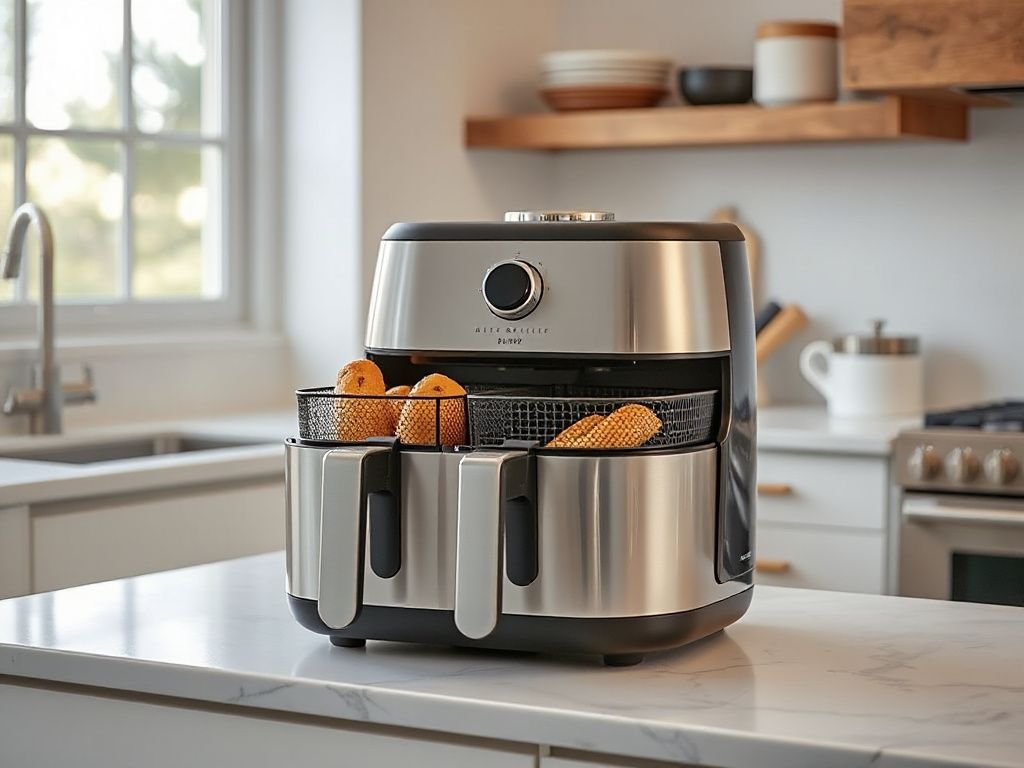
A dual basket air fryer is not two single-basket fryers glued together. Each chamber has its own heating element and its own circulating fan, which means one side can run at 400°F for crispy chicken while the other holds at 325°F for a delicate vegetable or a cake pan. That independent temperature and time control is the whole point of the design.
The second critical distinction is the finish-sync function. On a regular single-basket air fryer you cook one thing, then start the other, and either the first gets cold or you reheat it. A dual-basket model lets you set a longer cook time on one side and a shorter on the other, then press a sync button. The shorter basket waits to start until the remaining times match, so both baskets beep at the same moment. Ninja calls this Smart Finish; other brands, including Cosori and Instant Pot, call it Sync Finish. The name differs but the behavior is identical.
For anyone comparing a dual-basket unit to a larger single basket, the trade is control versus raw volume. A 10-quart single basket might hold a whole chicken, but you cannot cook roasted potatoes at 425°F and the chicken at 375°F in the same space. A dual-basket model with two 5-quart baskets gives up that whole-bird capacity and gains simultaneous cooking at different settings. The decision comes down to how often you cook a single large item versus a protein plus a side.
A dual basket air fryer pairs two independently heated cooking chambers with a single control panel, allowing a protein and a side to cook at different temperatures and finish at the same time. For a detailed look at how one of these brands implements the dual-zone idea, our Ninja air fryer review walks through the actual control layouts on that brand.
The Dual Basket Air Fryer Buying Guide Starts With Your Counter
No feature matters if the machine does not fit where you cook. Before looking at wattage or basket coating, pull out a tape measure. Most dual-basket air fryers are wider than a standard toaster oven and deeper than a single-basket model because they house two fans, two heating elements, and two drawers. The listed width on the box is the machine’s widest point, but you also need to leave clearance behind the unit for the exhaust vent. A safe rule is to add four inches to the listed depth for airflow.
For a family of four, capacity gets tricky. Two 4-quart baskets total eight quarts, but you cannot put an eight-quart chicken in them. You get two separate 4-quart zones. That works for four chicken thighs in one basket and a pound of potatoes in the other, but a whole roasted chicken or a full sheet pan of vegetables will not fit. If your household regularly cooks a single large item, a larger single-basket air fryer or a countertop convection oven might serve you better. A Ninja air fryer review notes that single-basket models handle whole proteins more easily, though they give up the two-zone timing.
Basket sizes are not always equal. Some designs pair a 5-quart basket with a 3-quart side, which gives you flexibility but changes how you plan meals. Other models use two identical 4.5-quart drawers. Check the per-basket capacity listed on the specification sheet, not just the total capacity printed on the front of the box. The two numbers tell very different stories about what you can cook.
Before ordering, measure the depth of your counter from backsplash to front edge; a dual basket air fryer needs at least 15 inches of depth to sit without hanging over.
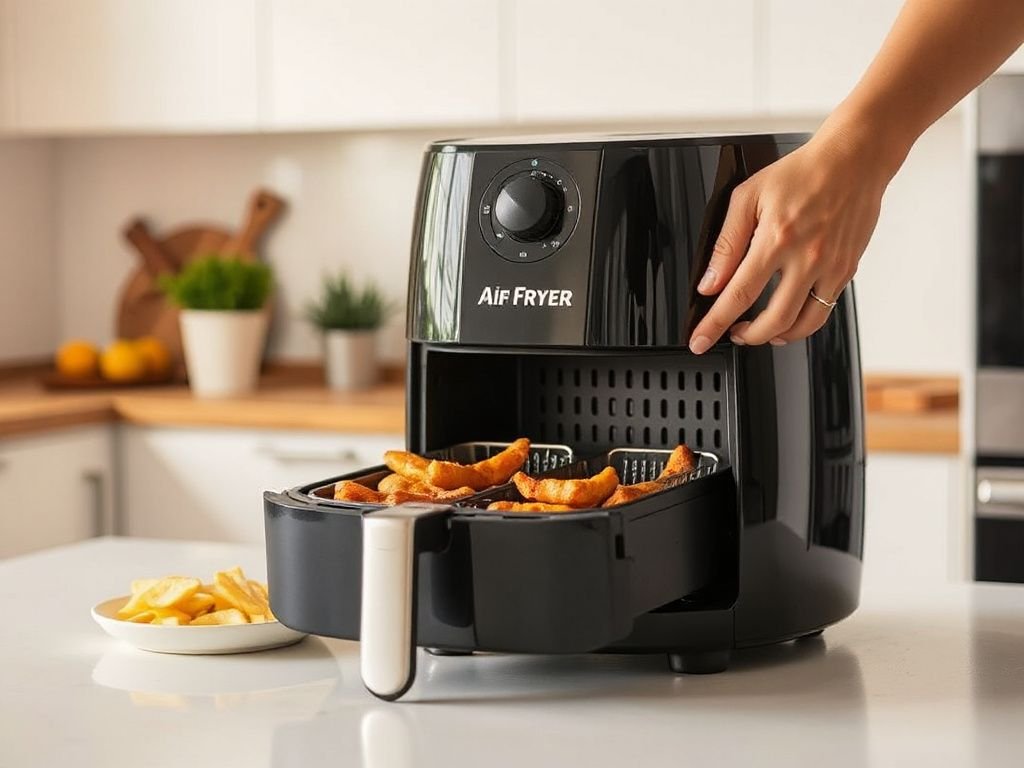
Controls: Sync Finish, Smart Finish, and Independent Timers
The control panel is where a dual basket air fryer either earns its price or becomes a source of frustration. You need four things to be independently adjustable: temperature for basket one, time for basket one, temperature for basket two, time for basket two. Some budget models force you to set both baskets to the same temperature even though the baskets are separate. That defeats the purpose. Check the product manual or the online listing for the phrase ‘independent temperature control’ before you buy.
Once both baskets have their own settings, the next question is whether the machine can sync the finish times. Here is how it works in practice:
- Set basket one to 400°F for 25 minutes for bone-in chicken thighs.
- Set basket two to 350°F for 12 minutes for broccoli florets.
- Press Sync Finish (or Smart Finish).
- The unit calculates that basket two should start 13 minutes later.
- Basket one starts immediately; basket two waits, then starts automatically.
- Both baskets beep done at the same time.
You can absolutely set one basket to finish earlier than the other by not using the sync function and just starting both at the same time. The earlier basket will beep while the other is still cooking, and you can pull that basket out. That is useful when you want a snack ready before the main course, or when the side dish needs to rest.
Difference between sync finish and smart finish is entirely branding. Smart Finish is Ninja’s trademark for the same behavior other manufacturers call Sync Finish. The underlying logic is identical: match the end times by delaying the start of the shorter basket. If a brand uses a different term, read the description to confirm it means both baskets finish together, not just that both timers are visible on one screen.
Sync finish uses the longer cook time as the anchor; the shorter basket waits to start until the remaining times match, so both finish together.
Materials, Cleaning, and What Touches Your Food
The baskets and crisper trays are the parts that contact food, so material matters. Most dual basket air fryers ship with a non-stick coating on both the basket and the removable tray. That coating makes cleanup easy but it wears down with abrasive scrubbers, metal utensils, and repeated dishwasher cycles. Some models offer stainless steel baskets instead, which tolerate harsher cleaning but require more oil to prevent sticking. The listing or manual will state whether the baskets are dishwasher-safe; do not assume.
Food-contact materials should carry a certification from a recognized body. In the United States, NSF International tests food-contact plastics and coatings for leaching, while the U.S. Food and Drug Administration regulates the substances allowed in food-contact surfaces. A basket without any listed certification is not automatically unsafe, but a marking from NSF or a statement of FDA compliance gives you a verifiable standard instead of a marketing phrase.
For electrical safety, look for a UL listing or an ETL mark from Intertek. Both indicate the appliance has been tested against a recognized safety standard for fire and shock hazards. The Consumer Product Safety Commission maintains a searchable recall database; checking a model against that list before buying takes two minutes and can spare you a known defect.
Hand washing with warm, soapy water and a soft sponge is the safest route for any non-stick basket, even if the manufacturer says dishwasher-safe. Dishwasher detergents are strongly alkaline and can etch the coating over time, leaving it dull and less slippery. If you do use a dishwasher, place baskets on the top rack and skip the heated dry cycle. Stainless steel baskets can go on any rack but may show water spots; a quick towel dry fixes that.
Dishwasher detergents are strongly alkaline and can dull a non-stick coating over time, so hand washing with warm soapy water extends the life of the basket.
Airflow, Overloading, and Why You Still Need to Shake
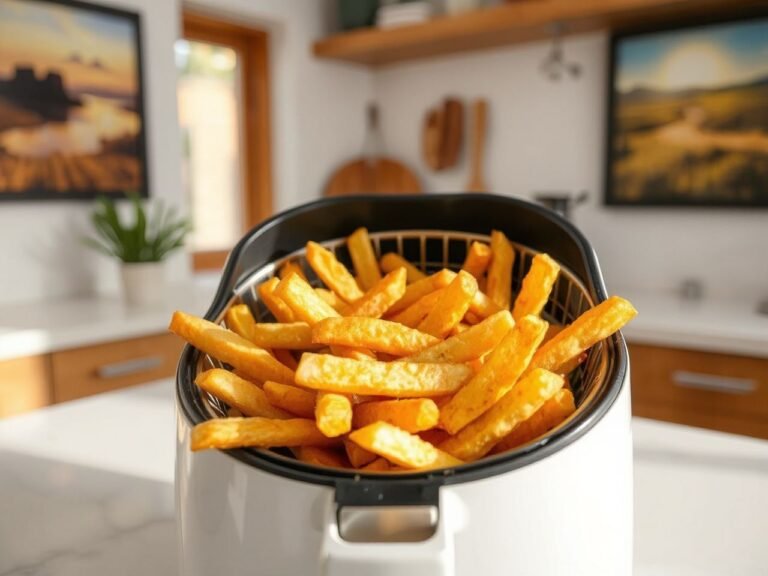
Air frying works by pushing hot air rapidly around food, which strips moisture from the surface and creates browning. Each basket in a dual-basket unit has its own fan and heating element, but that does not mean you can fill both drawers to the brim. Air needs space to circulate between pieces. If you pack fries edge-to-edge, the middle pieces steam instead of crisp, and you get a soggy pile with a few crunchy edges.
The practical rule is to fill each basket no more than half to two-thirds full for anything you want crispy, and to arrange food in a single layer whenever possible. That is less food per batch than the basket’s volume suggests, and it is the single biggest source of disappointment for new owners. A 4-quart basket does not crisp four quarts of fries; it crisps about two and a half quarts arranged loosely.
Shaking or flipping is still necessary, even with two separate cooking zones. The fan moves air in a pattern, and food closest to the heating element browns faster. For small items like fries or Brussels sprouts, pull the basket out at the halfway point and give it a shake. For larger pieces like chicken thighs or fish fillets, flip them once with silicone tongs. Some newer models advertise a reminder to shake, but the action itself does not change.
Overloading also increases cook time and can trip the overheat protection, which shuts the unit off mid-cycle. That is a safety feature, not a defect. If the unit shuts down during a full-basket cook, reduce the load and restart.
Each basket has its own fan, but packing food edge-to-edge blocks the circulating air and produces steamed food instead of crisp edges.
Energy Use, Running Costs, and the Single-Basket Option
Dual basket air fryers draw more power than single-basket units because they have two heating elements. A typical dual-basket model lists a total wattage between 1,600 and 1,800 watts, while a single 5-quart air fryer usually runs 1,400 to 1,500 watts. That sounds like a jump, but the cook time is often shorter because you are cooking two things at once instead of sequentially.
At the national average residential electricity rate of 16 cents per kilowatt-hour, a 1,700-watt air fryer costs about 27 cents for every hour of continuous use. The U.S. Department of Energy publishes rate data if you want to check your local cost. A full meal that takes 25 minutes in both baskets uses roughly 0.7 kilowatt-hours, or about 11 cents. Heating a full-size electric oven for the same task typically uses two to three times that energy because the oven cavity is larger and takes longer to preheat.
Many dual-basket models let you run only one side, which cuts the draw roughly in half. If you are just reheating a single portion, use one basket and leave the other empty. The manual will state whether the empty basket’s fan also runs; if it does, the draw is not cut exactly in half because the control electronics and second fan still consume a small amount. But the difference is negligible.
Running a 1,700-watt air fryer for 30 minutes at 16 cents per kilowatt-hour costs about 13.6 cents, cheaper than heating a full-size electric oven for the same task.
Common Problems, Sticking Food, and the Cake Question
The problems people report most often with dual-basket air fryers fall into a few predictable categories: smoke from accumulated grease, a plastic smell during the first few uses, food sticking to the basket, and uneven cooking from overloading. Most of these are manageable with habits rather than repairs.
Smoke usually means grease or food particles built up under the crisper tray or on the heating element. Clean the basket and tray after every use, and occasionally wipe the area above the basket where splatter collects. A plastic smell is normal for the first two or three runs; run the unit empty at 400°F for 10 minutes before cooking to burn off manufacturing residues. If the smell persists after a week of use, contact the manufacturer.
Food sticking is largely a coating issue. Non-stick baskets lose their slipperiness over time, especially with metal tongs or forks. Use silicone or wooden tools, and give the basket a light spray of oil before adding food. Air fryer parchment liners with holes also reduce sticking without blocking airflow, but avoid solid parchment sheets that curl and trap moisture. The Gourmia air fryer review notes that some Gourmia models include a non-stick basket that responds well to a light oil rub, but the same principle applies to any brand.
Baking a cake in one basket while air frying chicken in the other is possible but quirky. Set the cake side to 325°F with a solid cake pan (not the perforated tray), and set the chicken side to 375°F. The high-speed fan in an air fryer dries out cake batter, so a solid pan with reduced airflow helps. It will not be a bakery-quality crumb, but it works for a small quick bread or a 6-inch round. Use the sync function if you want the cake to finish right as the chicken rests.
Most non-stick coatings fail because metal utensils scrape them; use silicone or wooden tools and the basket will stay intact for years.
Frequently Asked Questions
What is the most important feature to check before buying a dual basket air fryer?
This dual basket air fryer buying guide highlights two must-haves: independent temperature and time controls for each basket, and a sync finish function. Without independent controls, you cannot run chicken at 400°F and vegetables at 350°F simultaneously. Without sync, you are just using two timers. Measure your counter before either feature matters.
Can I cook two completely different foods with different temperatures at the same time?
Yes, that is the primary reason to buy a dual-basket model. Each basket has its own heating element and fan, so one side can roast at 425°F while the other bakes at 300°F. Press the sync button and the shorter basket will start late so both finish together. If you prefer staggered finish, set both baskets and ignore the sync function.
Do the two baskets have to be the same size?
No. Many dual-basket air fryers use two identical 4- or 5-quart drawers, but some designs pair a larger basket with a smaller one. This gives you flexibility to cook a main in the big side and a small side in the other. Always check per-basket capacity on the spec sheet, because total capacity printed on the box can hide an unequal split.
Are dual basket air fryers more expensive to run than a single air fryer?
They draw more watts—typically 1,600 to 1,800 total versus 1,400 for a single. But you cook two items at once, so total kitchen time drops. Running one basket only cuts the draw roughly in half. At 16 cents per kilowatt-hour, a 25-minute dual-basket meal costs about 11 cents, which is cheaper than using a full-size oven.