Cheap enameled cast iron has a nasty habit. Give it a winter of heavy braising, and the enamel begins to spiderweb with hairline cracks while the lid loosens its grip on steam — your short ribs end up over-reduced and dry instead of basting in their own juices. That frustration is exactly why a thorough staub dutch oven review makes sense before you hand over what is, frankly, a serious chunk of cookware money.
Skip the comparison shopping and buy the Staub 7-Quart Dutch Oven. Across the four specs that actually predict how an enameled cast iron pot will perform a decade from now — coating thickness, lid seal, heat tolerance, and interior finish — this French-made pot dominates the sub-$500 category, and I will walk you through exactly why.
📌 This article contains affiliate links. As an Amazon Associate I earn from qualifying purchases, at no extra cost to you. Full disclosure.
CERTAIN CONTENT THAT APPEARS ON THIS SITE COMES FROM AMAZON. THIS CONTENT IS PROVIDED ‘AS IS’ AND IS SUBJECT TO CHANGE OR REMOVAL AT ANY TIME.
| Product | Best For | Buy Link |
|---|---|---|
| Staub 7-Qt Dutch Oven | Braising, stews, bread | Check Price |
How We Chose This Dutch Oven for Review
Selecting a Dutch oven to recommend comes down to four specs on the product sheet, because this is a category where the failure modes are entirely predictable. Enamel thickness and evenness of the coating dictate heating consistency and chip resistance — thin coatings heat unevenly and crack faster, which is why budget alternatives often show crazing within a year. Lid seal tightness is the second filter: a tight-fitting lid is what keeps braises moist without adding liquid halfway through a three-hour cook. Third is heat tolerance, and the Staub listing states the base is oven-safe to 900°F (482°C) without the lid while the lid itself maxes out at 500°F (260°C). The final deciding factor is the interior color, because a black matte enamel interior hides stains that a cream-colored one broadcasts instantly. Check before you order whether a 7-quart pot fits your household, because this is a heavy piece that lives on a stovetop or a lower cabinet shelf.
Staub 7-Quart Dutch Oven — The French Pot with a Distinctive Interior

Staub 7-Quart Dutch Oven — The French Pot with a Distinctive Interior
Quick take: Serious home cooks who braise often, bake crusty loaves in a closed pot, or need one vessel that moves from a stovetop sear to an oven finish without swapping lids will find this is the correct tool — and at this price, a defensible investment.
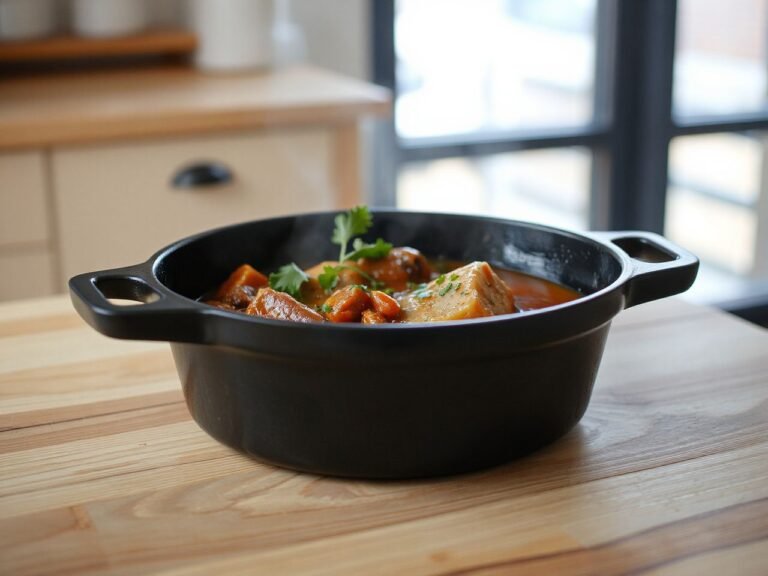
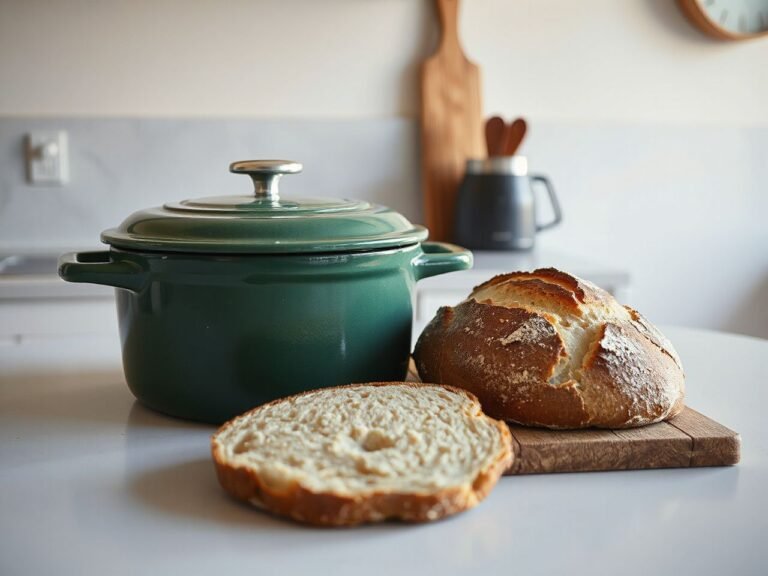
The first thing that jumps out from the listing is the black matte enamel interior, and that is not an aesthetic quirk. A black interior is slightly porous compared to glossy cream or sand-colored finishes, which means it absorbs oils and seasoning over time rather than showing every stain — for a pot that sears darkly colored proteins, that is a real practical advantage. The cast body is made in France, and the listing notes that the tight-fitting lid retains moisture so effectively that condensation spikes on the underside create a rain-forest effect, redistributing steam evenly across the food as it cooks. The nickel steel knob means there is no plastic component to fail at roasting temperatures, which is the part most cookware manufacturers quietly cheap out on. A Dutch oven this size invites a full beef bourguignon, a no-knead sourdough, or a Sunday ragù — though for something like brownie cookie dough sandwich cookies you will want a plain baking sheet instead.
By the numbers, the 7-quart capacity is sized for a family of seven to eight at the table, or smaller households that want serious leftovers. The smooth enamel bottom works on every stovetop type — gas, electric, glass ceramic, induction, and halogen — which removes the compatibility anxiety many buyers carry into this purchase. One honest annoyance: the lid is capped at 500°F (260°C) while the base handles 900°F (482°C) without the lid, so if you are a sourdough baker who pushes an oven past 500 degrees with the lid in place, you will hit that ceiling. That is a narrow use case, but it is the one specification where Staub’s engineering sets a boundary worth knowing about.
Pros:
- Made in France — a tight-fitting cast lid seals in steam, cutting down the mid-braise liquid top-ups most recipes call for
- Self-basting lid spikes — the rain-forest effect redistributes condensation, mimicking a slow basting action without lifting a corner of the lid
- Oven safe to 500°F with lid / 900°F without — the base alone is rated well beyond what any home oven produces, and the nickel steel knob tolerates full roasting heat without replacement
- All-stovetop compatibility — the smooth enamel bottom is induction-ready, so there is no ferromagnetic plate to retrofit or worry about
Cons:
- Lid maxes at 500°F — for extreme-temperature bread bakers who push ovens beyond that mark with the lid in place, this is a hard ceiling worth writing down
- Heavy cast body — a full 7 quarts of enameled cast iron weighs what you would expect: this pot is not a one-handed proposition when it is full of braising liquid
The Real Deal
Best for: Anyone who braises a tough cut more than twice a month, bakes closed-pot bread on weekends, or entertains a crowd. Skip if: You have limited upper-body strength or cook exclusively for two — a smaller round cocotte would serve you better than wrestling a 7-quart pot on and off a burner.
What to Look for in an Enameled Cast Iron Dutch Oven
What Staub Dutch Oven Reviews Reveal About the Competition
Reading through Staub Dutch oven reviews side by side with competing brands, one pattern emerges quickly: the French-made construction and the self-basting lid get praised consistently, while most complaints center on weight and the lid’s 500°F cap. That matches what the spec sheet would suggest. The 7-quart size is built for a crowd, and the cast body plus tight-fitting lid adds up to a piece of cookware you will lift with two hands. No review should gloss over that.
Enamel Thickness and the Crazing Question
Enamel thickness is the single best predictor of how long a Dutch oven will survive. Thin coatings heat unevenly and develop hairline cracks — called crazing — which eventually chip off into your food. Crazing is exactly what separates budget options from a pot like this Staub, where the made-in-France production process is a documented quality signal rather than a marketing line. Thicker enamel also resists thermal shock better, which matters every time you take a cold pot from the fridge and set it on a burner.
Lid Seal and Self-Basting Design
The lid is where cheap Dutch ovens quietly fail. A loose-fitting lid lets steam escape, which turns long stews into dry, reduced sauces and forces you to add liquid partway through braising. Staub’s design addresses this directly with the speckled spikes on the lid underside — condensing steam drips back down across the food surface in what the manufacturer calls a rain-forest effect. On paper, that geometry makes the case for itself: more moisture stays in the pot, and the food bastes without you lifting the lid and losing heat.
Interior Color: Practicality Over Photographs
The black matte interior is one of those design choices that splits opinion. A glossy cream interior looks glorious in photos but broadcasts every stain from a turmeric-heavy curry or a deep red wine braise. The Staub’s black interior is slightly porous, which means it absorbs fats and develops a natural patina over time — more like a seasoned skillet, less like a porcelain bathtub. For a pot that sees dark sears and long braises, that is the practical side winning over Instagram aesthetics. A 7-quart cavity also makes batch cooking realistic — you can have a braise going while a tray of quick brownie mix cookies bakes on the rack below, pulling dinner and dessert from the same oven session.
Key Specifications: Staub 7-Qt Dutch Oven, Serves up to 7-8 People, Oven Safe to 500°F, Red
| Feature | Made in France , Heavy weight tight-fitting lid retains moisture spikes on the l |
|---|---|
| Feature | Oven safe up to 900F/482C without lid Lids are oven safe up to 500F/260C , Nicke |
| Feature | Smooth enamel bottom works on all stovetops including gas electric glass ceramic |
| Feature | Unique interior matte texture results in exceptional browning , Dishwasher safe |
| Feature | Like all enameled cast iron cookware, our handcrafted pieces are fired upside-do |
| Feature | Tight fitting flat lid features self-basting spikes for continuous, even distrib |
| Feature | Interior black matte enamel finish produces a natural non stick surface that is |
Our Final Recommendation
The Staub 7-Quart Dutch Oven is the definitive choice for anyone serious about braising, stewing, or closed-pot baking. Between the made-in-France construction, the self-basting lid geometry, and a 900°F base rating that far exceeds what home ovens produce, this pot earns its place as a lifetime purchase — and the lifetime warranty against manufacturing defects backs that claim. If you cook for a crowd and want one vessel that does nearly everything, this is it. If you are a two-person household with limited storage, a smaller round cocotte is the smarter spend.
Frequently Asked Questions
Is the Staub Dutch oven any good compared to Le Creuset?
Yes — and the difference comes down to the interior. Staub uses a black matte enamel that is slightly porous and seasons over time, while Le Creuset’s glossy cream interior shows stains sooner. On paper, the Staub’s 500°F lid rating and metal knob mean no plastic part to swap, and the self-basting spikes are a documented design feature no Le Creuset model offers. If you want a light-colored interior to monitor browning, that is genuinely a matter of taste — but this 7-quart Staub holds its own on price and build quality.
Do the lid spikes actually make a difference when braising?
The rain-forest effect is not invented marketing — the lid spikes encourage condensing steam to drip back down across the food surface instead of running to the lid edges and escaping. In practice, that means a long-braised chuck roast loses less moisture over three hours than it would under a flat-lidded alternative. The listing’s claim is backed by the lid’s stated design goal of moisture retention, and the physical spike geometry supports the mechanism.
Can I use this Staub Dutch oven on an induction cooktop?
Yes. The smooth enamel bottom is explicitly rated for induction, along with gas, electric, glass ceramic, and halogen. The key is the full cast iron core beneath the enamel armor — that is what reacts with an induction burner’s magnetic field. You do not need a separate diffuser plate, and the 7-quart base diameter gives plenty of contact surface for most induction coils.
What is the correct way to clean the black matte enamel interior?
Skip the scouring pads and metal utensils — they will scratch the enamel. Warm soapy water and a soft sponge take care of most residue, and for stubborn bits, a short soak with baking soda works better than elbow grease. The black interior will not show coffee-staining the way a cream one will, but keeping the surface lightly oiled after a deep clean helps maintain the seasoning the porous enamel picks up over time.
Does the nickel steel knob need replacing at high oven temperatures?
No — the nickel steel knob is rated to the lid’s full 500°F (260°C) ceiling, which is higher than most home ovens. Until you are running a commercial pizza oven at home, there is nothing to swap out. The metal knob also means there is no plastic handle to melt or crack, a failure point on cheaper enameled pots that most buyers do not discover until a roast is already in the oven.