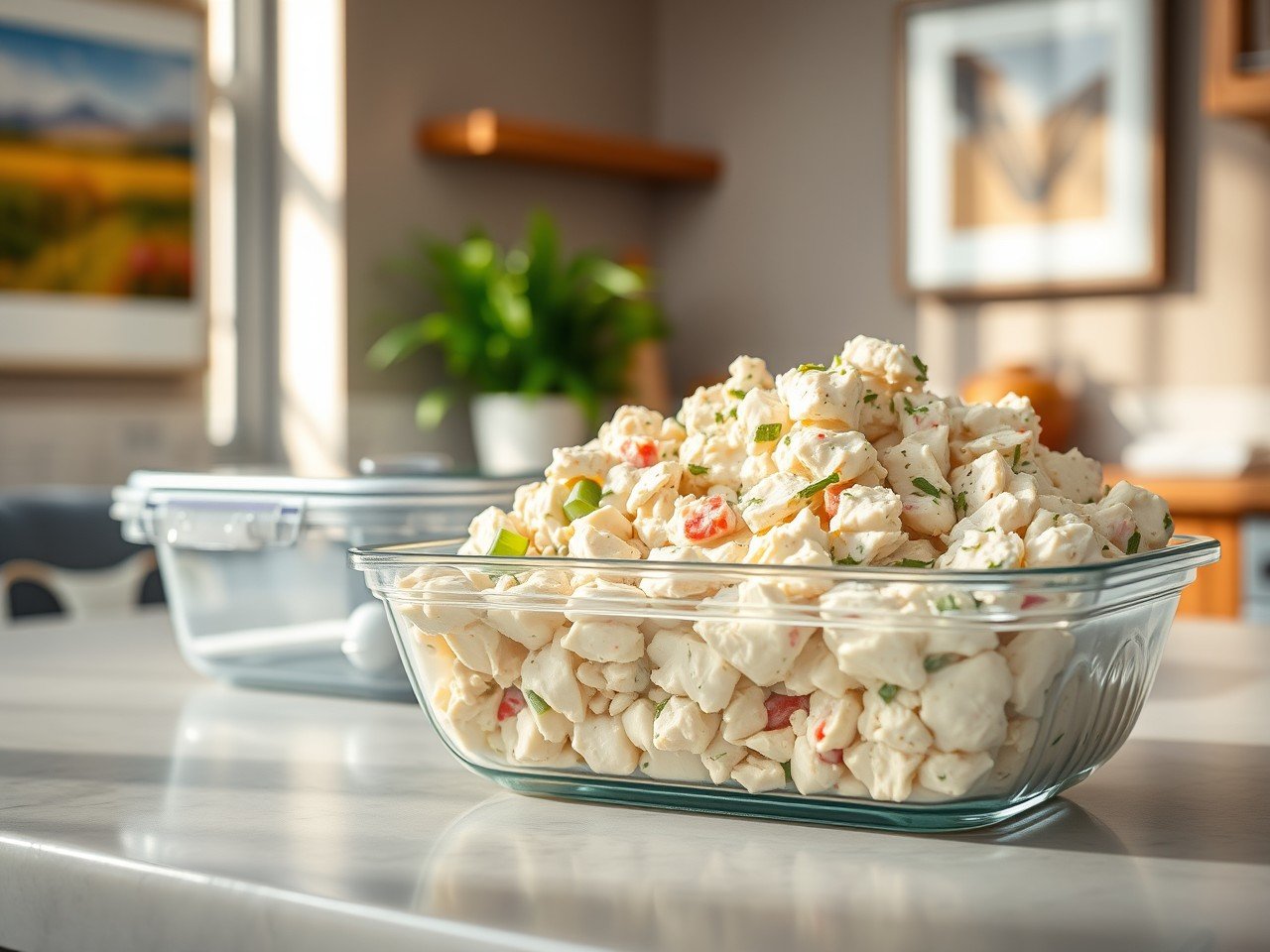
Yes, technically, but not well. Chicken salad that already has mayonnaise in it can be frozen safely, but the dressing separates and crisp add-ins go limp. Your better bet is freezing the plain cooked chicken and building the salad fresh after it thaws.
The difference that matters is between food safety and eating quality. A frozen, properly thawed salad is generally safe to eat, but the emulsified dressing and watery add-ins are what break down. That’s why the real question is which components of the salad deserve freezer space.
Key Takeaways
- Freeze the parts, not the finished salad: plain cooked chicken freezes far better than a dressed mixture, and the dressing and crunchy add-ins go in after thawing.
- If the finished salad must be frozen, expect to stir and re-season it, leave out celery, apples, grapes and hard-boiled eggs, and thaw it in the refrigerator only.
- Never refreeze thawed chicken salad, and discard any that smells off or has sat out too long, whatever its freezer history.
Can You Freeze Chicken Salad Without Ruining It?
Chicken salad can be frozen without becoming unsafe. But it can’t be frozen without losing quality when it has a mayonnaise-based dressing. The freezer stops bacterial growth. It does nothing to protect texture. That’s why the answer splits in two: safe, yes, and recommended for best results, no.
Three things change in the freezer. The dressing loses its smooth body, water-rich vegetables release liquid, and the cooked egg white turns rubbery. Meanwhile, the chicken itself holds up reasonably well. That’s the whole basis for the parts-based approach below.
Safe versus good: two different tests
A food-safety test checks whether the food stayed cold enough, long enough, and thawed correctly. A quality test asks whether anyone will enjoy eating it. Frozen chicken salad can pass the first and still fail the second.
Safety guidance for cooked poultry comes from the U.S. Department of Agriculture. That’s the body to check for current storage and handling advice. Quality is a matter of food science, and the sections below cover it ingredient by ingredient.
The temperatures that frame every decision
Freezer and refrigerator temperatures set the limits for every storage choice. A freezer should sit at a maximum of 0 °F (−17.7 °C), and a refrigerator should stay no higher than 40 °F (4.4 °C). Perishable food should get into the refrigerator inside 2 hours. Make that 1 hour if the surrounding temperature is above 90 °F (32.2 °C).
| Condition | Limit |
|---|---|
| Freezer temperature | 0 °F (−17.7 °C) maximum |
| Refrigerator temperature | 40 °F (4.4 °C) maximum |
| Time out before chilling, normal conditions | Within 2 hours |
| Time out before chilling, above 90 °F (32.2 °C) | Within 1 hour |
These limits apply before freezing as much as after. Chicken salad that sat on a buffet table past the window shouldn’t go into the freezer, in the hope that cold will fix it. Freezing pauses bacterial growth. It doesn’t reverse it.
Why Does Mayonnaise Separate or Turn Watery When Frozen?
Mayonnaise separates in the freezer because it’s an emulsion, a suspension of tiny oil droplets held in a water-based mixture by egg yolk. Freezing forms ice crystals. They disturb that structure, and on thawing, the oil and water no longer stay blended.
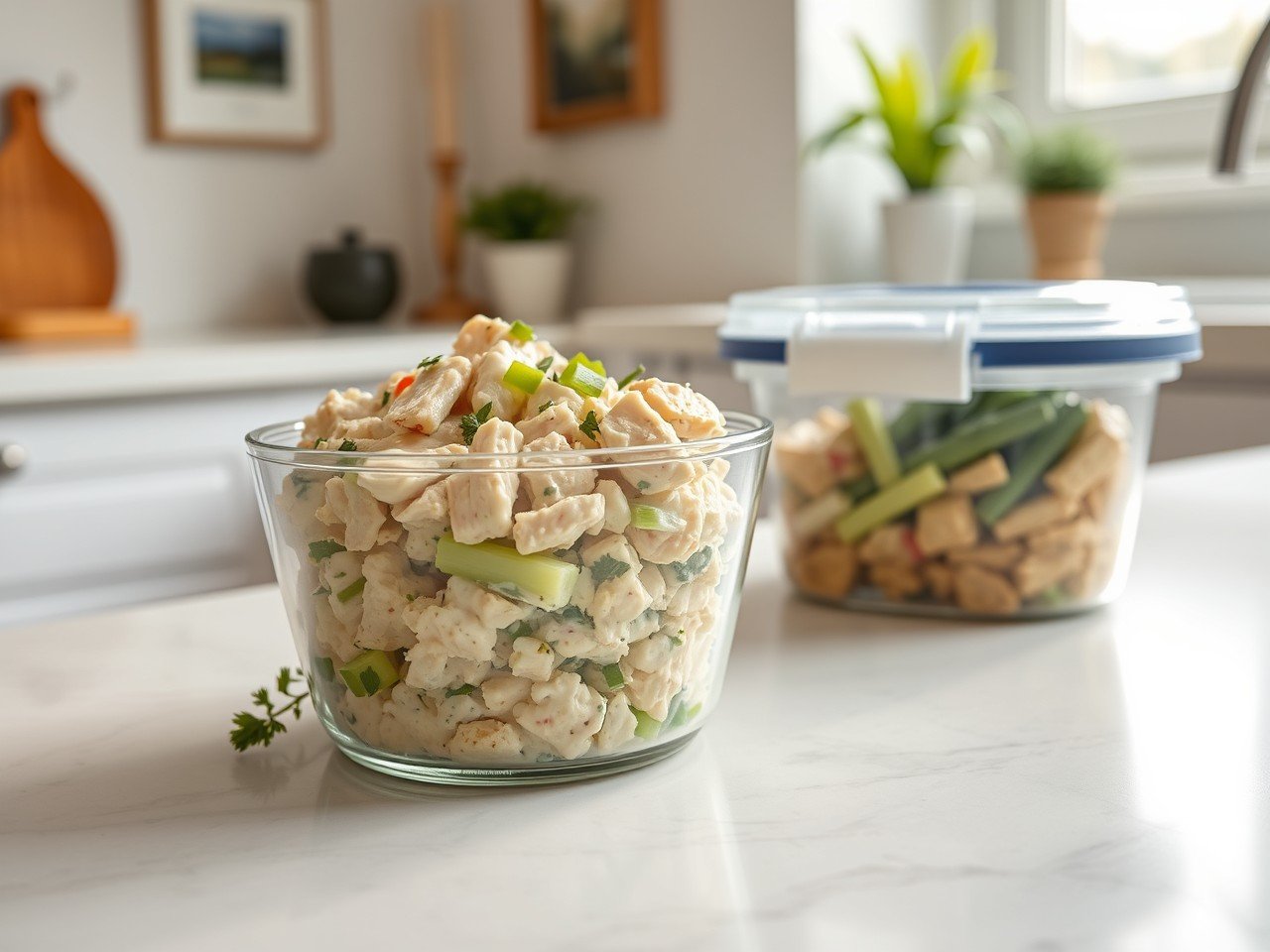
The visible result is a dressing that looks curdled, greasy or grainy, with a pool of liquid around the chicken. Stirring can bring some of it back together. But the original creamy body rarely returns in full. A salad that was thick and glossy before freezing often comes out looser and duller.
What happens to the add-ins
Celery, apples and grapes are mostly water held inside rigid cell walls. Ice crystals damage those walls. So on thawing, the pieces go soft and release liquid into the dressing. That released water thins the salad further and adds to the watery look.
Hard-boiled egg whites behave differently but end up in the same place. They turn rubbery when frozen. Egg yolk crumbles tend to survive better than the whites, though neither is a good candidate for a salad meant to be frozen whole.
Which ingredients get worse in the freezer
- Celery: loses its snap and leaks water, leaving limp, stringy pieces.
- Apples and grapes: turn soft and mealy, and release juice into the dressing.
- Hard-boiled eggs: the whites become rubbery.
- Onion and fresh herbs: go soft and lose fresh flavor.
- Nuts: lose crunch from moisture in the dressing, which is why they belong in the finished salad rather than the frozen batch.
A classic recipe built on grapes and walnuts is a good example of what to avoid freezing whole. The classic chicken salad with grapes and walnuts depends on exactly the fruit and crunch that suffer most. So it’s best made fresh.
Is It Better to Freeze the Chicken Separately?
Freezing the cooked chicken on its own and making the salad after thawing is the better approach. It keeps the one component that freezes well apart from the three that don’t. The dressing, the crunchy vegetables and the eggs are added fresh. So none of them ever meets the freezer.
This is the central point of the whole topic. Treat chicken salad as a set of parts. The finished mixture is a short-lived assembly, and the cooked chicken is the part worth storing.
How to freeze plain cooked chicken for later salads
- Cook and cool promptly. Get the cooked chicken into the refrigerator inside the 2-hour window, or 1 hour in hot conditions, before it goes anywhere near the freezer.
- Shred or dice it. Cutting to the size the salad will use means no extra handling after thawing, and smaller pieces thaw evenly.
- Leave it undressed. No mayo, no yogurt, no salt-heavy mix-ins. Plain chicken is the version that thaws cleanly.
- Portion it. Divide it into amounts that match one batch of salad, so nothing needs to be refrozen.
- Pack it flat or in a tight container. See the packaging section below.
- Label it with the date, then freeze at 0 °F (−17.7 °C) or colder.
When the time comes, thaw the chicken in the refrigerator. Then stir in fresh dressing and add celery, grapes, apples or eggs at the last stage. It tastes like a salad made that day, because the textural parts were.
How to Freeze Chicken Salad That Is Already Mixed
Chicken salad that’s already mixed can be frozen if it’s packed airtight and labeled. It’s a compromise rather than a success. A stable dressing base and fewer watery add-ins improve the result, but you’ll still need to stir and re-season it after thawing.
Choose a steadier dressing base
Dressings that don’t rely on a delicate emulsion hold up better. Greek yogurt or an oil-based dressing used in place of mayonnaise is more forgiving in the freezer. Yogurt can still turn a little watery and needs a good stir. A high protein chicken salad built on a yogurt base is the kind of recipe that tolerates this better than a traditional mayo version.
Oil-and-vinegar styles do the same job. A Greek chicken salad with an oil-based dressing avoids the emulsion problem. Still, its tomato and cucumber should be kept out of the freezer batch.
Leave out what suffers most
- Skip the celery, apples and grapes, and add them fresh later.
- Skip the hard-boiled eggs entirely.
- Hold back nuts and any crunchy topping.
- Keep seasoning light, since flavors often need adjusting after thawing anyway.
Pack it to limit freezer burn
Freezer burn happens when air touches the food’s surface and moisture sublimates. Sublimation means water leaves the food as vapor into the surrounding air. The result is leathery, grayish-brown patches. Food with freezer burn is still safe to eat, but those patches taste dry and dull.
The fix is to keep air away from the salad. A freezer-safe airtight container works if it’s filled close to the top, with little empty space. Heavy-duty freezer bags work if the air is pressed out before sealing. Pressing a layer of plastic wrap onto the surface adds a second barrier in a rigid container.
Choose packaging for the shelf, not just the food
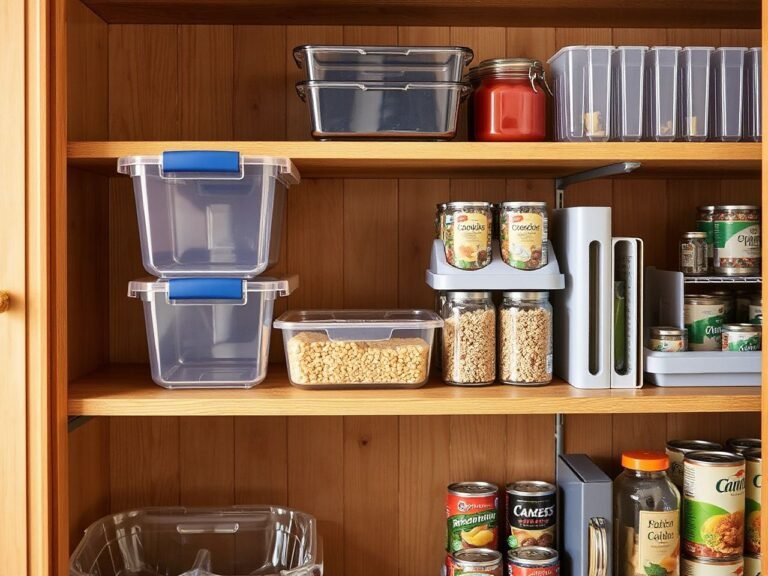
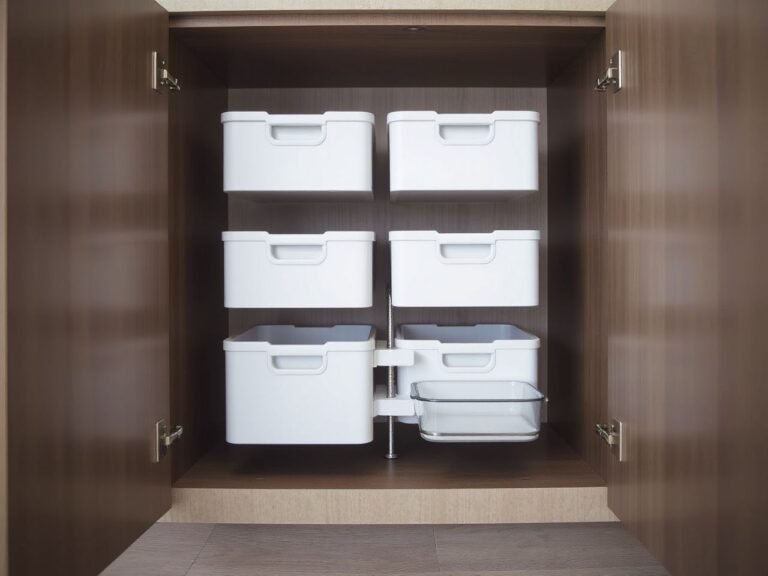
Container shape decides how many portions fit and whether the freezer door still closes. Rigid tubs of uneven height stack poorly, and tall ones can block the door or push against items on the shelf above. Flat bags or containers of matching height stack into stable columns. They leave clear room for other food.
- Same-height containers make a stack that will not slide when the door opens.
- Flat bags fit into narrow gaps and use the least vertical space.
- Door-shelf storage is the warmest spot in a freezer, so keep chicken on the main shelves where temperature is steadier.
- Labels facing outward let the date be read without unstacking anything.
How Should You Thaw Frozen Chicken Salad Safely?
Frozen chicken salad should be thawed in the refrigerator, never on the counter. Thawing on the counter lets the outer layers warm into the range where bacteria multiply. The center is still frozen, which defeats the purpose of freezing it carefully.
Move the container to a refrigerator shelf set at no higher than 40 °F (4.4 °C). Leave it there long enough to thaw fully. Small, flat portions thaw faster and more evenly than a thick block. Plan the thaw a day ahead rather than rushing it.
Where to put it in the refrigerator
Put thawing salad on a lower shelf. Use a plate or shallow tray so any liquid can’t drip onto other food. Skip the door shelves, since they swing warmer every time the door opens. A flat container on a main shelf keeps the door clear and the stack stable.
How to bring thawed salad back to life
Chicken salad that turned watery or grainy after thawing can be partly rescued. These steps address the usual problems:
- Drain off the liquid. Tip the container slightly and pour off the pooled water before doing anything else.
- Stir thoroughly. Vigorous stirring can recombine some of the separated dressing.
- Add fresh dressing. A spoonful of fresh mayonnaise or yogurt restores body and covers the split.
- Re-season. Salt, pepper, lemon juice or herbs usually need topping up.
- Add fresh crunch. Stir in new celery, apple, grapes or nuts just before serving.
A salad with a different flavor can hide texture changes better too. A sesame ginger chicken salad or a Southwest chicken salad with a bold dressing masks softness more easily than a plain, creamy classic.
Can You Refreeze Chicken Salad After Thawing?
Thawed chicken salad shouldn’t be refrozen. Each freeze-thaw cycle damages texture further. A salad that has already separated once will separate more. So a second round leaves a poor result.
The way around this is portioning before the first freeze. Divide the chicken into amounts you’ll use in one go. That way a single portion can be thawed and the rest stays frozen. Doing this is more useful than any trick for rescuing a refrozen batch.
How Long Does Chicken Salad Keep, and When Should You Throw It Out?
Chicken salad keeps for a limited time in the fridge and longer in the freezer. The exact periods should be checked against current guidance from the USDA rather than guessed. Your fridge must stay at or below 40 °F (4.4 °C), and the freezer at 0 °F (−17.7 °C) or colder, for any storage time to hold.
Dates on labels matter because nobody remembers what went in a freezer weeks ago. Write the date the salad or chicken was packed, and use older packages first. A freezer with clear labels and a stack arranged oldest-in-front is easier to manage.
Signs that chicken salad has gone bad
- An off or sour smell. Discard it. Smell is the quickest check, though a clean smell does not prove safety.
- Slimy texture or visible spoilage. Throw out the whole container.
- Time out of refrigeration. Salad left out past 2 hours, or 1 hour above 90 °F (32.2 °C), should go in the bin, even if it looks fine.
- Uncertain history. If it is unclear how long the salad was stored or whether it was thawed on the counter, the safe choice is to discard it.
Freezer burn isn’t on this list. Leathery, grayish-brown patches mean the food has dried out in places. But it’s still safe to eat. Trimming the dry spots improves the taste, though a heavily burned portion may not be worth eating.
Does store-bought deli chicken salad freeze any better?
Store-bought deli chicken salad has the same problems as homemade. It’s also built on a dressing and add-ins that suffer in the freezer. Commercial recipes may differ in dressing stability. Still, the packaging label and the rules of the retailer are the right places to check for freezing guidance. The U.S. Food and Drug Administration sets labeling rules for packaged foods. So any instructions printed on the pack deserve more weight than general assumptions.
Make-Ahead Options That Hold Up Better
The best make-ahead approach for chicken salad lunches is storing the components separately and combining them on the day. It works because cooked chicken freezes well. Dressing keeps in its own container, and crunchy ingredients stay crisp when kept dry.
A parts-based meal-prep layout
- Frozen shelf: portioned, undressed cooked chicken in flat bags, dated and stacked.
- Refrigerator main shelf: a small tub of dressing, and a container of cut celery or fruit, prepared close to serving.
- Assembly day: thaw one bag in the refrigerator, then mix with dressing and fresh add-ins.
Mayo-free salads that tolerate the freezer better
Salads built on oil, vinegar, citrus or yogurt avoid the main failure point of mayonnaise, the broken emulsion. They aren’t immune to texture loss in the vegetables. Still, the dressing itself behaves more predictably. Pair them with sturdy ingredients rather than watery ones, and add anything crisp after thawing.
A Practical Decision Guide
The right choice depends on how much quality matters and how far ahead the salad is planned. A short decision path keeps it simple:
- Planning ahead, and quality matters: freeze plain cooked chicken only, and dress it fresh.
- Leftover dressed salad that would otherwise be wasted: freeze in small airtight portions, accept softer texture, and plan to stir and re-season.
- Salad that contains eggs, grapes, apples or celery: pick those out or make a fresh batch rather than freezing the lot.
- Salad that sat out too long, or smells wrong: discard it, whatever the freezer could have done.
Freezer burn, texture change and separation are quality issues, and so is refreezing a salad that was thawed in the refrigerator. Time out of refrigeration and counter thawing are safety issues. Keeping the two categories apart makes every choice easier.
The Bottom Line
Frozen chicken salad is safe when handled correctly, yet the creamy dressing and fresh crunch rarely survive the trip. The cooked chicken is the part that deserves the freezer. Dressing, vegetables and eggs are better added once the chicken has thawed in the refrigerator.
Frequently Asked Questions
Can you freeze chicken salad that has mayo in it?
Yes, it’s safe, but quality drops. Mayonnaise is an emulsion, and freezing breaks it, so the thawed dressing looks split or watery. Stir well, drain any liquid, and add a spoonful of fresh dressing. Leaving out celery, grapes, apples and boiled eggs before freezing gives a better result, and the salad should never be refrozen.
What is the best way to freeze chicken salad for later?
Freeze the plain cooked chicken, shredded or diced. Portion it into flat bags or tight containers, with the date on the label. Press out air to limit freezer burn. Keep the freezer at 0 °F (−17.7 °C) or colder. Thaw one portion in the refrigerator, then mix in fresh dressing and crunchy ingredients just before serving.
How can you tell if thawed chicken salad has gone bad?
Throw it out if it smells sour or off, looks slimy, or has been out of refrigeration longer than 2 hours, or 1 hour above 90 °F (32.2 °C). Gray, leathery patches are freezer burn, which is dry and unappealing but still safe. When the storage history is unclear, discarding the salad is the safer choice.