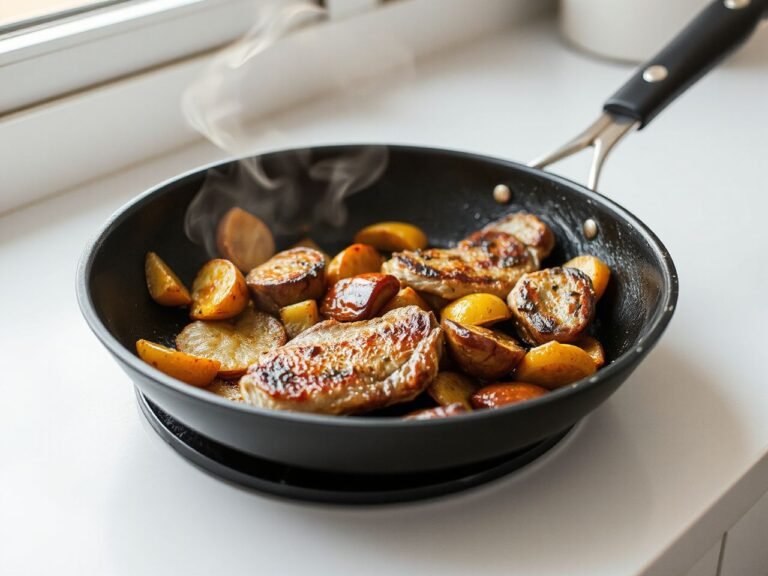
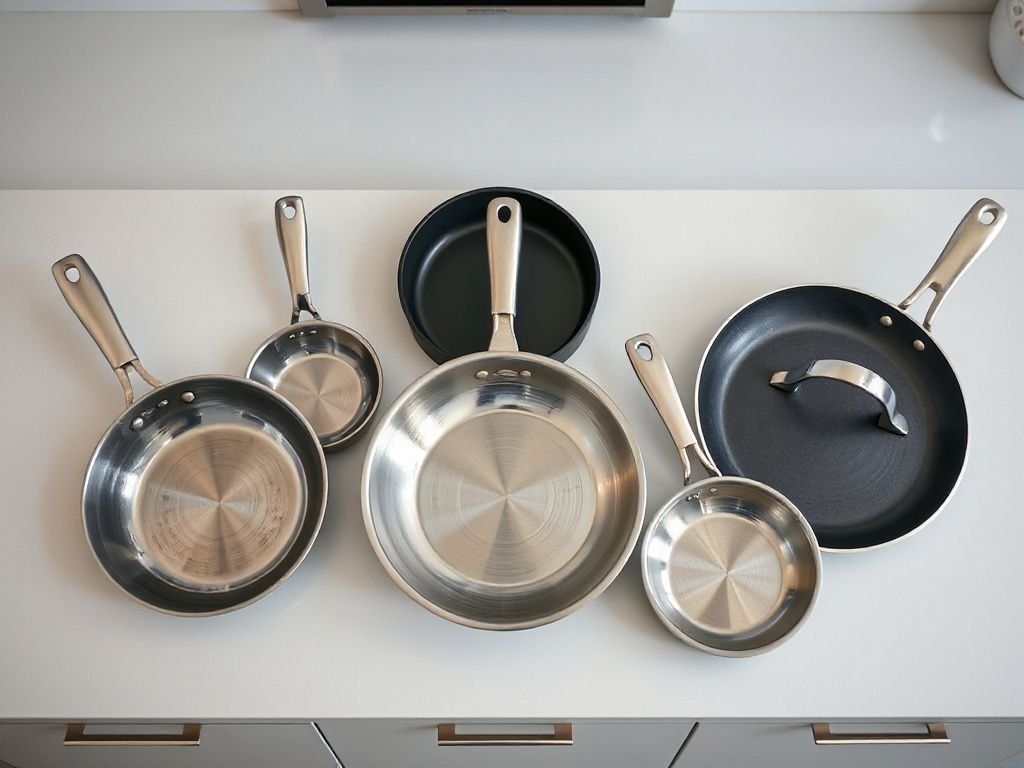
Eight chicken thighs go into a pan the recipe called a large skillet, and twenty minutes later they sit pale, weeping liquid, and gently simmering in their own juices instead of browning. The pan is not defective and the recipe is not wrong. The number stamped on the bottom described the pan’s geometry, not the space the food actually needed, and that gap is what pan sizing, properly explained, is really about.
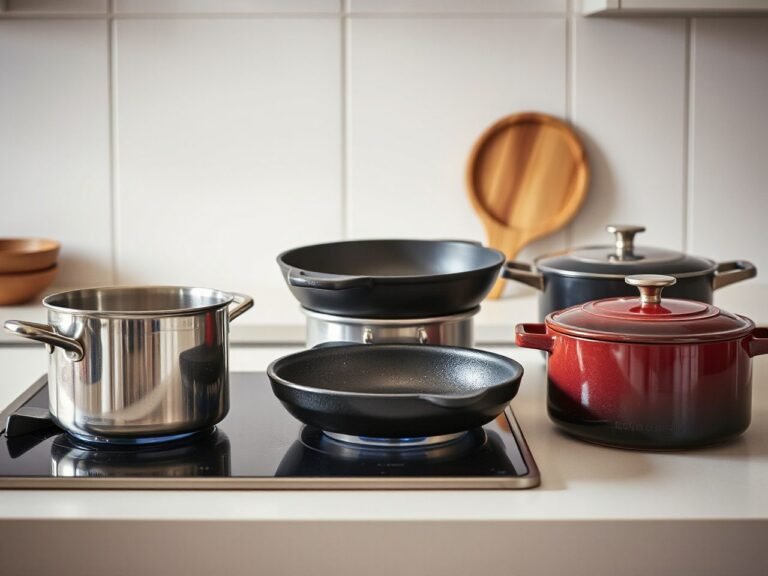
Skillets get measured across the outer top rim, while pots get measured by volume, so the same size number can mean very different usable space depending on the piece in your hand. Work backward from the food instead. A single uncrowded layer of protein needs flat-bottom surface area; a braise or a stock needs headroom-adjusted volume. Then check that diameter against your actual burner and your oven cavity rather than trusting the label alone.
Key Takeaways
- Skillets are labeled by top rim diameter, not the flat cooking surface — a 12-inch pan often has only about 9 inches of usable flat bottom.
- Skillets and sheet pans sell by dimension; saucepans, sauté pans, and pots sell by volume (quarts or liters), so the two systems are not interchangeable.
- A full sheet pan (about 26×18 in) will not fit most home ovens — the half sheet is the real residential standard.
- Match pan diameter to your burner and pick size by how much room the food needs in a single layer, not by the number alone.
Why Pan Size Numbers Lie About Usable Space
The most common sizing mistake is not choosing the wrong number. It is assuming the number means what you think it means. A pan can be honestly labeled and still betray you at the stove because the measurement point and the cooking point are two different places.
Rim diameter versus the flat cooking surface
A fry pan or skillet is measured rim to rim across the widest part of the top, following the way most manufacturers and the industry describe them. The sides flare outward, though, so the flat disc at the bottom, where food actually touches metal, is always smaller.
A 12-inch skillet frequently offers only 9 to 9.5 inches of flat cooking surface. The Lodge 10.25-inch cast iron skillet, for example, gives you closer to 8 inches of true flat base once you account for its sloped walls. That is why food that looked like it should fit ends up shingled and steaming.
Straight-sided pans behave differently. All-Clad D3 tri-ply sauté pans keep their walls nearly vertical, so a 12-inch sauté pan holds far more of its diameter as usable bottom than a 12-inch fry pan does. When surface area matters, the wall angle matters as much as the headline number.
Two measuring systems living on the same shelf
Here is the split that trips people up. Skillets and sheet pans are sold by physical dimension in inches. Saucepans, sauté pans, stockpots, and Dutch ovens are sold by volume in quarts or liters. A Le Creuset Signature enameled Dutch oven is a 5.5-quart or 7.25-quart piece, never a nine-inch one, even though it has a diameter you could measure.
Buying by the wrong system is how you end up with a 3-quart saucepan that is too narrow for the job you imagined. Volume tells you how much liquid a pot holds; it says nothing directly about how wide the base is, and two pots of identical volume can have very different footprints.
Pan Sizes Explained by What You Actually Cook
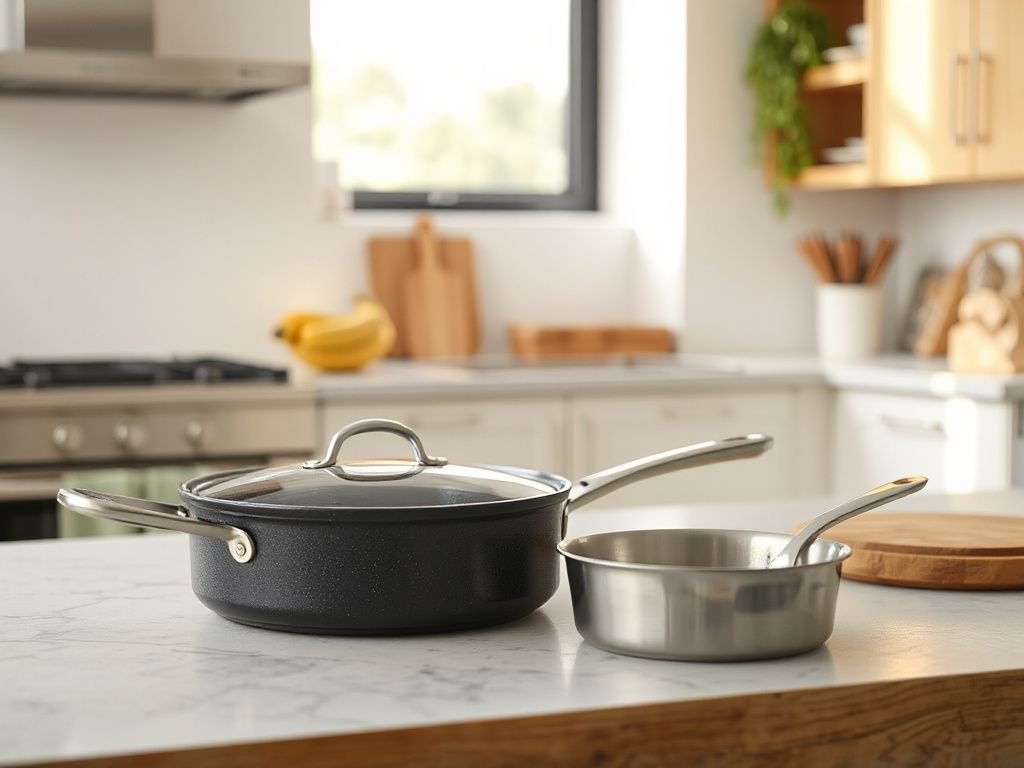
Once you stop reading the label as a promise and start reading it as a rough coordinate, choosing gets simpler. Match the pan to the food, then sanity-check the number.
The 8, 10, and 12-inch skillet, in plain terms
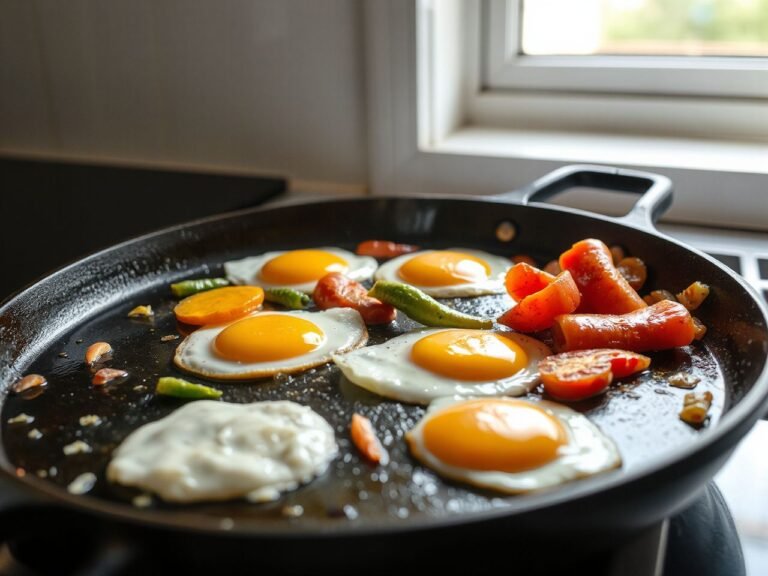
- 8-inch skillet: one or two eggs, a single chicken breast, toasting spices, a small omelet. Roughly 6 inches of flat bottom. Anything more crowds fast.
- 10-inch skillet: the everyday workhorse. Two portions of protein, a stir-fry for two, a batch of sauteed vegetables. About 7.5 to 8 inches of usable base.
- 12-inch skillet: four chicken thighs with room between them, a full pound of ground meat, a family-scale hash. Around 9 inches of flat surface, which is the real reason it browns better than the 10-inch when the pan is full.
T-fal and Tefal nonstick sets usually bundle 8, 10, and 12-inch pans together for exactly this reason. Those three cover the overwhelming majority of stovetop tasks a home cook faces.
Saucepans, sauté pans, and stockpots by volume
Pots are about capacity, and capacity has to leave room for movement. A rolling boil, a simmer that spits, a pasta pot that foams up all need headroom you do not count as usable.
- 2-quart saucepan: rice for two to four, a single sauce, reheating soup. A 2-quart is usually shorter and narrower than a 3-quart, not just shorter.
- 3-quart saucepan: the go-to for grains, blanching, small-batch sauces. It is typically both a bit wider and a bit taller than the 2-quart, which is why it reduces liquid faster.
- 3 to 4-quart sauté pan: straight walls, wide base, a lid. Ideal for braises, shallow frying, and anything that starts on the stove and finishes with liquid.
- 6 to 8-quart stockpot or Dutch oven: stock, pasta water, chili, big soups. Instant Pot and Dutch oven capacities are rated the same way, so a 6-quart Instant Pot maps neatly onto a 6-quart pot in your head.
A Mauviel M’150 copper sauteuse shows how shape follows purpose here: the curved, flared sides are built for whisking and reducing sauces, not for holding a single flat layer of meat. Volume and geometry are telling you what the pan wants to do.
Sizing for one, two, or a family of four
For one or two people, a 10-inch skillet, a 2-quart saucepan, and a 4-quart pot handle nearly everything. For a family of four, step the skillet up to 12 inches, add a 3 to 4-quart sauté pan, and keep a 6 to 8-quart stockpot for pasta and soup nights. A one-pot chicken dumpling soup that feeds four in about 40 minutes lives comfortably in that 6-quart pot with room for the dumplings to expand, and that headroom is the whole point of the larger size.
Sheet Pans, Baking Pans, and What Fits Your Oven
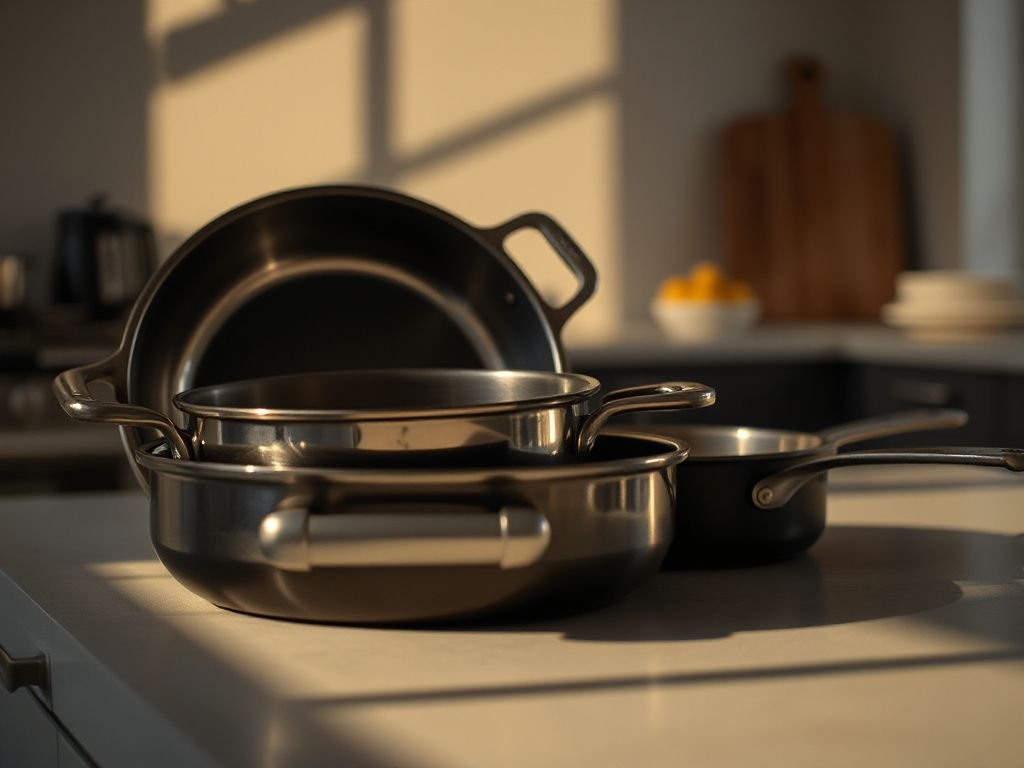
Bakeware is where the fit-your-oven question stops being theoretical. A pan that is technically standard can still be too big for the box you own.
Full, half, and quarter sheet
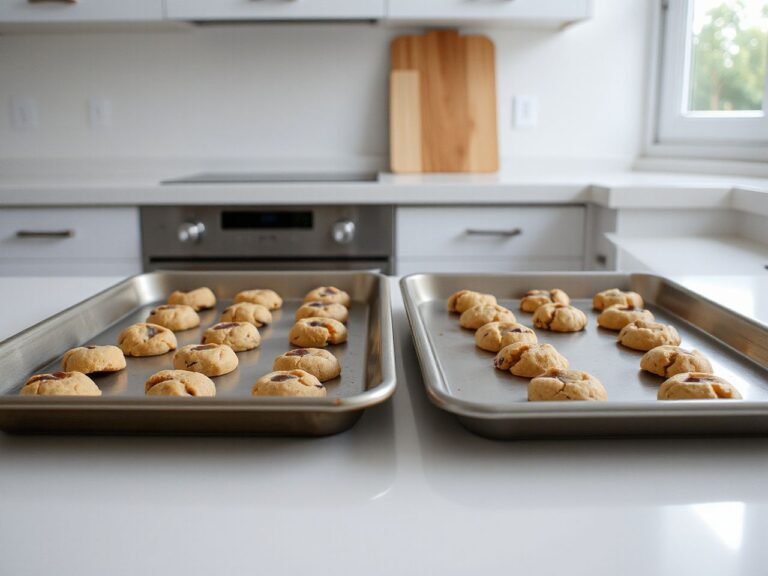
Commercial sheet pan sizing comes from the foodservice world, and Vollrath and Winco publish the gauges most cooks recognize. A full sheet pan measures roughly 26×18 inches and does not fit a standard 30-inch residential oven. It is built for commercial racks.
- Half sheet (about 18×13 in): the true home standard, and what most recipes mean by sheet pan.
- Quarter sheet (about 9×13 in): perfect for a small roast of vegetables, toasting nuts, or a single-tray dinner for two.
Heavier gauge aluminum resists the warping that makes a thin pan buckle and pop under the broiler. Thin sheet pans warp because the metal expands unevenly when one area heats faster than another, and a lower gauge number means thicker, sturdier metal.
Standard baking pan sizes and when you can substitute
The core baking pans are the 9×13-inch rectangle, the 8×8-inch square, the standard loaf pan (usually 9×5 or 8.5×4.5 in), and the 8 or 9-inch round cake pan. Substituting between them is a volume question, not a diameter one.
- An 8×8 square holds about the same volume as a 9-inch round, so they swap fairly cleanly.
- A 9×13 holds roughly double an 8×8, so one 9×13 recipe splits into two 8-inch squares.
- Loaf pans vary more than people expect. The half-inch difference between a 9×5 and an 8.5×4.5 changes how high the loaf climbs and how long it bakes, which is worth understanding before you swap; our breakdown of which loaf pan sizes actually fit and bake evenly walks through the numbers.
Depth changes bake time more than footprint does. Pour the same batter into a deeper, narrower pan and the center takes longer to set while the edges risk drying, so drop the oven temperature by about 25°F and check earlier.
Matching Pan to Burner and Adjusting for Size
A pan sized correctly for the food can still cook badly if it is sized wrong for the heat under it. This is the step most guides skip.
Burner spread and hot spots
Pan diameter should roughly match the burner it sits on. Put a 12-inch skillet on a small back burner and the flame or coil heats a hot circle in the center while the rim stays cool, which is why the middle of a big pan scorches while the edges barely color.
The mismatch hits hardest on gas and electric coil, where heat comes from a defined ring. Thin aluminum makes it worse because it cannot move heat sideways fast enough. Heavy cast iron and thick tri-ply like All-Clad D3 spread heat better precisely because the metal conducts across the base, evening out a small burner’s hot center.
Induction adds its own rule. The pan should sit close to the hob’s coil diameter, and it must be magnetic to work at all, so a wide copper piece that performs beautifully on gas may do nothing on induction.
Does pan size change cooking time or temperature?
It changes both, mostly through surface area. A wider pan exposes more food to direct heat and more liquid to the air, so it browns and reduces faster. Move a sauce from a 2-quart saucepan into a 12-inch skillet and it will reduce in a fraction of the time simply because evaporation scales with surface area.
Crowd a pan and the surface temperature drops as cold food and released moisture flood a burner that cannot recover fast enough. That is the mechanism behind steaming instead of searing: trapped water vapor keeps the surface at boiling temperature, and browning needs a much hotter, drier surface. The fix is more space or more batches, never more heat into a packed pan.
European versus American numbers, and converting cm to inches
European cookware is measured in centimeters, so a 28 cm pan is simply about 11 inches, and a 24 cm pan is roughly 9.5 inches. To convert, divide centimeters by 2.54 to get inches. A 20 cm cake tin is close to 8 inches, near enough to swap for most recipes.
Professional kitchens use another system entirely, the GN or Gastronorm standard defined in the EN 631 specification tracked among international standards bodies. GN sizing lets pans, racks, and warmers from different makers interlock, which is why a hotel pan from one brand drops cleanly into another’s counter.
The Two or Three Pans That Cover Most Everyday Cooking
If you want to stop buying redundant pieces, three pans carry most of the load: a 10 or 12-inch skillet, a 3-quart saucepan, and a 6 to 8-quart pot or Dutch oven. Add a half sheet pan and you can roast, and that is a genuinely complete kitchen.
Everything else is refinement. A sauté pan for braises, a small 8-inch for eggs, a second sheet for big bake days. A weeknight favorite like this quick rotisserie chicken and mushroom soup that comes together in about 25 minutes needs nothing more than that 3-quart saucepan, which is proof of how far a small, well-chosen set actually goes.
Think in terms of nesting and lids too. Buying within one range often means lids interchange across sizes and pans stack, which saves more cabinet space than any single clever gadget. Storage is a sizing decision as much as cooking is.
Frequently Asked Questions
When a pan says 10 inches, is that the top rim or the flat cooking surface?
It is the top rim, measured across the widest part of the pan. Because the walls flare outward, the flat cooking surface at the bottom is always smaller, typically 1.5 to 3 inches less. A 10-inch skillet usually gives you around 7.5 to 8 inches of true flat base, which is the space that actually determines how many pieces of food fit without crowding.
Is a 3-quart saucepan wider or just taller than a 2-quart?
Usually both, but not by much in either direction. Manufacturers add capacity by increasing diameter and height together to keep the pan balanced and stable. A 3-quart typically runs about an inch wider and slightly taller than a 2-quart, so it heats a little more surface and reduces liquid faster. Check the base diameter, not just the quart rating, if width matters for your recipe.
Why does my food steam instead of sear in a pan that is the right diameter?
Diameter is not the whole story, because the usable flat surface is smaller than the labeled number and crowding fills it fast. Too much food at once drops the surface temperature and releases moisture the burner cannot boil off quickly, so the food sits in steam. Cook in batches, leave visible space between pieces, and dry proteins before they hit the pan.