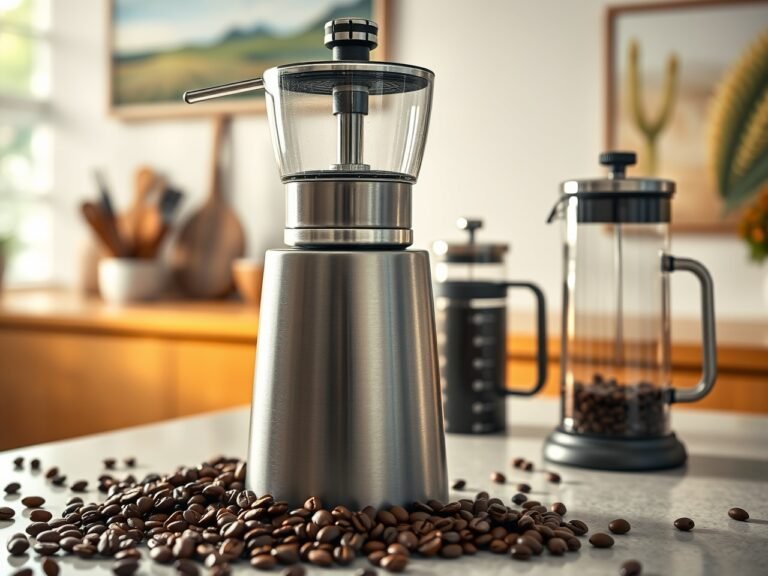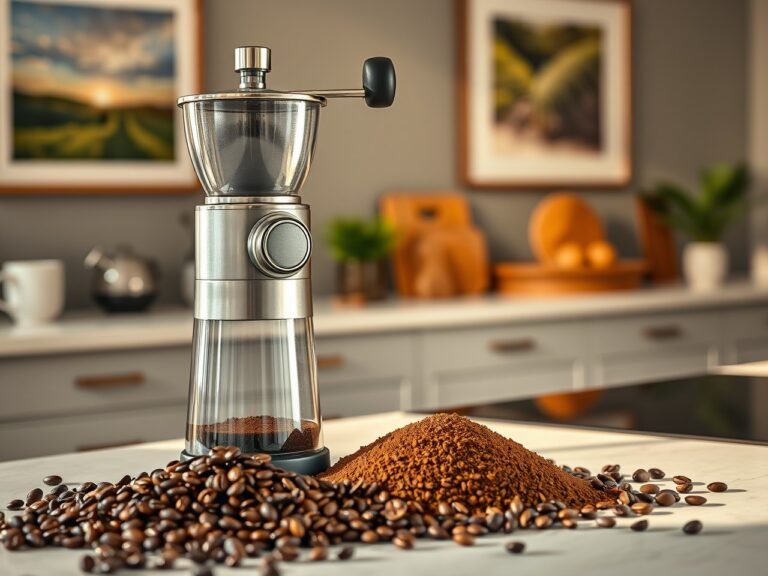
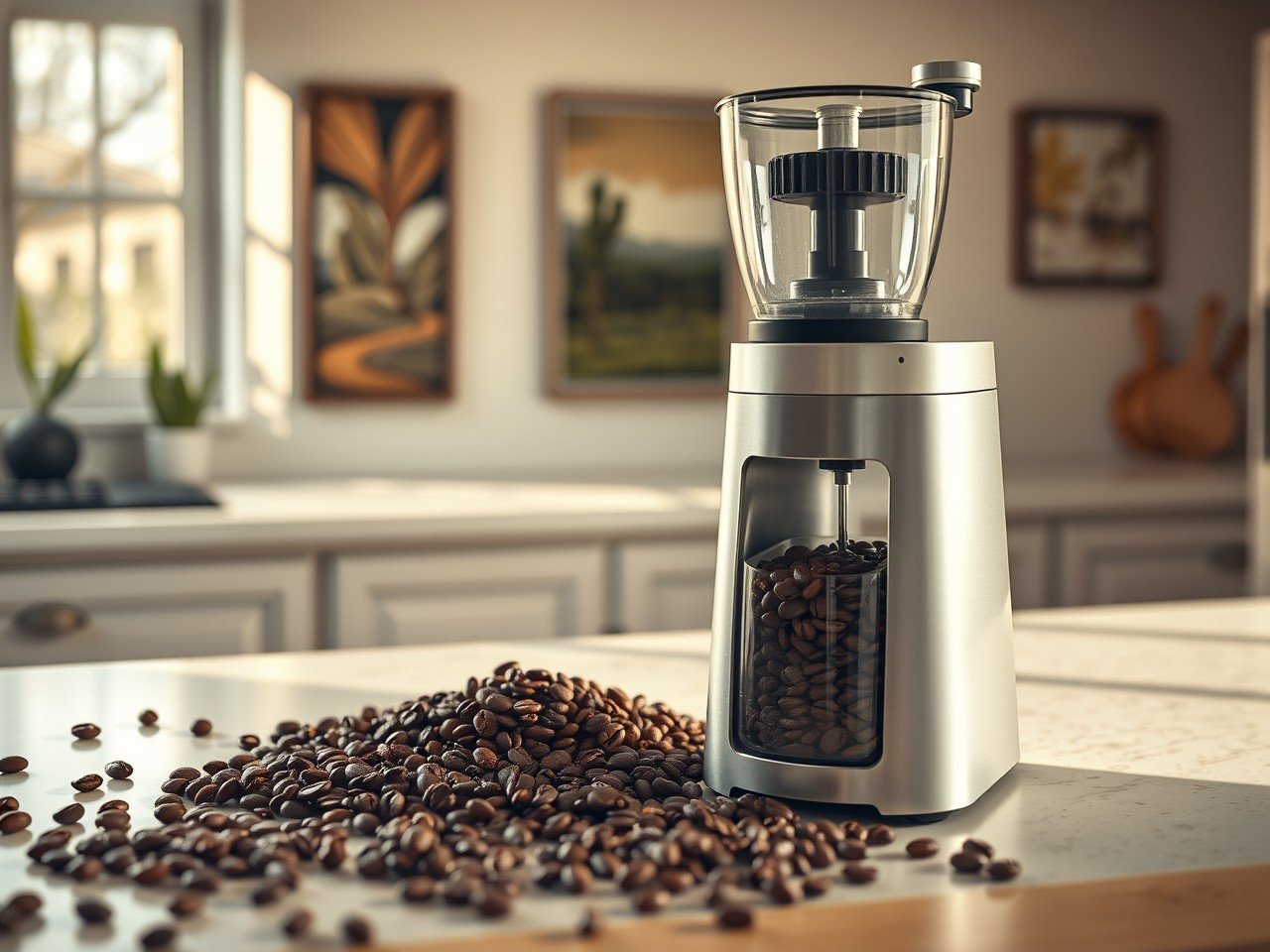
Setting counts on the box rarely help. Burr type, burr size and a steady drive matter far more. Budget listings say little about any of them. This list compares five grinders on exactly those points.
As an Amazon Associate we earn from qualifying purchases. This does not affect the price you pay.
CERTAIN CONTENT THAT APPEARS ON THIS SITE COMES FROM AMAZON. THIS CONTENT IS PROVIDED ‘AS IS’ AND IS SUBJECT TO CHANGE OR REMOVAL AT ANY TIME.
The Fellow Ode Gen 2 is the pick: its 64 mm flat burrs and single-dose design are built specifically for brewed coffee.
| Product | Best for | Burr type and size | Grind settings |
|---|---|---|---|
| Fellow Ode Gen 2 | Best overall | 64 mm flat burrs | 31 |
| CEVING Mini Manual Grinder | Best value | Ceramic conical (size not listed) | 40 |
| Aromaster Burr Grinder | Timer-based dosing | Conical (size not listed) | 45 |
| HAUSCAFE Burr Grinder | Narrow counter space | Conical (size not listed) | 38 |
| AAOBOSI Espresso Grinder | Espresso-first households | 40 mm stainless conical | 45 |
Home Fresh Eats is funded by affiliate commission. Our picks come from comparing published specifications and documented features against what matters in the category — no brand pays for a place on this page. If you buy through a link here we may earn a commission at no extra cost to you, and it pays for the research behind the next guide. Full disclosure.
Fellow Ode Gen 2 (64 mm Flat Burrs, Single Dose)

- BrandFellow
- ModelOde Gen 2
- Dimensions9.41 inches x 4.13 inches x 9.78 inches
- Weight9.92 pounds
- Size / capacity120v, Type B Plug
- ColourMatte Black
Quick take: The Ode Gen 2 is the grinder to buy if filter coffee is the whole point and the budget stretches to a premium-priced machine.
The Ode Gen 2 pairs 64 mm flat burrs with a two-stage grinding geometry, as the manufacturer calls it. It has 31 grind settings tuned for pour over, drip, French press and cold brew. The listing also says it isn’t meant for espresso. At 9.92 pounds, it is heavy enough to stay put while the burrs spin. That matters, because a grinder that shifts on the counter will wobble. Its size is 9.41 x 4.13 x 9.78 inches.
Design choices explain the rest. A 100 g single-dose load bin holds only the beans for the next brew. That means the remaining beans stay in their bag. The maker also lists anti-static technology, a built-in knocker and a magnetic catch cup, all aimed at retention and mess. Those are manufacturer claims, not measurements, and the listing publishes no retention figure. Large flat burrs are commonly associated with a clean, clarity-forward cup. Burr alignment matters more than shape alone. Among the best coffee grinders for pour over, this is the only one here with burrs that big. It’s the only one where the stated purpose matches the brew method.
Pros:
- 64 mm flat burrs — the largest burr set on this list, aimed at consistent particle size at filter settings.
- Single-dose bin — only the beans you’re about to brew get ground, which keeps the rest fresh.
- Anti-static, knocker and magnetic catch cup — three listed features that target the flying chaff and leftover grounds that clutter most budget grinders.
- Brew-only tuning — 31 settings concentrated on filter ranges rather than stretched across espresso as well.
Cons:
- Premium price — the cost sits well above the other four, and the hand grinder here covers casual pour over for far less.
- No espresso capability — the listing says it is not for espresso, and there is no timer or dose automation, so every brew means weighing and loading beans.
Our Take
Skip if: espresso is in the plan, or a large batch is brewed every morning and a 100 g bin means repeated refills.
CEVING Mini Manual Grinder (Ceramic Conical Burrs, 40 Settings)

- BrandCEVING
- ModelMCG-01
- Dimensions7.4 inches x 2.3 inches x 6.7 inches
- Weight0.84 pounds
- Size / capacityCeramic Burr
- ColourM01 Black
The short version: A hand grinder that costs a fraction of the electrics here and is a sensible entry point for one-cup pour over.
The CEVING MCG-01 uses ceramic conical burrs and a 30 g capacity. It sits in a body of 7.4 x 2.3 x 6.7 inches. The spec table lists 0.84 pounds, but the bullet copy quotes 325 g. The two don’t quite match, so treat both as approximate. Either way, it packs into a bag easily. The 40 settings sit on an external adjustment ring, easier to read than internal dials. The grinder splits into three main parts for cleaning. The listing advises against washing with water.
Hand cranking removes the motor and gear question entirely. That’s why a decent manual can out-grind a cheap electric. The trade is effort and capacity. 30 g is one generous cup or a small carafe. Anything larger gets tiring quickly. The listing doesn’t state the burr diameter. Also, 40 settings across a small ring may mean coarse steps between them. Setting counts can’t be compared across brands. The listing doesn’t answer it. Among budget coffee grinders for pour over, the CEVING is the one that doesn’t depend on a plastic gear train.
Pros:
- Ceramic conical burrs — listed as running cooler than steel and suited to a single filter cup.
- External adjustment ring — 40 settings can be changed without opening the grinder.
- Three-part design — quick to take apart and brush out at the sink, with no cord or electronics to protect.
- Compact and light — fits travel, camping or an office desk where an electric grinder won’t.
Cons:
- 30 g capacity — fine for a single cup, but slow and tiring for a full pot or guests.
Who Should Buy This
Best value: Single-cup brewers, travellers and anyone testing pour over without committing to an electric. Skip if: several cups are brewed at once or hand cranking will feel like a chore every day.
Aromaster CG223 Burr Grinder (5–40 Second Timer)

- BrandAromaster
- ModelCG223
- Dimensions9.0 inches x 6.0 inches x 13.0 inches
- Size / capacityHousehold
- ColourGraphite Black
Here’s the deal: A stainless-bodied electric with a programmable timer for people who want to press a button and walk away.
The Aromaster CG223 measures 9 x 6 x 13 inches. It uses a conical burr system with 45 grind settings. It also has a 5–40 second timer. The listing adds a stainless steel body, anti-static grinding, a removable burr and a cleaning brush. The removable burr is the detail that counts at the sink. Stale oils and fines collect around it. A burr that lifts out can actually be cleaned. Weight and warranty aren’t listed.
Timer dosing is convenient, but imprecise. The same seconds produce different weights with different beans, roast levels and grind settings. A scale is still the reliable way to hit a recipe ratio. The manufacturer markets the 45 settings across espresso, pour over and French press. That spreads the steps across a wide range. It leaves fewer for the medium-fine zone. Burr diameter isn’t stated either. It is a reasonable batch-brew grinder.
Pros:
- 5–40 second timer — repeatable dosing for people who brew the same amount daily.
- Removable burr — allows deeper cleaning than grinders where the burr is fixed.
- Anti-static design — aimed at fewer grounds scattering across the counter.
- Stainless steel body — easier to wipe clean than a fully plastic housing.
Cons:
- Time, not weight — a timer is a proxy for dose, so a scale is still needed for consistent ratios.
- Unlisted burr size — the diameter and step range at filter settings aren’t published, so uniformity can’t be judged from the page.
Final Thoughts
Timer-based dosing: Households that brew a similar amount every morning and want hands-off grinding. Skip if: recipes are weighed to the gram, or a fixed-burr, small-batch grinder with a published burr size is the goal.
HAUSCAFE Electric Burr Grinder (38 Settings, One-Touch)

- BrandHAUSCAFE
- ModelUSAMZ-HC-G101-BK
- Dimensions3.9 inches x 12.2 inches x 7.1 inches
- Size / capacityNormal
- ColourSliver-G102
In a nutshell: A slim, simple electric for beginners who want a burr grinder instead of a blade and have little counter space.
The HAUSCAFE (model G101) is 3.9 inches wide, 12.2 inches tall and 7.1 inches deep. It has 38 grind settings and a conical burr. Controls are one-touch. The listing mentions a removable hopper, a grounds container and a cleaning brush. Weight, burr diameter and material aren’t listed. No timer or dose control appears in the feature copy.
The narrow footprint is the selling point. Compared with the Aromaster’s 6-inch depth, this fits tighter shelves and corners. Control is the tradeoff. The manufacturer pitches 38 settings from espresso through French press, so the filter range is likely a slice of that dial, and the steps may be coarse for fine-tuning a Kalita Wave. A conical burr is still a big step up from a blade grinder. A blade grinder chops beans into a mix of dust and chunks.
Pros:
- Slim 3.9-inch width — the narrowest footprint among the electric grinders here.
- Conical burr — avoids the uneven chopping of a blade grinder.
- Removable hopper and grounds container — both lift out for rinsing or wiping at the sink.
- One-touch operation — nothing to program, which suits a first burr grinder.
Cons:
- Sparse specs — no burr size, material, weight or timer is listed, so uniformity claims can’t be checked.
Why It Earns a Spot
Narrow counter space: Beginners and small kitchens upgrading from a blade grinder.
AAOBOSI CG223A Espresso Grinder (40 mm Conical, Portafilter Holder)

- BrandAAOBOSI
- ModelCG223A
- Dimensions7.28 inches x 4.72 inches x 14.17 inches
- Size / capacity45
- ColourSliver
Quick take: An espresso-first grinder that can handle filter coffee, but only buy it if espresso is also on the menu.
The AAOBOSI is built around a 40 mm stainless steel conical burr. It also includes a 51/53 mm portafilter holder and an LED display. The display sets cups or a grinding time up to 40 seconds. It has 45 settings. The listed dimensions are 7.28 x 4.72 x 14.17 inches. Anti-static is listed on the outlet. Weight isn’t given.
Judge it on coarse settings, not on espresso features. The 45 steps are laid out from fine espresso and moka up to coarse French press, so pour-over sizes occupy the middle of the dial and the espresso end takes the finest steps. A 40 mm burr is a mid-sized conical, and like the others, no data shows how even the particles come out at filter settings. If the household pulls shots and brews filter, one machine covering both is convenient. If not, the portafilter holder is hardware paid for and never used, and the Fellow is the better filter grinder.
Pros:
- 40 mm stainless conical burr — a stated burr size, which most budget listings omit.
- 51/53 mm portafilter holder — useful for espresso drinkers who also brew filter.
- Cup and time control — an LED display offers cup-based or timed grinding.
- Anti-static outlet — aimed at tidier dosing into a cup or portafilter.
Cons:
- Espresso-oriented design — the setting range and holder suit shots, so filter use rides on the coarser steps.
- Tall, 14.17-inch body — it can clash with under-cabinet clearance, and weight isn’t listed.
The Real Deal
Espresso-first households: Anyone who pulls espresso and wants occasional filter coffee from one grinder. Skip if: only pour over is brewed, since portafilter features add cost and height without helping the cup.
How We Chose These Coffee Grinders for Pour Over
These picks come from published specifications, materials, care instructions, and documented features. Patterns buyers often mention also fed in, especially around static, retention, and cleaning. None of the grinders were tested hands-on. Weighting went first to burr type and size. It then shifted to whether the design suits single dosing or batch brewing. Finally, cleaning access mattered most. Setting counts were treated as marketing, because step size varies between brands. Before ordering, check whether the listing publishes burr diameter. Then confirm the finest step size. Also confirm the clearance for the grinder’s height.
How to Choose the Best Coffee Grinders for Pour Over
Why the burr gap and burr quality beat setting counts
The gap between the two burrs sets the grind size. That sounds simple. Still, any slop in alignment or motor stability can change the gap mid-grind. The result is a mix of fines and boulders. Fines over-extract into bitterness. Boulders under-extract into sourness. A single cup can taste like both.
Flat or conical, ceramic or steel
A shortlist of the best burr grinders for pour over usually splits along burr shape. Flat burrs, like the Fellow’s 64 mm set, are commonly linked to a clearer cup. Conical burrs tend toward a fuller body. The taste gap is usually smaller than the gap between a well-aligned burr set and a sloppy one. Ceramic, as in the CEVING, runs cool. Stainless steel, as in the AAOBOSI, is the more common choice in electrics.
What the motor and gears can handle
Burr grinders turn at relatively low speeds. Low-cost electrics typically use a small motor driving reduction gears. Heavy-duty commercial grinders use a belt with a large motor instead. For brewed coffee that’s fine. Cheap units can be damaged by pushing the motor or plastic gears too hard, as with Turkish-fine grinding, so don’t ask a budget electric to do it. A hand grinder sidesteps the question.
Single dose, timer or hand crank
Doserless grinders may dose by weight or by time. A timer, as on the Aromaster, is a proxy that drifts with bean density and settings. A single-dose bin like the Fellow’s rewards weighing and keeps beans fresh. For help narrowing the field, the coffee grinder buying guide covers the basics. The budget grinder roundup looks at cheaper options.
Static, cleaning and food contact
Static comes from dry beans, especially darker roasts, and anti-static features help only so far. Clean it by brushing out grounds, then lifting the burr where the design allows. Materials touching coffee fall under FDA food-contact rules in the US, yet none of the five listings states a food-contact certification, so check the manufacturer’s documentation if that matters to you. For the brewer side, the pour over coffee maker buying guide explains what else changes the result.
Our Final Recommendation
The Fellow Ode Gen 2 is the overall winner, thanks to large flat burrs, a single-dose bin, and a design that stays in the filter lane. The CEVING Mini Manual Grinder is the best value. It uses ceramic-burr hand grinding for single cups. The Aromaster, HAUSCAFE and AAOBOSI make sense for specific needs: timers, tight counters or espresso, but none of them publishes the burr specs the Fellow does.
Frequently Asked Questions
Is a hand grinder good enough for pour over?
A hand grinder works well for pour over when the burrs are decent and the dial is easy to adjust. The CEVING has ceramic conical burrs and an external ring. It suits single cups. Its 30 g capacity makes a full pot slow and tiring. An electric makes more sense for several cups.
Is the Fellow Ode worth spending more on than a budget grinder?
For daily filter coffee, it can be. The Fellow brings 64 mm flat burrs, a single-dose bin, and anti-static features aimed at retention. It is tuned only for brewed coffee. A budget grinder saves money, yet publishes less about burr size and step range. Casual drinkers may not need the difference.
Can an espresso grinder like the AAOBOSI make good pour over?
It can, but judge it on coarse settings rather than espresso features. The AAOBOSI’s 45 steps run from espresso to French press, so pour-over sizes sit mid-dial. The 40 mm conical burr is a plus, though uniformity at filter sizes isn’t published. It makes sense mainly if espresso is also brewed.