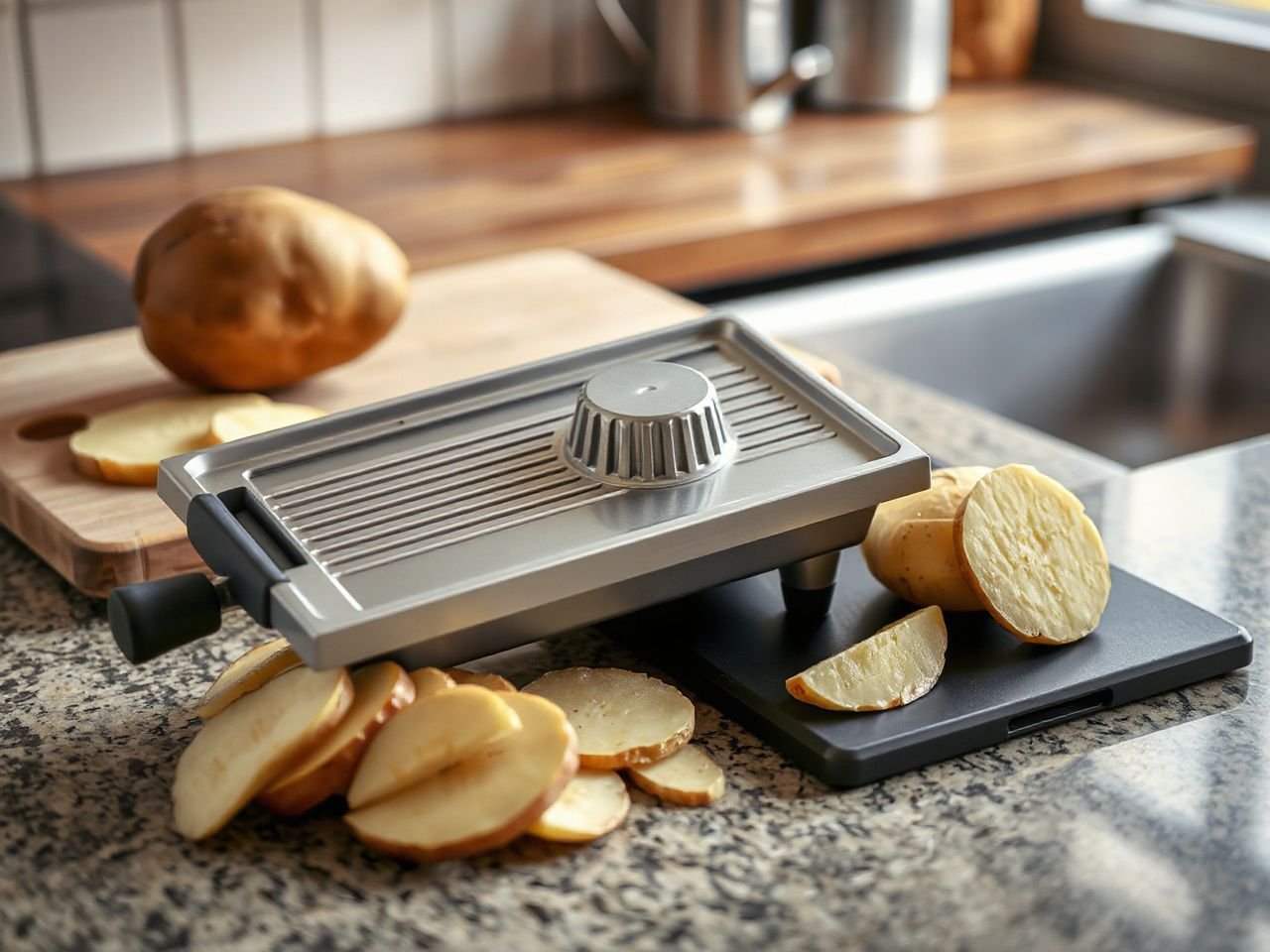
Uneven slices, a platform that shifts, and a hand guard that feels like an afterthought can turn a useful kitchen tool into a source of worry. A useful mandoline slicer buying guide distinguishes cutting performance from apparent feature count: a slicer must hold food steadily, keep its setting fixed, and let the user protect the hand as the food becomes smaller. Cleaning, blade handling, and storage also belong in the suitability test, because a slicer that is awkward to disassemble or secure can be impractical even when its cuts are precise.
Key Takeaways
- Choose stability, a firm thickness lock, and a usable hand guard before counting extra blades.
- Match the blade and platform to the foods and cuts you actually prepare.
- Plan for safe cleaning and storage because exposed mandoline blades remain dangerous after slicing ends.
Beginner: Understand How a Mandoline Slicer Works
The basic cutting action
A mandoline has a fixed frame and a movable slanted surface. Food rests on that surface and travels toward a blade as the user slides the food across it. The blade removes a slice at the point where the food passes over the cutting edge, while the gap between the platform and blade controls the slice thickness.
A mandoline features two parallel working planes, with one plane able to change height on adjustable designs. That movement changes the distance between the food’s path and the blade. A fixed model keeps the cutting gap constant; an adjustable model lets the user select different slice thicknesses, provided the adjustment mechanism holds its position securely.
A mandoline cuts by moving food across a slanted platform toward a blade. The user supplies the motion, pressure, and control, so a stable base and a secure food holder matter as much as the blade itself.
V-blade and flat-plane mandolines
A V-blade mandoline places two cutting edges at an angle that forms a V. As food meets the two edges, the cut begins at more than one point. A flat-plane mandoline uses one straight cutting edge across the platform. The difference affects how the food meets the blade and how the user controls the stroke.
The useful comparison is not the name alone. Inspect how food is supported before it reaches the blade, how much of the cutting edge is exposed, and whether the platform stays level under hand pressure. A V-blade design may appeal to someone who wants a particular cutting action, while a flat-plane design may offer a simpler path to understand and clean. Neither description removes the need for a hand guard.
Fixed or adjustable thickness
A fixed slicing platform has a predetermined gap. That makes the setup simple: there is less to adjust and less opportunity for a setting to move during use. The tradeoff is limited control over slice thickness.
An adjustable slicing platform suits cooks who move between thin slices, thicker cuts, and different recipes. The adjustment can be useful only if the mechanism locks firmly. Before cutting, move the platform gently without food on it and read the setting indicator, if one is provided. If the platform shifts, rocks, or fails to settle in the selected position, do not rely on that setting.
An adjustable mandoline is suitable only when its platform remains fixed during a cutting stroke. Feature count should come after checking the lock, because an extra range of settings has little value if the selected gap changes under pressure.
Blade choices for common cuts
The primary slicing blade produces flat slices. A julienne blade uses additional cutting edges positioned at right angles to the primary blade, dividing the slice into strips as the food passes over the surface. This is the basic action behind julienne and matchstick preparation.
A waffle-cut arrangement changes the cut from a plain slice to a ridged pattern by combining repeated directional cuts. The exact result depends on the platform and blade arrangement, so read the instructions for the particular slicer rather than assuming that every interchangeable blade fits every setting.
- Flat slicing blade: suited to repeated slices when consistent thickness matters.
- Julienne blade: suited to strips and matchstick preparation.
- Waffle-cut blade or setting: suited to a ridged pattern made through repeated directional cutting.
Stainless steel blades are common in this category, while ceramic blades appear on some designs. The label alone does not tell you how easy a blade will be to remove, clean, replace, or store. Treat every cutting edge as exposed and sharp, regardless of its material.
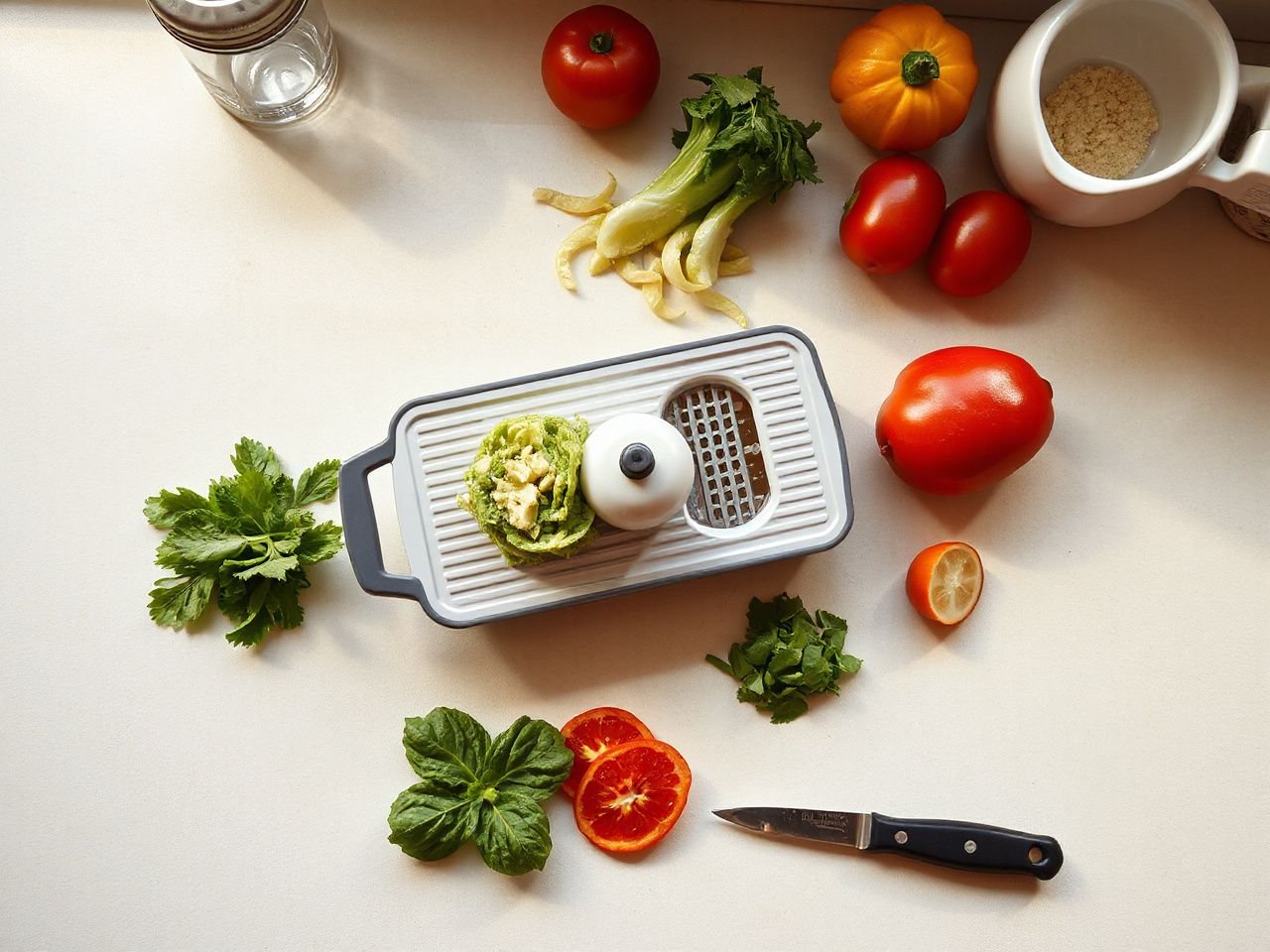
Intermediate: Judge Control, Stability, and Hand Protection
Why mandolines slip or wobble
A mandoline needs stable contact with a cutting board or another suitable surface. Slipping can make the food travel unpredictably, produce uneven slices, and bring the hand closer to the blade. A narrow base, a poorly placed support, an unsuitable work surface, or pressure applied from the wrong direction can all make control harder.
Check the underside and the contact points before buying. The slicer should sit without rocking, and its handle or support should allow the user to push food forward while keeping the other hand away from the blade path. If the design is intended to rest over a bowl, check that the frame sits securely rather than balancing on a small edge.
A stable mandoline needs firm contact with its work surface before food reaches the blade. A slicer that moves during the stroke is difficult to control, regardless of how sharp or precise its blade appears.
How the hand guard should work
The food becomes smaller with every stroke, which brings the hand closer to the cutting edge. A mandoline blade can cause severe cuts even when only a small piece of food remains. The hand guard or another appropriate protective method must remain in use from the first stroke through the final usable piece.
A food holder should grip the food firmly enough that the user does not need to place fingertips on the top or sides of the item. Look for a guard that travels along the food path, stays aligned with the platform, and leaves enough surface area to hold the food without forcing the hand toward the blade. A guard that is difficult to attach or easy to set aside is a poor safety feature in practice.
Cut-resistant kitchen gloves may provide an additional layer of protection, but a glove does not make contact with a mandoline blade safe. The hand still needs to remain behind the guard, and the user should stop when the food can no longer be held securely.
Foods that challenge a mandoline
Some foods are too small, soft, irregular, or hard for safe and effective mandoline slicing. A soft food may compress rather than travel cleanly. An irregular food may twist beneath the guard. A very small piece may not offer enough surface for the holder to grip.
Hard foods also require care. Forcing a food through the blade can make the holder lose contact or push the food sideways. Large, firm, regular pieces are easier to position than scraps, but size alone does not make a food safe. The reader must judge whether the item sits flat, can be held securely, and moves across the platform without unusual force.
- Set aside food that bends, collapses, or tears instead of meeting the blade cleanly.
- Trim irregular pieces so the guard can sit squarely, or choose a chef’s knife when trimming would leave an unsafe remnant.
- Do not force hard food through a blade when the platform or holder begins to shift.
- Use a food processor slicing disc when the quantity or shape makes hand-guided slicing impractical.
A chef’s knife gives direct control over each stroke and handles small or irregular pieces more flexibly. A mandoline offers a repeatable path for suitable foods, while a food processor can handle larger batches with less hand movement near an exposed blade. The right tool depends on the food, quantity, desired thickness, and level of control required.
Check the setting before every session
Interchangeable blades and adjustable platforms vary in how securely they lock. A blade may appear seated while one edge remains higher than the other, and a platform may show a setting without holding it firmly under pressure.
Inspect the attachment points, engage the lock, and move the platform gently before placing food on it. Run a clean finger nowhere near the cutting edge; instead, use sight and the tool’s handles or frame to check alignment. A blade that does not sit flat or an adjustment that moves should be corrected before use.
A mandoline blade must be fully seated before food is pushed across the platform. A small alignment problem can affect the cut and make the tool harder to control.
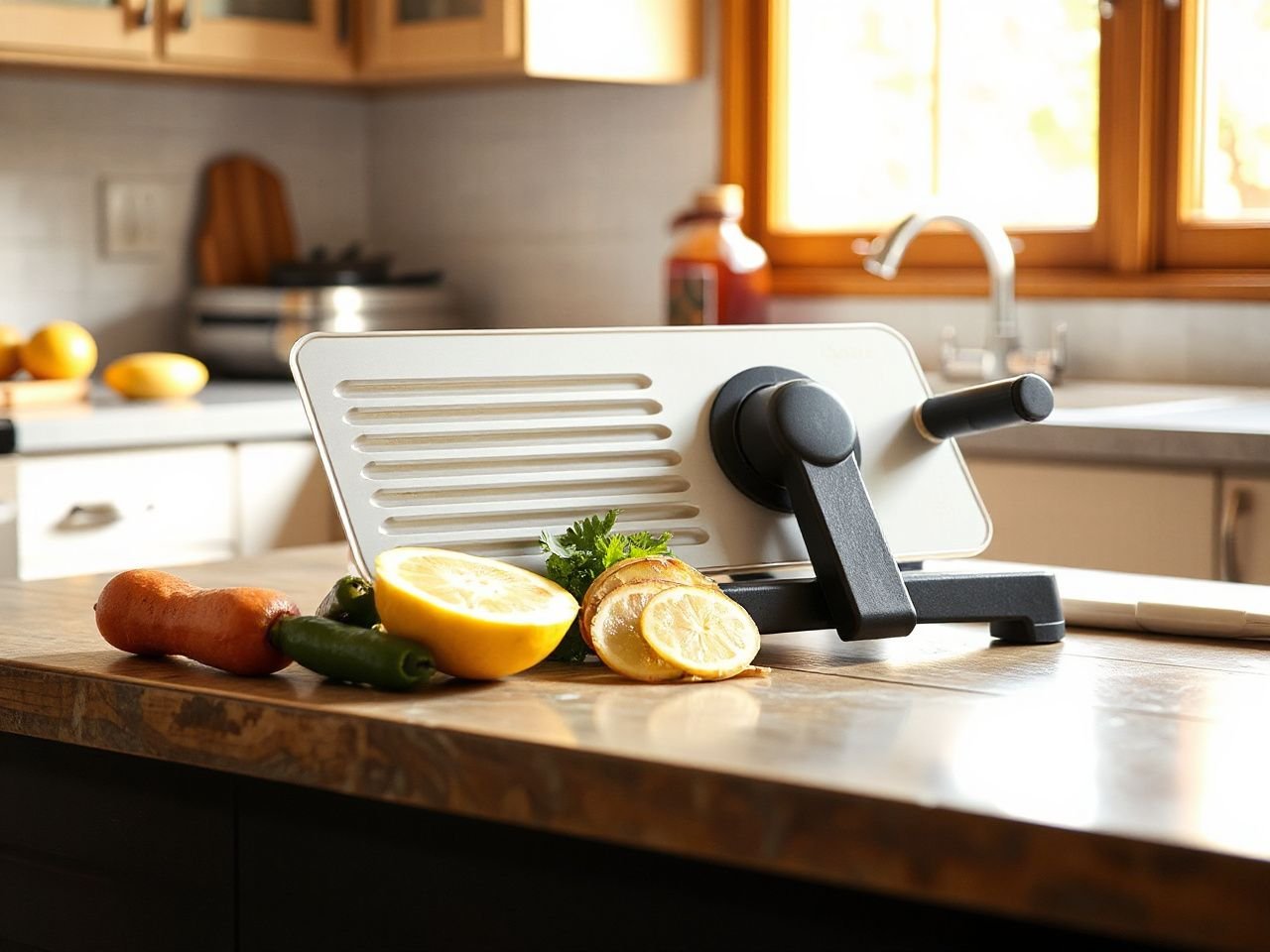
Advanced: Account for Cleaning, Blades, and Storage
Cleaning the body and platform
Food residue can collect around the blade, beneath the platform, and in the frame. Clean the slicer soon after use, following the manufacturer’s instructions for removable parts. Keep the cutting edge pointed away from the hand, and use a brush, cloth, or tool designed for cleaning rather than placing fingers along the blade.
Rinse or wipe the body only in the manner allowed by the instructions. A platform with hinges, channels, or removable sections deserves a close visual check because small fragments can remain where the food travels. Dry parts fully before storage so the blade and frame do not sit wet in an enclosed space.
Mandoline cleaning requires control of the blade, not just removal of food residue. A clean slicer can still cause an injury if the blade is hidden in cloudy sink water or left exposed in a drying rack.
Can mandoline blades go in a dishwasher?
There is no universal answer for every mandoline. Some manufacturers permit certain parts to go in a dishwasher, while others direct hand washing or place limits on heat, detergents, or placement. The manual and care marking for the particular tool control the answer.
If the instructions allow dishwasher cleaning, place the blade where it cannot fall beneath other items or become difficult to see during unloading. If the instructions do not clearly allow it, wash the blade by hand with the cutting edge facing away from the hand and store it only after it is dry.
For general consumer-product safety information, consult the U.S. Consumer Product Safety Commission, which provides guidance for safer use of consumer products. Food-contact cleaning questions should also be checked against guidance from the U.S. Food and Drug Administration rather than guessed from a product label.
Blade sharpening and replacement
Mandoline blades are not all designed to be sharpened by the user. Some can be replaced, some may require a specified service method, and some instructions may warn against sharpening. Do not assume that a generic knife sharpener is suitable for a mandoline blade.
Look for the manufacturer’s guidance on replacement parts and care. A blade that catches, tears food, or requires unusual pressure may no longer be suitable for the task, but the cause could also be residue, misalignment, or an incorrect attachment. Clean and check the assembly first; replace the blade when the instructions direct replacement or when its condition prevents controlled use.
Safe storage for sharp kitchen tools
Storage becomes part of the buying decision as soon as the slicer has removable blades. A blade storage case can keep a spare cutting edge covered, but the case must close securely and keep the blade from shifting. If the slicer folds, confirm that the folded position actually protects the cutting edge rather than merely reducing its footprint.
Do not place an exposed blade loosely in a drawer, sink, drying rack, or container where another tool can cover it. A safe storage arrangement should make the blade visible when handled, keep it separated from ordinary utensils, and allow the user to remove it without reaching across the edge.
Safe mandoline storage keeps exposed blades covered, stable, and easy to identify. A slicer that cuts well but cannot be stored without reaching near an uncovered edge may be unsuitable for a busy kitchen.
Read the physical details, not only the feature list
Dimensions can affect where the tool rests and how it fits into a drawer or cabinet. One listed mandoline measures 14.17 inches by 5.91 inches by 1.57 inches. Compare the stated dimensions with the place where the slicer will be used and stored, while remembering that the folded or assembled form may differ from the measurement shown.
Also check the manual, blade case, and platform before purchase. The important questions are practical: Can the guard stay attached? Can the blade be removed without placing fingers near the edge? Does the selected thickness lock? Can each part be dried and stored without becoming hidden beneath other utensils?
The Bread Knife Buying Guide: How It Works for Better Slices explains why a different slicing tool may suit bread and other soft, structured foods better. That distinction helps keep a mandoline focused on foods that can travel safely across its platform.
Advanced: Build a Decision Process Around the Twentieth Cut
Step 1: Define the cuts you actually need
Write down the regular tasks before looking at attachments. If the work is mostly flat slices, a primary slicing blade and a secure platform may be enough. If julienne vegetables appear often, inspect the right-angle cutting arrangement and how it is stored. A waffle cut requires a compatible blade or setting, plus enough control to repeat the directional movement safely.
Do not choose a tool around an occasional cut while accepting a poor hand guard or unstable base for everyday slicing. The recurring task should determine the core design.
Step 2: Compare the food path
Look at the platform from the side. Food should have a clear path to the blade, with no awkward ledge that makes the holder tip or lose contact. A slanted platform is part of the cutting action, but its angle and support should still let the user maintain steady forward pressure.
A food holder that works only while the food is large does not solve the main safety problem. Check how the holder handles the final useful section and where the hand sits during that stroke.
Step 3: Test the controls without cutting
Operate the thickness control, blade release, and hand guard while the slicer is empty. The mechanism should give a clear sign that it has locked or released. If a setting depends on a loose slider, an unclear latch, or a part that can be installed in more than one alignment, read the instructions before use.
Use sight and gentle pressure, not a food item, to confirm that the platform and blade are secure. This check takes place before the sharp edge meets food.
Step 4: Decide how much adjustment is useful
Fixed thickness is sensible for a narrow range of repeated cuts. Adjustable thickness suits recipes that call for different slices, but every added movement is another mechanism to inspect and clean. The choice should follow the work rather than the number of settings advertised.
A fixed slicer reduces adjustment decisions, while an adjustable slicer increases thickness control. The safer choice is the one whose setting can be verified and held during the full stroke.
Step 5: Plan the end of the task
Before buying, follow the imagined sequence from the last slice to the drying rack and storage area. Ask where the blade goes, how the platform is cleaned, and whether the hand guard can be washed without exposing the cutting edge. If the answer is unclear, the tool may create more work than its cutting speed saves.
The useful comparison is not mandoline versus knife in the abstract. A chef’s knife offers flexible knife skills for irregular food and small pieces. A mandoline offers repeatable slices for food that fits its holder and platform. A food processor slicing disc may make more sense for larger quantities, while a vegetable spiralizer serves a different shape altogether. Tool choice should follow the food and the cut.
Step 6: Keep the first setup simple
Start with the primary blade, a stable surface, the hand guard, and a food that sits securely. Confirm the setting with a test piece, then stop if the food slips, the platform moves, or the holder no longer grips. Advanced attachments can wait until the basic movement feels controlled.
I care more about the twentieth cut than the first because repeated work reveals the design decisions that matter: a lock that stays fixed, a guard that remains usable, and a cleaning process that does not invite contact with the blade. A mandoline should make those decisions easier, not ask the user to improvise around them.
Frequently Asked Questions
Do I really need a hand guard for a mandoline slicer?
Yes. The hand guard keeps the fingers behind a barrier as the food becomes smaller, which is the point at which control becomes more difficult. Use the guard from the first stroke and stop when the remaining food no longer sits securely. A cut-resistant glove can add protection, but it does not replace the guard or safe hand position.
What is the difference between a V-blade and a flat-plane mandoline?
A V-blade uses two angled cutting edges, while a flat-plane mandoline uses one straight cutting edge. The difference changes how food meets the blade and how the cut begins. Compare the platform support, guard alignment, blade removal, and setting lock rather than choosing by blade name alone.
How should mandoline blades be cleaned and stored?
Follow the care instructions for the specific model, keep fingers away from the cutting edge, and use a brush or cloth where appropriate. Do not leave a blade hidden in sink water or loose in a drying rack. A covered blade storage case or another stable, visible arrangement is safer than an exposed edge in a drawer.
Is a mandoline better than a chef’s knife or food processor?
No single tool suits every slicing task. A mandoline provides a repeatable path for suitable, securely held food. A chef’s knife offers more control over small or irregular pieces, while a food processor slicing disc can suit larger quantities. Choose according to the food’s shape, the desired cut, the batch size, and how safely the item can be held.
For readers comparing other kitchen equipment by setup, control, and storage demands, the practical guide to cookware types uses the same useful principle: judge how the tool behaves during ordinary work, not how many features appear on its package.