There’s a specific kind of satisfaction in pulling a banana bread loaf from the oven that slides out cleanly, with a deep golden crust and no torn bottom. The right pan makes that happen. After comparing six of the best loaf pans for banana bread across materials, sizes, and release mechanisms, one clear winner emerged for most home bakers.
Skip the research and grab the Jcrisova Loaf Pan Set of 2 — its pop-out silicone bottom paired with a rigid metal frame solves the two biggest banana bread problems at once: even browning and effortless release.
If you’re after a richer loaf, our peanut butter banana bread recipe pairs beautifully with any of the pans below. For now, here’s the full breakdown.
📌 This article contains affiliate links. As an Amazon Associate I earn from qualifying purchases, at no extra cost to you. Full disclosure.
CERTAIN CONTENT THAT APPEARS ON THIS SITE COMES FROM AMAZON. THIS CONTENT IS PROVIDED ‘AS IS’ AND IS SUBJECT TO CHANGE OR REMOVAL AT ANY TIME.


Spare Essentials 65 Pack 2Lb Foil Bread Pans (High-Volume Disposable)

Quick Comparison: Best Loaf Pans for Banana Bread
| Product | Best For | Buy Link |
|---|---|---|
| Mwnxia Mini Loaf Pans with Lids 50 Pack | Gifting & mini loaves | Check Price |
| Findful 50 Pack Loaf Pans | Budget bulk baking | Check Price |
| Spare Essentials 65 Pack 2Lb Foil Bread Pans | High-volume gifting | Check Price |
| Vinino Large Nonstick Silicone Loaf Pan | Nonstick purists | Check Price |
| E-far Loaf Pan with Lids | Stainless durability | Check Price |
| Jcrisova Loaf Pan Set of 2 | Overall winner | Check Price |
How We Chose These Loaf Pans
These picks come from comparing published specifications, materials, and documented features against what actually matters in this category. What decides it here is the pan material’s heat conductivity and the shape’s thermal mass: metal (aluminum or stainless) heats fast and gives even browning, but thin or dark-finished pans scorch crusts before the center sets; silicone insulates and bakes slower, often requiring a shelf under it; disposable aluminum is cheapest per use but sacrifices structural rigidity and can buckle. Also critical is the pan’s exact volume — a mismatch with the batter amount leads to overflow or a collapsed loaf — and the release mechanism (nonstick coating, pop-out bottom, or disposable) that determines how easily the finished loaf comes out without tearing. We weighted nonstick performance and structural support most heavily, since banana bread is dense and sticky. Before ordering, check your recipe’s batter volume: a standard 8.5×4.5×2.5-inch pan holds about 6 cups, while a 9x5x3-inch pan holds 8 cups. Overfilling is the most common cause of a sunken loaf.
Mwnxia Mini Loaf Pans with Lids 50 Pack (Gifting & Sharing)
Quick take: These little 6×3.5×2-inch disposable aluminum pans are ideal for bakers who want to gift banana bread or bake mini loaves without cluttering the kitchen with reusable pans.
The 50-pack of thick aluminum pans feels noticeably sturdier than the paper-thin foil pans you occasionally see at dollar stores. Each pan has a matching lid, so you can bake, cool, and hand off a loaf without wrapping in parchment. The aluminum is 100% recyclable, which matters if you bake a lot. The lids are not described as oven-safe, so they’re for storage and transport only.
For banana bread, these mini pans hold about 2 cups of batter — roughly a third of a standard loaf. You’ll split one recipe across two or three pans, which works well if you bake for a crowd or want variety. The thick aluminum resists bending under dense batter, but it’s still disposable: don’t expect to reuse a pan more than once or twice before it starts to lose shape. One honest annoyance: the lids fit snugly on top, but they don’t lock, so carry them flat.
Pros:
- 50 pans with lids — ready-to-gift packaging for mini banana breads and other quick breads.
- Thick aluminum — sturdier than typical disposable foil, less prone to side blowouts.
- Recyclable — no cleanup, just bake, give, and toss responsibly.
Cons:
- Small cavity — not for standard banana bread recipes; you’ll need multiple pans per batch.
- Disposable design — structural rigidity degrades after one or two uses, so not economical for frequent home baking.
In a nutshell:
Great match for: Holiday gift bakers, bake sales, or anyone who hates washing loaf pans. Think twice if: You bake banana bread weekly and want a single pan that handles a full recipe.
Findful 50 Pack Loaf Pans (Budget Bulk Option)
Here’s the deal: At 50 pans for a very low per-unit cost, these heavy-duty aluminum loaf pans are the most economical way to bake banana bread when you need volume without fuss.
The Findful pans measure a full 8.5×4.5×2.5 inches, the classic standard for banana bread. That means your entire recipe fits in one pan — no splitting required. The aluminum is described as heavy-duty and evenly heat-distributing, which on paper suggests fewer burnt edges than thinner foil. The shape retains its form under standard quick bread batter, though dense loaves may cause slight bowing at the bottom if you lift the pan while it’s hot.
No lids are included, so you’ll need foil or wrap for gifting. These pans are strictly one-time use: after a single bake, the aluminum softens and won’t hold up to a second round. For home bakers who only need a pan occasionally, buying a 50-pack means you’ll be set for years. But if you bake banana bread every week, you’ll blow through them fast and generate more waste than a reusable pan would.
Pros:
- Full standard size — fits any classic banana bread recipe without volume adjustments.
- Heavy-duty foil — reasonably thick, reduces the flimsy feel of cheap disposables.
- Bulk value — per loaf, the cost is almost negligible.
Cons:
- No lids — gifting or storing requires extra wrapping.
- Single-use only — not a sustainable choice for frequent bakers.
Why it made our list:
Perfect for: Occasional bakers, potluck season, or anyone on a strict budget who wants a proper full-size pan. Not great if: You’re trying to reduce kitchen waste or bake banana bread more than once a month.
Spare Essentials 65 Pack 2Lb Foil Bread Pans (High-Volume Disposable)
The real story: Aimed at commercial kitchens and serious gift-givers, this 65-pack of 2-pound foil bread pans offers the deepest thickness in the disposable category, and the larger capacity suits slightly bigger banana bread recipes.
These pans are described as sturdy aluminum foil, designed for 2-pound loaves. That means they run a touch larger than standard 1.5-pound pans, giving your banana bread a little extra headroom so the top doesn’t dome into the foil. The extra aluminum thickness helps prevent scorching on the bottom — a common complaint with cheap disposables — but the corners still bend if you’re not careful when moving a filled pan. The listing positions these for commercial value, which suggests the foil is a step up from dollar-store pans.
No lids are mentioned, so if you’re baking to give away, plan on foil and twine. For a home baker, 65 pans is overkill unless you host regularly or run a small side business. The pans are recyclable, but that’s small comfort if you’re tossing them after every loaf. On paper, the thicker construction is the main reason to choose this pack over the Findful option: a 2-pound cavity gives you flexibility for larger batches.
Pros:
- 2-pound capacity — slightly larger than standard, reducing overflow risk for generous recipes.
- Sturdy foil — the thickest of the three disposable options, holds its shape better when filled.
- Bulk count — ideal for churches, community kitchens, or bake sale fundraisers.
Cons:
- No lids included — extra wrapping required for transport.
- Overkill for singles — 65 pans will last the average household years and take up shelf space.
Our take:
Best suited for: Anyone baking banana bread to sell or give away at scale. Pass on this if: You just want one or two pans for weekend baking — the other disposables offer similar quality in smaller counts.
Vinino Large Nonstick Silicone Loaf Pan 9×5 Inches (Nonstick Purist Pick)

What stood out: A single cream-colored silicone pan sized for family banana bread recipes, with a slick nonstick surface that promises clean release without greasing or parchment.
The Vinino measures 9×5 inches, the larger standard size that holds roughly 8 cups of batter. That suits most modern banana bread recipes, especially those with add-ins like nuts or chocolate chips. Silicone is naturally flexible, so the pan must be placed on a baking sheet before filling — otherwise you’ll slosh batter all over the oven. The cream color is a practical choice: dark pans absorb more radiant heat and can over-brown the crust, while light silicone bakes more gently and evenly, though the trade-off is a slower overall bake time. The nonstick property is inherent to silicone, not a coating, so it won’t peel or scratch off.
The biggest drawback is structural: silicone flexes, and a full pan of dense banana bread batter will bulge outward if not supported. A rimmed baking sheet underneath is non-negotiable, and you’ll need to carry the baked loaf on that sheet until it cools, because the pan cannot hold its shape with a hot, heavy loaf inside. For release, this pan likely beats metal nonstick alternatives — a slight twist and the loaf should pop out without tearing. If you’re a banana bread purist who hates greasing pans, this is a strong contender, but it bakes slower than metal, so check for doneness with a skewer rather than relying on the clock.
Pros:
- Genuine nonstick surface — no PTFE or ceramic coating, just flexible silicone that banana bread peels away from.
- 9×5-inch capacity — handles full-size family recipes and thicker batters.
- Light color — reduces risk of burnt crusts, a common issue with dark metal pans.
Cons:
- Flexibility — requires a baking sheet underneath and careful handling; not self-supporting.
- Slower baking — silicone insulates more than metal, so expect a longer bake time and possibly a paler crust.
Final thoughts:
Ideal for: Bakers who prioritize effortless release and don’t mind using a baking sheet. Skip if: You want a pan you can grab straight from the oven with one hand.
E-far Loaf Pan with Lids (Durable Stainless Option)
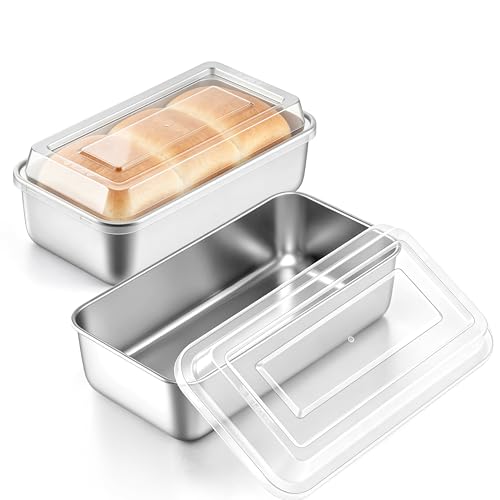
Why it stands out: This food-grade stainless steel loaf pan with a sealable clear lid is the most durable of the six, built to last decades with zero chemical coatings or peeling risks.
The E-far pan is made from thickened stainless steel, which the listing claims distributes heat evenly and resists warping. Stainless is a good conductor, but unlike aluminum or nonstick, it’s not naturally release-friendly: banana bread is dense and sticky, and without a coating you’ll absolutely need to grease and flour the pan, or use parchment. The pan’s lid is the real differentiator — a transparent, food-grade lid with four locking notches and a 1-inch headspace, creating an airtight seal. That’s fantastic for storing a baked loaf on the counter without plastic wrap, or for transporting it to a potluck. The lid is not oven-safe, so bake first, then cover after cooling.
The spec sheet says “golden crust, fluffy interior, no hot spots.” That’s a bold claim, and stainless does heat relatively evenly, but dark or thin stainless can still scorch the crust on the bottom if your oven runs hot. This pan is heavier than silicone or disposable aluminum, which is great for stability but means you’ll want oven mitts. The 9×5-inch size (implied, though not explicitly stated) should fit standard banana bread recipes. If you’re a seasoning purist who hates coated pans and doesn’t mind a little extra greasing, this is the pan for you. For everyone else, the lack of nonstick will feel like a step backward.
Pros:
- Food-grade stainless steel — no PTFE, ceramic, or chemical coatings to wear off; safe for metal utensils.
- Airtight storage lid — keeps banana bread fresh and transportable without wrap.
- Warp-resistant design — thick steel holds its shape better than thin aluminum.
Cons:
- No nonstick surface — banana bread will stick unless you grease and flour thoroughly, and even then release is trickier than with coated or silicone pans.
- Heavier than alternatives — a full pan is heavy, and the lid adds extra weight for storage.
Who should buy this:
Great for: Anyone who refuses to cook with nonstick coatings and values an airtight lid for counter storage. Not great if: You just want to bake banana bread without fussing over sticking.
Jcrisova Loaf Pan Set of 2 (Overall Winner)

The real deal: The Jcrisova combines a rigid metal frame with a flexible silicone pop-out bottom, giving you the even heat of metal and the clean release of silicone — and you get two pans for the price of one.
The set of two 9×5-inch pans (standard size, though not explicitly stated in the listing) solves banana bread’s classic problem: a dense, moist loaf that welds itself to the pan. The silicone bottom is flexible, so after baking you can press upward from below to pop the loaf out intact, no scraping or parchment required. The metal frame provides rigid support during baking and handling, which addresses the silicone-only weakness of flexing under heavy batter. The listing notes that the pop-out bottom reduces the need for parchment liners — for everyday banana bread, that’s a real time-saver.
On paper, this design is the best of both worlds: the metal conducts heat efficiently for even browning, while the silicone base prevents sticking and tearing. The only potential annoyance is that the silicone bottom may not sit perfectly flush after repeated use — some pop-out pans develop a slight gap where batter can seep. That’s a minor risk given the overall benefit. Both pans are identical, so you can bake two loaves at once, or use one for banana bread and the other for a savory meatloaf. For the home baker who wants a reliable, low-effort banana bread pan, this is the one to beat.
Pros:
- Pop-out silicone bottom — the loaf releases cleanly without tearing, even for sticky banana bread.
- Metal frame support — gives the pan structure during baking and carrying, unlike pure silicone.
- Set of two — doubles your baking capacity at a reasonable price per pan.
Cons:
- Potential seal gap — over time, the silicone bottom may not fit as tightly, allowing minor batter seepage.
- No lid or storage cover — unlike the E-far, you’ll need to wrap the loaf after baking.
Our verdict:
Best for: Anyone who bakes banana bread regularly and wants the easiest possible release without sacrificing even browning. Skip if: You’re on a strict budget and only bake occasionally — a disposable pack will do, but you’ll miss the pop-out convenience.
Buying Guide: Choosing the Best Bread Pans for Banana Bread
Banana bread is a dense, moist quick bread, so the pan you choose matters more than with a light cake. Here’s what to prioritize.
Material and Heat Conductivity
Metal pans — aluminum or stainless — heat quickly and produce a crisp, golden crust. Aluminum is the classic choice: it conducts heat evenly and is lightweight. Stainless is heavier and more durable, but without a nonstick coating it requires aggressive greasing. Silicone insulates rather than conducts, so bakes take longer and crusts stay pale; that’s the trade-off for effortless release. Disposable aluminum is thin, so it heats fast but can scorch the bottom if your oven runs hot. For banana bread, a light-colored metal pan is ideal — dark pans absorb more heat and can over-brown the outside before the center sets. According to the FDA’s guidance on food-contact materials, any nonstick coating or silicone you buy should be labeled food-safe, so check for that stamp.
Size and Volume
Overfilling is the fastest way to ruin banana bread. A standard 8.5×4.5×2.5-inch pan holds about 6 cups of batter; a 9x5x3-inch pan holds 8 cups. Most banana bread recipes yield between 5 and 7 cups, so either size works, but if you use a smaller pan, leave at least half an inch of headspace. If you’re unsure, measure your batter before pouring. The mini pans in this roundup hold about 2 cups each, so a standard recipe fills three of them. That’s fine for gifts, but not for a full loaf.
Best bread pans for banana bread: Release Mechanism
The single most important feature for banana bread is how easily the loaf comes out. Nonstick coatings (like PTFE) work well but wear down over time and can’t handle metal utensils; ceramic coatings are safer but less durable. Silicone releases naturally, but pans lack structure. Pop-out bottoms offer the best of both: a metal frame for even baking and a flexible base for clean extraction. Even with a nonstick pan, a light greasing and flouring — or a parchment sling — is cheap insurance, because banana bread sticks more than nearly any other quick bread.
For other quick breads like moist apple bread, the same rules apply. If you’re also into cookies, a brownie cookie dough sandwich cookie needs a different pan entirely, so don’t force a loaf pan into that job.
Our Final Recommendation
For most home bakers, the Jcrisova Loaf Pan Set of 2 is the clear winner: a metal frame for heat, a pop-out silicone bottom for release, and two pans for the price of one. If you’re on a tight budget, the Findful 50 Pack gives you full-size disposable pans at pennies apiece, but you’ll sacrifice reusability. For pure nonstick purists, the Vinino Silicone Loaf Pan is a solid premium alternative, though it demands a baking sheet underneath. Disposable options like the Spare Essentials pack are fine for giving away bread, but they’re wasteful for personal baking. The E-far stainless pan is durable but frustrating for sticky quick breads. My money is on the Jcrisova: it solves the single biggest banana bread pain point without creating new ones.
Frequently Asked Questions
Should I grease and flour a non-stick loaf pan before baking banana bread?
Even with a nonstick coating or silicone surface, a light greasing and flouring is cheap insurance. Banana bread is dense and sugary, and those sugars caramelize and bond to the pan’s surface. Use softened butter or neutral oil, dust with flour, and tap out the excess. For pop-out or silicone pans, a quick spritz of cooking spray is enough, but never use metal utensils on a nonstick surface — they’ll scratch the coating and ruin release over time.
Why does my banana bread burn on the outside but stay raw in the middle?
That’s almost always a pan issue: dark metal pans absorb more heat, so the outside cooks faster than the center. Light-colored aluminum or a light silicone pan is better. Also check your oven temperature with an independent thermometer, because many home ovens run 25–50°F hot. Finally, if you’re using a glass pan, reduce the oven temperature by 25°F, because glass retains heat more aggressively than metal and will over-brown the crust.
Can I reuse disposable aluminum foil loaf pans?
You can, but I wouldn’t rely on it for more than one extra bake. Disposable aluminum is thin, and the repeated expansion and contraction of heating and cooling weakens the metal. The corners get soft and the bottom may warp, which causes uneven baking. If you want a pan you’ll use weekly, buy a quality reusable pan like the Jcrisova or E-far. Disposables are best for gifting and bake sales, where the pan leaves the kitchen permanently.
What’s the difference between a 1-pound and 2-pound loaf pan for banana bread?
The “pound” label refers to the loaf weight, not the pan weight. A 1-pound pan typically holds about 4 cups of batter and measures roughly 8×4 inches; a 2-pound pan holds 6–8 cups and measures 8.5×4.5 or 9×5 inches. Most standard banana bread recipes are designed for a 2-pound pan, but if you’re scaling down or using a smaller pan, reduce the batter by a third and shorten the bake time by 5–10 minutes. The Spare Essentials pack is explicitly sized for 2-pound loaves, giving you extra headroom.