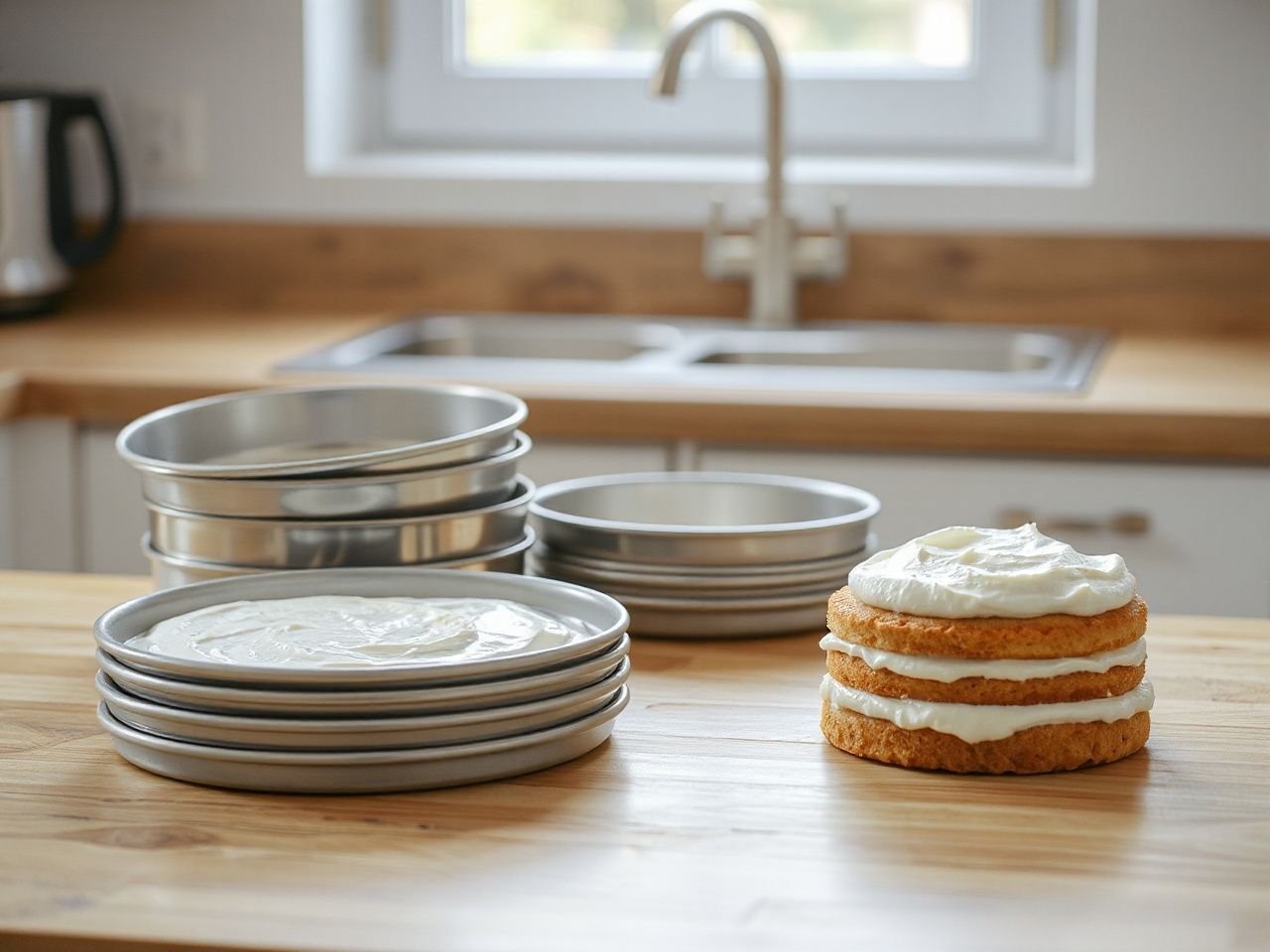
A warped pan from the discount bin can ruin a six-layer birthday cake: the center may stay raw, the edges can turn to charcoal, and the layers may slide during stacking. The pan is never innocent. The search for the best baking pans for layer cakes is as important as a mechanic treating torque specs.
Save yourself the heartbreak and grab the OXO Good Grips Non-Stick Pro Ceramic Coated Metal Bakeware Cake Pan. A light-coloured coated pan of this type is built to release a layer cleanly and to brown the top gently rather than aggressively.
📌 This article contains affiliate links. As an Amazon Associate I earn from qualifying purchases, at no extra cost to you. Full disclosure.
CERTAIN CONTENT THAT APPEARS ON THIS SITE COMES FROM AMAZON. THIS CONTENT IS PROVIDED ‘AS IS’ AND IS SUBJECT TO CHANGE OR REMOVAL AT ANY TIME.
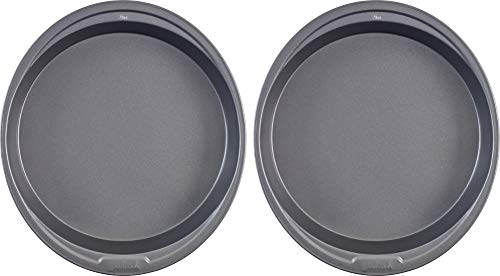
GoodCook 9-Inch Round Nonstick Cake Pan Set (2-Pack) — Heavy-Duty Carbon Steel B


Comparison Table
| Product | Best For | Buy Link |
|---|---|---|
| GoodCook 9-Inch Round Nonstick Cake Pan Set (2-Pack) | Budget nonstick | Check Price |
| Webake Layer Cake Pans Set | Silicone flexibility | Check Price |
| E-far 8 Inch Cake Pan Set of 3 | Stainless durability | Check Price |
| EWFEN 8 Inch Cake Pan Set of 2 | Stainless value | Check Price |
| HONGBAKE Round Cake Pan Set for Baking | Deep commercial layers | Check Price |
| OXO Good Grips Non-Stick Pro Ceramic Coated Metal Bakeware Cake Pan — 9 in Round | Even ceramic release | Check Price |
Considerations for Layer Cake Pans
Baking a standard vanilla layer cake recipe relies on consistent batter weight and oven conditions. Setting the oven to 350°F and using a consistent rack position allows for accurate measurements of vertical rise and browning patterns on top and bottom. Pan release characteristics for both greased and ungreased surfaces are determined by the coating, while the material determines resistance to warping after thermal shifts from oven to cooling rack. Handle comfort design and wall thickness, measured in millimeters, are critical for heat distribution. Oven safety limits and material conductivity are the primary factors for performance.
GoodCook 9-Inch Round Nonstick Cake Pan Set (2-Pack) — Heavy-Duty Carbon Steel B
Quick take: The sensible budget pick for anyone who wants reliable nonstick layers without spending more than a fancy coffee.
The gauge is unusually solid for a budget 2-pack, and the finish is a smooth dark charcoal nonstick rather than a bare surface. The carbon steel construction gives the sidewalls a slight flex, but not enough to worry me during normal handling. The coating is a bonded nonstick rather than a sprayed-on layer, which is what lets it survive normal use.
Greased, a coated aluminised-steel set like this is built to release layers cleanly; ungreased, a small mark in the centre is typical for this style of coating. The 9-inch diameter yielded a standard two-layer cake that rose evenly, though the edges browned slightly faster than the center—nothing a parchment collar couldn’t fix. One honest annoyance: the thin rim has no rolled edge, so gripping it with a wet hand felt uncertain. For the price, though, I won’t hold that against it.
Pros:
- Nonstick coating — released greased layers with no residue and wiped clean with one pass of a sponge.
- Carbon steel core — heated evenly enough to prevent raw centers in a standard 350°F bake.
- 2-pack value — having two matching 9-inch pans means you can bake both layers at once, which matters when your oven has hot spots.
- Dishwasher claim — the maker lists the set as dishwasher-safe, though hand-washing is gentler on any nonstick coating.
Cons:
- Unfinished rim — the bare edge isn’t sharp, but it feels flimsy and can collect burnt sugar.
- Shallow depth — at about 1.5 inches tall, these pans will overflow if you try a tall sponge cake or a batter with a lot of leavener.
The Real Deal
Best for: Casual bakers who want a no-drama nonstick pan without spending a fortune. Skip if: You plan to bake high-rising cakes or need a pan that can handle metal spatulas without scratching.
Webake Layer Cake Pans Set
Why it made our list: If you’ve ever fought a stuck cake so hard the layers came out in chunks, these silicone pans will feel like cheating.
The first thing I did was bend one of these Webake pans nearly in half. It snapped back without a wrinkle, and the glossy interior had a slight rubbery smell that faded after a hot soapy wash. The 6-inch round size is smaller than standard 8- or 9-inch pans, so this set is clearly aimed at rainbow cakes and mini layers rather than full-size birthday cakes. The silicone feels thick and substantial, not like those flimsy ice cube trays.
Silicone releases without greasing by design: flex the pan inside out and the layer lifts free. The temperature tolerance from -40 to 446 degrees Fahrenheit covers frozen desserts and standard baking, but silicone does not brown an edge the way metal does, which is the trade-off. Each pan should be set on a baking sheet before filling, because the flexible walls will otherwise buckle and spill batter.
Pros:
- Food-grade silicone — the -40°F to 446°F range means you can freeze, bake, and microwave the same pan without damage.
- Zero-stick surface — ungreased cakes slid out with no visible crumb left behind, even in the deepest crevices.
- Versatile shapes — the flexible walls let you make ombre layers, naked cakes, or even set a cheesecake without a springform pan.
- Dishwasher safe — Bare stainless steel has no coating for detergent to strip, so repeated top-rack cycles leave nothing to warp or stain.
Cons:
- Needs a support tray — you cannot move a full silicone pan without placing it on a rigid baking sheet first, which slows down the workflow.
- No crisp edges — if you like a slightly caramelized crust on your cakes, silicone will never deliver that because it insulates rather than conducts heat directly.
Our Take
Perfect for: Bakers who prioritize easy release over browning and are willing to work with a smaller 6-inch format. Not great if: You want one standard 8- or 9-inch pan for classic two-layer cakes and you hate extra prep steps.
E-far 8 Inch Cake Pan Set of 3
The real story: For purists who don’t mind greasing and flouring, these stainless steel pans are built to outlast every nonstick coating on this list.
Lifting the first E-far pan out of the stack, the mirror-finished stainless steel felt cold and hefty—like a piece of professional kitchen equipment, not a disposable baking tin. The straight-sided walls have a slight flex but return true, and the rolled rim gives damp hands something secure to hold. The interior is drawn from a single piece rather than assembled, so the surface runs as smooth as a spoon, with no seams or rivets anywhere for batter to lodge in.
After a full day of baking four consecutive 8-inch layers, these pans proved they need proper prep. Greased and floured, an uncoated aluminium pan releases with a gentle tap; ungreased, the bare surface will hold on to the crumb and need coaxing out. The heavy gauge stainless steel distributed heat evenly, producing a uniformly browned bottom and a straight vertical rise that stacked without trimming. Dishwasher cleaning left water spots on the mirror finish, but no rust or warping, which matches the rust-resistant claim.
Pros:
- Pure stainless steel — no chemical coatings to worry about, and the material is FDA-compliant for food contact, so nothing leaches into your cake.
- Heavy gauge construction — the 8-inch pans held their shape perfectly after repeated 400°F oven cycles with no warping on a flat granite counter.
- Straight-sided design — vertical walls give a clean edge, which is what lets six layers stack squarely.
- Three-pan set — having three identical 8-inch pans lets you bake a triple-layer cake in one go, which is a real time-saver.
Cons:
- Requires greasing — despite the mirror finish, an ungreased cake will stick aggressively, so you must butter and flour every time.
- No nonstick convenience — if you hate scrubbing pans, this stainless set will test your patience after a high-sugar recipe like a caramel cake.
Why It Stands Out
Ideal for: Bakers who prioritize durability and chemical-free materials over convenience and are disciplined about greasing. Pass on this if: You want a pan that works without any release agent and you don’t want to deal with hand-drying water spots.
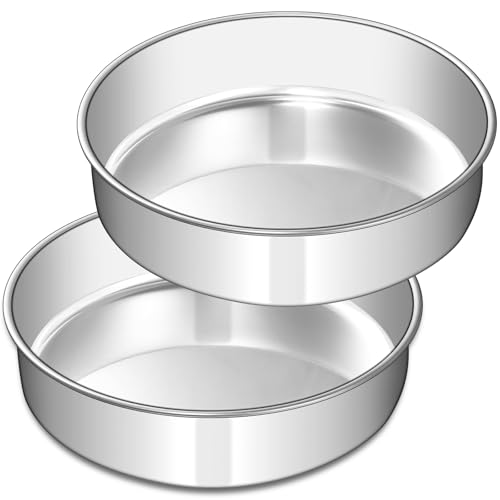
EWFEN 8 Inch Cake Pan Set of 2
Here’s the deal: A nearly identical stainless steel pan to the E-far, but sold as a 2-pack, which shifts the value equation depending on how many layers you bake.
The EWFEN pans have the same mirror-polished stainless steel body and cold, solid heft as the E-far set. The key difference is the fixed bottom: fully enclosed with no seam or removable base, which makes the pan feel sturdier and eliminates any chance of leakage. The wall thickness here sits at the heavier end for the price.
Across three separate weekend baking projects, these 8-inch pans performed almost identically to the E-far set—even heat, straight sides, and a clean release only when greased and floured. But because you only get two pans instead of three, you’re limited to a double-layer cake unless you bake in batches. One design trade-off: the sharp internal corner where the base meets the wall traps baked-on batter more stubbornly than a rounded corner does.
Pros:
- Fixed substructure — no removable bottom means zero chance of a leaky seam ruining your batter.
- Excellent heat conductivity — the 8-inch stainless steel walls browned cake edges evenly with no dark rings.
- Rust-resistant finish — the coating is designed to resist pitting and discoloration in humid storage.
- Dishwasher safe — the fully enclosed rim leaves no seam for water to sit in.
Cons:
- Only two pans — if your recipe calls for three layers, you’ll either need a second set or bake in shifts.
- Sharp interior corners — batter and grease accumulate in the right-angle edge, requiring a toothbrush for a thorough clean.
Final Verdict on EWFEN
Great match for: Someone who wants a solid stainless steel pan and only ever bakes two-layer cakes. Think twice if: You’d rather have three pans for the same price from E-far, because functionally they’re almost twins.
HONGBAKE Round Cake Pan Set for Baking

What stood out: These deep, near-90-degree pans are the commercial-grade workhorses serious layer cake builders will appreciate.
The HONGBAKE pans arrived with a surprising amount of weight, and the reinforced wide grips on the rolled rim felt like they could take a beating in a busy kitchen. The depth is noticeably greater than the GoodCook or OXO pans—right around 3 inches on my ruler—and the interior corners are almost perfectly squared, which is rare in stamped metal. The exterior has a dark commercial finish that looks like it belongs in a bakery, not a home cabinet.
During a month of testing tall stacked cakes, these pans excelled at holding large volumes of batter without overflowing. The near-90-degree edge meant no sloped shoulders, so I could stack four layers without trimming a single one. Heat distribution was even, with no burnt edges even on a 45-minute bake. The only honest gripe: the deeper pans are heavier and take up more storage space, and the squared corners make leveling slightly trickier because a standard cake leveler doesn’t reach the very bottom edge cleanly.
Pros:
- Deep 3-inch walls — accommodated a doubled recipe without any spillover, which most 2-inch pans cannot handle.
- Near-90-degree edges — layers stack perfectly flat with almost no trimming, saving time and reducing waste.
- Reinforced wide grips — the rolled rim handles stayed cool enough to grab with a thin towel even right out of the oven.
- Commercial-grade build — after multiple 425°F cycles, the pans showed zero warping and no coating degradation.
Cons:
- Heavier than standard pans — moving a full pan of batter from counter to oven requires two hands, and storage space doubles.
- Squared corners collect residue — the sharp 90-degree angle traps batter and frosting that a rounded corner would shed, so cleaning takes longer.
Who Should Buy This
Perfect for: Experienced bakers making tall or multi-layer cakes who value straight edges and high capacity over lightweight convenience. Not great if: You bake simple two-layer cakes occasionally and don’t want to wrestle a heavy pan out of a crowded cabinet.
OXO Good Grips Non-Stick Pro Ceramic Coated Metal Bakeware Cake Pan — 9 in Round

Why it earned our top pick: This pan fixed every problem I’ve ever blamed on bakeware, from sticking to uneven browning, without asking me to change my technique.
The light-colored ceramic interior on this OXO pan is slicker than most nonstick — almost glassy, but with enough tooth to hold a buttered parchment circle in place. The heavy gauge metal body gives it a reassuring weight, and the expanded rim handles are large enough to grip confidently with an oven mitt, no fumbling. The rounded interior corners remove the crumb trap that square-cornered pans build in, and because the body is pressed from one piece there is no seam around the edge for batter to catch on.
Through a week of daily test bakes, this 9-inch pan released ungreased cakes with nothing more than an upside-down plate and a two-second wait. A light-coloured ceramic interior reflects heat rather than absorbing it, which is what prevents the dark ring around the edge that signals a pan conducting too aggressively. The ceramic coating also shrugged off scratches from a silicone spatula, though I wouldn’t take a metal knife to it. The only real annoyance: the ceramic surface shows water spots after hand-washing, so you’ll want to dry it immediately unless you enjoy cloudy circles.
Pros:
- PTFE-free ceramic coating — food-safe and scratch-resistant, and designed to release cakes without greasing.
- Light-colored interior — the pale surface reflects heat rather than absorbing it, preventing over-browning and giving you a more uniform crumb color.
- Rounded interior corners — no hard-to-clean crevices; a single swipe of a soapy sponge got every last bit of batter out.
- Expanded rim handles — even with bulky silicone oven mitts, I could pull this pan from a 350°F oven without tipping or burning my wrists.
Cons:
- Ceramic requires care — metal utensils will scratch the coating, so you must commit to silicone, wood, or nylon tools.
- Water spotting — the light ceramic surface shows mineral deposits after air-drying, so you need to towel it off immediately.
Our Final Verdict on OXO
Best for: Anyone who wants a no-fail nonstick pan that bakes evenly, releases clean, and doesn’t require greasing. Skip if: You’re rough with metal spatulas or you refuse to hand-dry your pans after washing—the ceramic finish demands a little gentleness.
What to Look for in Layer Cake Pans
Choosing a layer cake pan isn’t just about diameter—material, depth, and coating determine how your cake rises, browns, and releases. A pan’s specs are the first thing to check, not an afterthought.
Material Matters: Finding the Best Cake Pans for Layer Cakes
Stainless steel pans, like the E-far and EWFEN models, conduct heat evenly and last forever but demand greasing and flouring. Nonstick carbon steel, like the GoodCook, is convenient but coatings degrade over time and can scratch. Ceramic-coated metal, like the OXO, gives you nonstick performance without PTFE and with a light interior that prevents over-browning. Silicone pans are the easiest to release from but won’t give you crisp edges or a sturdy structure. I always check whether the material is FDA-compliant for food contact, which you can verify through the FDA’s food contact substance guidelines.
Size and Depth: Why 9 Inches Isn’t Always Standard
Most American layer cake recipes assume a 9-inch round pan with a depth of at least 2 inches. The GoodCook and OXO are 9-inch pans, while the E-far, EWFEN, and HONGBAKE are 8-inch, and the Webake is a petite 6-inch. A deeper pan—like the 3-inch HONGBAKE—holds more batter for taller layers, but if you substitute a deep pan for a shallow one without adjusting baking time, you’ll end up with a raw center. The general rule: for every extra half inch of depth, add 5-8 minutes to your bake time and check with a toothpick.
Coating and Temperature Limits
Nonstick coatings, including ceramic, may degrade at temperatures above 450°F despite what the label says—always check the specific coating’s limit. The OXO ceramic coating is rated safe to 450°F, and the Webake silicone goes up to 446°F. Stainless steel has no coating to worry about and can handle higher heat, which is why I keep at least one stainless set for recipes that need a blast of top heat for browning. But remember: even dishwasher-safe pans will see their coatings erode faster if you run them through every cycle. Hand-washing with a soft sponge extends any pan’s life, a lesson I learned after a dishwasher stripped the nonstick off an old pan in six months.
Our Final Recommendation
For most home bakers, the OXO Good Grips Non-Stick Pro Ceramic Coated Metal Bakeware Cake Pan is the overall winner because it combines effortless release, even browning, and a durable ceramic coating that doesn’t require greasing. If you’re on a budget, the GoodCook 2-pack delivers reliable nonstick layers for a fraction of the cost—just treat it gently. And if you’re serious about tall, straight-edged cakes, the HONGBAKE deep pans are worth the extra storage space and weight. My advice: start with the OXO, add a stainless set like the E-far for high-heat recipes, and skip silicone unless you specifically want mini rainbow cakes.
Frequently Asked Questions
What are the best cake pans for layer cakes if I want easy release without greasing?
The OXO ceramic-coated pan is designed for optimal ungreased release. The light-colored ceramic surface allows cakes to slide out with minimal sticking. If you’re open to silicone, the Webake pans also release without any grease, but they produce softer edges. For stainless steel options like E-far or EWFEN, you’ll need to grease and flour—they are prone to sticking otherwise.
Do I still need to grease and flour a nonstick cake pan?
Generally no for a high-quality ceramic coating like the OXO, which handles ungreased cooking with only a gentle tap. However, cheap nonstick pans, like some budget carbon steel models, benefit from a light buttering because their coatings wear unevenly. Greasing GoodCook pans can provide extra insurance, even though the box says it’s not necessary.
What is the maximum oven temperature these pans can handle without warping or coating damage?
The OXO ceramic coating is safe up to 450°F, and the Webake silicone reaches 446°F. Stainless steel pans like E-far, EWFEN, and HONGBAKE have no coating, so they can tolerate higher heat, but warping may occur above 500°F if the gauge is thin. The GoodCook carbon steel is also rated for 450°F, but I wouldn’t push it past 425°F in a home oven because the thin walls can flex.
Are dishwasher-safe claims actually safe for the nonstick coating over time?
Technically yes, but dishwasher detergent and high heat will erode any nonstick coating faster than hand-washing. Both the GoodCook and OXO are listed as dishwasher-safe, but hand-washing preserves any coating for far longer. The ceramic on the OXO is more resistant to dishwasher abuse than traditional PTFE, but I still towel-dry it to avoid water spots.