A small stand mixer can occupy little counter space yet stall when a stiff dough loads the hook, leave flour beneath the beater, or walk across the worktop under torque. The key distinction is between countertop footprint and mixing capability: a compact stand mixer may save space while still having limits imposed by bowl geometry, transmission torque, attachment clearance, and dense-dough load. A useful compact stand mixer buying guide therefore compares working capacity and failure behavior rather than treating wattage or bowl volume as complete measures of performance.
That distinction matters more than a polished speed dial. The listing may tell you the bowl volume, motor rating, materials, and attachments, but those details do not automatically reveal how a machine behaves under a heavy batch. I read the specification sheet first, then ask what the omitted details mean for noise, stability, kneading, cleaning, and repair.
Key Takeaways
- A bowl’s stated volume is not its safe working capacity, especially for dense dough.
- Published wattage cannot predict kneading performance across different mixer designs.
- Stable placement, correct loads, careful cleaning, and compatible attachments matter as much as footprint.
Beginner: What compact really means
Counter space is only the first measurement
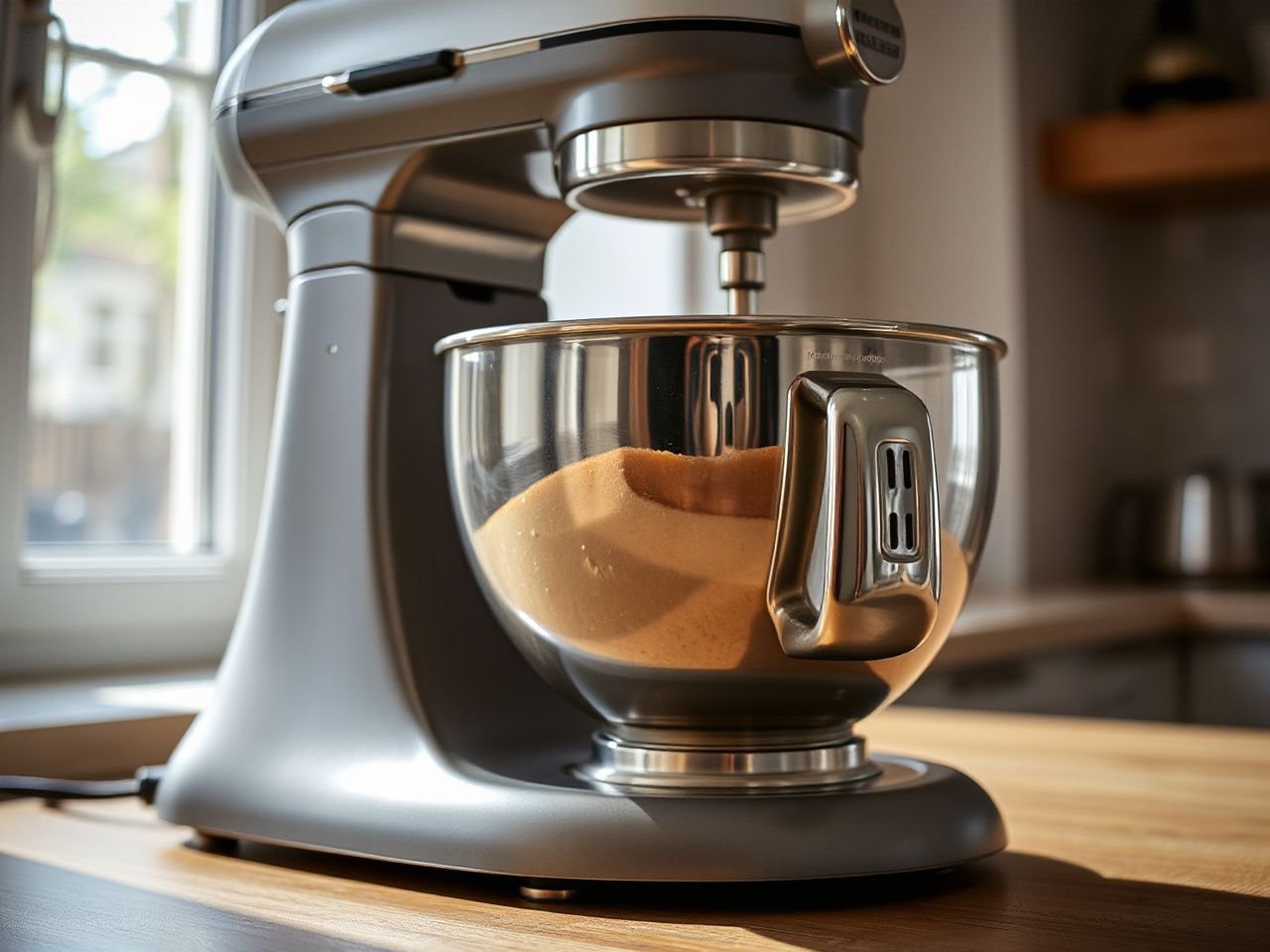
A compact stand mixer usually takes up less countertop room and weighs less than a conventional full-size machine. That description is useful, but incomplete. A buyer also needs to check the space above the appliance, the room required for a tilt-head, the reach needed to remove a stainless steel mixing bowl, and whether a cabinet or backsplash interferes with the head.
Compact stand mixers are defined by reduced physical footprint, not by a universal performance class. A smaller housing can still produce meaningful torque, and a light machine can move when a dough hook meets a dense mass. Leave enough clear counter space to hold the appliance firmly and remove the bowl without twisting the machine against a wall.
A compact stand mixer can save counter space without offering the same dough capacity as a full-size mixer. That is the sentence to keep in mind while reading product listings.
Bowl volume is not working capacity
A bowl’s advertised volume describes the container, not the amount of every ingredient that can be mixed safely. Whipped cream and egg whites need room for expansion and movement. Flour-heavy mixtures occupy space before hydration, while dense dough places a much greater mechanical load on the dough hook and transmission than a light batter does.
The manufacturer may provide a maximum flour or dough load, but many listings provide only the bowl volume. If that limit is missing, do not convert the bowl size into a confident dough capacity. Treat the missing figure as a missing decision point.
- Light mixtures may use more of the bowl’s available space, provided the attachment remains clear.
- Dense dough deserves a smaller working load than the bowl’s physical volume might suggest.
- Large batches can leave ingredients unmixed if the beater cannot reach the lower or outer areas of the bowl.
- A splash guard can reduce mess, but it does not increase motor capacity or bowl clearance.
Batch size also changes noise. A motor under load usually produces a deeper, harsher sound than the same motor turning a whisk through a light mixture. I treat a louder or changing motor note as information about resistance, not as a reason to raise the speed immediately.
Compact mixer, hand mixer, or food processor?
A stand mixer holds the bowl and attachment in a fixed relationship, leaving both hands available for adding ingredients or shaping dough. A hand mixer is easier to store and can move around a bowl, but the user must provide the control and support. A food processor uses a blade or other dedicated tool for tasks that depend on rapid cutting, chopping, or batch processing rather than the open mixing action of a beater or dough hook.
Those tools overlap, but they are not interchangeable. A compact stand mixer suits repeated whisking, creaming, batter mixing, and kneading within its stated limits. A hand mixer suits smaller tasks where direct control matters. A food processor may handle a preparation that requires a blade, but its bowl capacity and blade design impose different limits.
The right comparison is the task, not the appliance category’s marketing language. Someone making occasional cakes may value storage and bowl access, while someone making bread needs honest information about dense-dough load, transmission behavior, and thermal protection.
Beginner: Read the motor and mixing system correctly
Why wattage is an incomplete clue
Published wattage is not a reliable cross-brand measure of mixing performance. Input power, transmission design, speed control, attachment geometry, and overload protection all change how much useful force reaches the dough. A higher number on a listing therefore cannot settle the kneading question by itself.
Available figures show the problem. The Martha Stewart 5.3-quart stand mixer is listed with a 660-watt motor and 12 speed settings. The Dash 3.5-quart tilt-head stand mixer is listed with a 350-watt motor and 12 speed options. The Kitchen in the Box 3.2-quart stand mixer is listed with a 300-watt motor and six speeds. The Hamilton Beach Classic Stand and Hand Mixer is listed with 290 watts of peak power.
Those figures describe different products on paper, but they do not establish a common kneading scale. Peak power also needs careful reading because a peak figure is not automatically the same as continuous power delivered during a stiff mixture. If a listing does not explain the rating, I would not use it as a performance ranking.
Motor wattage measures an electrical input claim, not the complete kneading capability of a stand mixer. Look for load guidance, overload information, transmission details, and clear instructions alongside the wattage.
Planetary mixing and bowl coverage
Planetary mixing means the beater rotates around its own axis while also traveling around the bowl. This path brings the attachment through more of the mixture than a simple stationary rotation would. The result can improve coverage, but the bowl shape, attachment height, ingredient quantity, and adjustment range still determine whether flour or fat remains on the sides.
A planetary system does not guarantee that the mixer will scrape every part of the bowl. A beater set too high can leave material beneath it. A beater set too low can scrape the stainless steel mixing bowl. Ingredients may remain unmixed if the batch is too small for the attachment to contact it or too large for the bowl to contain it comfortably.
The KitchenAid Artisan Mini 3.5-quart model is listed with planetary mixing and 59 points of contact. That is a useful description of the beater’s path, but contact points do not replace a stated working capacity or a clear explanation of attachment clearance.
Noise is a mechanical clue
Noise deserves more attention than a decibel claim that the listing does not provide. A steady hum, a strained growl, rhythmic knocking, and sudden clicking can indicate very different conditions, yet no product page can promise a quiet result under every load.
Dense dough often produces more sound because resistance rises as the hook folds and stretches the mass. A compact body may also transmit vibration through the counter. Place the appliance on a level, stable surface, keep the bowl fully seated, and avoid operating it unattended during heavy mixing.
A motor that becomes hot or changes sound should not be challenged to finish the batch. Stop the mixer, switch it off, and follow the manufacturer’s instructions before inspecting the bowl or attachment.
Intermediate: Match the machine to real batches
Using a dough hook without overloading the drive
Bread dough is a demanding use because hydration, flour quantity, gluten development, and dough temperature all affect resistance. Lower hydration generally produces a stiffer mass, but the listing rarely gives enough information to translate a recipe into a safe load. Use the manufacturer’s dough guidance whenever it is available, and reduce the batch if the guidance is absent.
Do not judge a dough hook by the bowl’s unused space alone. A dough can sit below the rim and still place high torque on the drive. If the hook stalls, the bowl moves, the mixer rocks, or the motor note rises sharply, stop rather than adding more speed.
A compact stand mixer may reach its practical limit before its bowl looks full. Dense dough imposes stricter limits than many light mixtures because resistance is concentrated at the attachment and drive.
Whisking and large light mixtures
A wire whisk needs room to move air through a mixture. A bowl can look generously sized while still being poorly matched to a small amount of cream or egg whites if the whisk cannot reach the mixture effectively. The opposite problem occurs with a large batch: the mixture may climb, splash, or remain below the whisk’s useful path.
Start at a low speed when adding powder or liquid ingredients, then increase only within the manufacturer’s instructions. A high speed can spread flour across the counter before the mixture has incorporated. The correct setting depends on the attachment, recipe, and machine controls rather than on the highest number printed on the dial.
Flat beater work and bowl adjustment
The flat beater is usually the central tool for cake batter, cookie mixtures, and creaming tasks. Its clearance must be correct. If the beater scrapes, stop the machine and consult the adjustment instructions rather than bending the attachment or forcing the bowl into a different position.
A beater that sits too high can fail to incorporate ingredients resting at the bottom. A beater that sits too low can mark the bowl and send vibration through the head. The problem may come from bowl seating, attachment choice, or adjustment rather than from motor power.
Stalling, overheating, and thermal protection
A thermal overload protector can shut the mixer down when heat or load reaches a protective limit. That safeguard reduces the chance of continued operation under damaging conditions, but it does not make overload harmless. Repeated stalls still place stress on the motor, transmission, attachment, and control system.
If a mixer shuts off, turn it off and unplug it before clearing an obstruction or removing an attachment. Follow the manufacturer’s instructions for cooling and restart conditions. Do not hold the switch in place, repeatedly restart the machine, or reach into the bowl while the attachment is connected to power.
Intermediate: Stability, safety, and attachment fit
Why a compact mixer can still move
A compact body does not remove torque. The dough hook can pull a stiff mass around the bowl, and vibration can make the appliance shift on a smooth counter. Keep the mixer on a level surface, seat the bowl correctly, use the intended attachment, and stay nearby while it runs.
Do not place the mixer where a moving head could strike a cabinet or where a falling attachment could reach a hot surface. Cable placement matters too; keep the cord away from heat and from the edge of the worktop.
Compact stand mixers can move under dense-dough load, so stable placement and attended operation are basic safety requirements. A lower price, smaller footprint, or lighter housing does not change that mechanical fact.
Attachment ecosystems are not universal
A dough hook, flat beater, and wire whisk may be included, but compatibility with additional tools depends on the brand, model family, attachment hub, drive interface, and bowl geometry. Accessories that fit one mixer should not be assumed to fit another simply because the machines look similar.
Some mixers use a front hub for optional tools, while others rely on attachments that connect directly to the head or bowl area. The listing may state a hub type, but it may not confirm compatibility with every accessory in a brand’s wider ecosystem. Check the exact model and attachment instructions before buying an add-on.
Attachment clearance also affects the usable bowl. A tool designed for a larger bowl may sit at the wrong height in a compact model, even if the connection appears similar.
Standards and electrical claims
The International Electrotechnical Commission is the organisation associated with that international standard, and the product documentation should identify the applicable compliance information.
The UL Standards and Research site is the appropriate place to understand UL’s standards role; a retailer bullet point alone should not be treated as proof of a particular certification.
Advanced: Maintenance, noise control, and ownership cost
Cleaning without harming the machine
Unplug the mixer before cleaning or clearing an attachment. Remove the bowl and tools according to the manual, clean food-contact parts using the stated method, and keep water away from the motor housing, controls, vents, and power connection.
The listing may identify a stainless steel mixing bowl, die-cast zinc housing, or other materials, but material names do not replace the care instructions. A removable attachment may tolerate a different cleaning method than the mixer body. Do not submerge the motor housing unless the manufacturer expressly permits it.
Dry parts fully before storage. Flour and dough can collect around the attachment shaft, bowl seat, or head joint, where residue may later interfere with fit. Avoid forcing dried dough loose with a sharp tool that could damage a finish or seal.
Maintenance beyond the purchase price
Ownership cost includes electricity, replacement beaters, storage space, cleaning time, and possible repair if a proprietary attachment or control component fails. A mixer with a larger attachment ecosystem may offer more uses, but proprietary interfaces can also make replacements less flexible.
The listing often omits repairability, replacement-part availability, and service instructions. Those omissions matter more to a frequent bread baker than to someone who uses a whisk occasionally. Before purchase, check whether the manufacturer identifies replacement attachments and cleaning procedures for the exact model family.
Electricity use cannot be calculated responsibly from a single wattage figure without knowing actual running time and load. A mixer rated at 660 watts does not necessarily draw that amount continuously in every task, and a 290-watt peak-power claim does not provide a complete operating-cost estimate.
For related kitchen planning, the Best Cooling Racks: Top Picks, Reviews, and Buying Guide can help with the counter space needed after mixing and baking. A worktop that fits the mixer but has no room for cooling equipment may still feel cramped.
Read the listing for what it does not say
Useful omissions include the absence of a flour limit, dough limit, noise measurement, attachment-hub description, overload procedure, bowl-clearance instructions, and replacement-part information. None of these gaps proves that the machine is poor. Each gap does mean the buyer should avoid filling in the answer with assumptions.
A product page that gives a bowl size but no working-load guidance is incomplete for a bread baker. A page that gives wattage but no explanation of whether the figure is peak or continuous is incomplete for cross-brand comparison. A page that lists attachments without model-family compatibility is incomplete for expansion planning.
The most useful stand mixer specification is the one that connects a component to a permitted task. A dough limit, overload instruction, or exact attachment compatibility statement tells more than a bare feature label.
Advanced: A practical decision process
Step 1: Define the hardest regular task
Start with the task that creates the highest load, not the easiest recipe. If bread dough is routine, make dense-dough guidance the first filter. If cakes and whipped mixtures dominate, bowl access, whisk clearance, speed control, and cleaning may matter more.
Write down the largest realistic batch and the attachment required. Do not use bowl volume as a substitute for the manufacturer’s flour or dough limit. If the limit is not listed, choose a smaller working assumption and accept the uncertainty.
Step 2: Check the physical fit
Measure the counter area available, then account for the tilt-head path, cabinet clearance, bowl removal, and cord routing. A machine that fits only when the head cannot open is not a practical fit. A lightweight appliance may need more free space around it because movement is harder to manage near a counter edge.
Check whether the stainless steel mixing bowl has a handle, whether the bowl locks in the stated position, and whether the attachment can be removed without striking a cabinet. The listing may not provide every dimension, so missing clearance information should be treated as a reason to measure the physical space carefully.
Step 3: Compare the load information
Set wattage beside the more important questions: Is the power figure peak or continuous? Does the manufacturer state a dough limit? Is there a thermal overload protector? Are speed instructions given for the dough hook, flat beater, and wire whisk?
Compare like with like. The Martha Stewart 5.3-quart listing’s 660-watt figure, the Dash 3.5-quart listing’s 350-watt figure, the Kitchen in the Box 3.2-quart listing’s 300-watt figure, and the Hamilton Beach Classic listing’s 290-watt peak figure should not be turned into a simple performance ladder.
Step 4: Check the attachment and care ecosystem
Confirm that the included dough hook, flat beater, and wire whisk suit the bowl and head. If optional tools matter, verify the exact attachment hub and model family. Read cleaning instructions before assuming that a bowl or beater is dishwasher-safe.
Storage also counts. A compact mixer can save counter space while its attachments occupy a drawer. Keep tools dry, avoid losing adjustment hardware, and store the manual where load limits remain easy to find.
Step 5: Set a stopping rule
Safe use depends on recognising failure behavior early. Stop for repeated stalling, a bowl that shifts, scraping, a sharp motor-pitch change, an unexpected shutdown, or heat that prompts the manufacturer’s overload instructions. Unplug before clearing the bowl or attachment.
That stopping rule protects the appliance and keeps a small problem from becoming a damaged attachment or drive. No compact mixer should be left to struggle while the user leaves the room.
Frequently Asked Questions
Does a compact stand mixer have lower capacity than a full-size mixer?
A compact stand mixer has a smaller physical footprint, but compactness alone does not define safe capacity. Bowl volume is only the container size. Dense dough, dry ingredients, attachment clearance, and the manufacturer’s load instructions impose stricter limits. A small mixer may handle light mixtures comfortably while requiring much smaller dough batches than its bowl volume suggests.
Does higher wattage mean better bread-dough performance?
No. Published wattage usually describes electrical input, and brands may present peak or continuous figures differently. Transmission design, speed control, attachment shape, bowl geometry, and thermal protection also affect kneading. Treat wattage as one data point. A stated dough limit and clear overload instructions are more useful for judging whether the machine suits regular bread making.
Why does a stand mixer overheat or shut off with thick dough?
Thick dough creates high resistance at the hook and drive. The motor may heat, stall, or activate a thermal overload protector. Protection does not make repeated overload harmless. Stop the mixer, switch it off, unplug it before clearing an obstruction, and follow the manufacturer’s cooling and restart instructions. Reduce the batch if the specified load has been exceeded.
Are attachments interchangeable between compact stand mixers?
Usually, compatibility depends on the brand, model family, attachment hub, drive interface, and bowl geometry. Similar-looking mixers can use different connection systems, and a tool intended for a larger bowl may sit at the wrong height. Confirm the exact model and manufacturer’s compatibility information before buying optional attachments or replacement beaters.
How should a compact stand mixer be cleaned?
Unplug the appliance before removing attachments or clearing residue. Clean the bowl and tools using the manufacturer’s instructions, and keep water away from the motor housing, controls, vents, and power connection. Dry removable parts before storage. Do not assume that a stainless steel bowl, coated beater, or whisk is safe for every cleaning method unless the listing or manual says so.
For readers planning a broader baking setup, our guide to choosing a Dutch oven for soup covers a separate set of capacity and heat-management decisions. The same principle applies here: the stated size is useful, but the real task determines the practical limit.