Most sandwich bread failures start long before the oven. They start with a pan whose stated capacity doesn’t match the dough weight in your recipe—a mismatch that leaves you with either dough overflowing the sides or a short, dense brick. I blame the pan before the recipe, and I’m usually right. When I went looking for the best loaf pans for sandwich bread, I filtered out anything that couldn’t answer one question: Will this give me square, uniform slices without constant trimming?
Short answer: the Lyksgir Pullman Loaf Pan with Lid has a 13×4-inch professional footprint and 4-vent steam circulation, making it a strong match for tall sandwich loaves here.
📌 This article contains affiliate links. As an Amazon Associate I earn from qualifying purchases, at no extra cost to you. Full disclosure.
CERTAIN CONTENT THAT APPEARS ON THIS SITE COMES FROM AMAZON. THIS CONTENT IS PROVIDED ‘AS IS’ AND IS SUBJECT TO CHANGE OR REMOVAL AT ANY TIME.
| Product | Best For | Buy Link |
|---|---|---|
| AKOLAFE 4-Pack Large Nonstick Loaf Pans | Budget quick breads | Check Price |
| Lollicy 3-Pack Pullman Loaf Pans with Lids | Value square slices | Check Price |
| Saiveina Pullman Loaf Pan with Lid | Giftable baking set | Check Price |
| Heysagix 9×5 Cast Iron Loaf Pans with Lids | Deep browning | Check Price |
| Lyksgir Pullman Loaf Pan with Lid 13×4 | Tall sandwich loaves | Check Price |
| Gicyiit Pullman Loaf Pan with Lid | Transparent capacity | Check Price |
| Articasting Cast Iron Loaf Pan with Lid | High-heat artisan | Check Price |
| Homemade Sandwich Bread Loaf Pan 12×4.2×4.5 Silicone | Soft family loaves | Check Price |
How We Narrowed Down These Loaf Pans
We compared published specifications and documented features against what actually decides a good sandwich loaf: material and heat distribution, the presence and fit of a lid, nonstick coating safety and durability, and dimensional accuracy against dough weight. Carbon steel heats fast and bakes crisp; cast iron gives deep browning but adds weight and seasoning upkeep. Silicone is nonstick but bakes pale and must be supported. The critical failure mode is buying a pan whose stated capacity doesn’t match the dough weight, leading to either overflow or a short, dense loaf—so dimensional accuracy and clear capacity labeling were weighted heavily. Before ordering any of these, check the pan’s length and width against your recipe’s dough weight; that single comparison will save more loaves than any feature. And when a coating says food-grade, look for independent verification from NSF International or the FDA’s food contact material regulations rather than trusting marketing copy.

Lollicy 3-Pack Pullman Loaf Pans with Lids (Best Value for Square Slices)


AKOLAFE 4-Pack Large Nonstick Loaf Pans (Budget Multi-Use)
Quick take: Best for cooks who want four basic nonstick pans for banana bread and quick loaves, not square sandwich slices.
The one-piece design and smooth wide edge suggest these will feel stable enough, but the outer dimensions 10.9×3.7×2.4 inches immediately raise a flag for sandwich bread. A standard 1-pound sandwich loaf fits a 9×5-inch pan; this pan is taller and narrower, which is better suited to dense fruit or nut breads than a wide Pullman-style loaf. The listing simply says nonstick without specifying PTFE or ceramic, so long-term release is a question mark.
Four pans mean multiple quick loaves in one afternoon, but none has a lid, so you will never get those flat, squared-off sandwich slices without trimming the dome. The lack of a stated capacity in pounds is a red flag for bread recipe matching. If you’re baking banana or zucchini bread, the four-pack value is solid; if you’re chasing a shokupan-style sandwich loaf, the shape will fight you every time.
Pros:
- Four pans — bake multiple loaves at once
- One-piece construction — no rim seams
- Smooth edge — safe grip
Cons:
- No lid — domed top guaranteed
- Odd dimensions — not a standard sandwich loaf footprint
The real story:
Ideal for: budget-minded quick bread bakers. Pass on this if: you want square sandwich slices without trimming.
Lollicy 3-Pack Pullman Loaf Pans with Lids (Best Value for Square Slices)
Quick take: Best value because you get three lidded pans and a bread knife for less than most single Pullman pans.
Material is thickened carbon steel, which is exactly what you want for fast, stable heat conduction. That means the pan will preheat quickly and recover temperature when the dough goes in, reducing the pale, gummy bottom common with thinner bakeware. The included lids lock in moisture, which is the whole point of a Pullman—it forces the dough to fill a rectangular shape and yields a fine, even crumb rather than a peaked top.
The set includes a bread knife for slicing, a practical touch though it will not rival a dedicated serrated bread knife. The listing does not specify pan length, width, or dough capacity, which is a real omission for anyone converting a recipe. Without those numbers, it is impossible to know if a 1.5-pound dough will fill the pan or spill over. Still, for the price, a three-pack with lids is the cheapest serious route to sandwich-ready loaves.
Pros:
- Three lidded pans — batch baking
- Carbon steel — ideal heat conduction
- Included knife — convenience
Cons:
- Missing dimensions — can’t verify capacity
- Thickness not specified in mm — no way to judge warp resistance
Our take:
Perfect for: bakers who want true Pullman square slices on a budget. Skip if: you need exact sizing for a known recipe.
Saiveina Pullman Loaf Pan with Lid (Bonus Heart-Shaped Pans)
Quick take: A complete set for occasion baking, but the Pullman core is what matters for sandwiches.
Premium carbon steel construction with a smooth nonstick coating is the right backbone. Nonstick release matters more on a lidded Pullman than on an open pan because the loaf steams inside and can weld itself to the walls if the coating is weak. The listing promises effortless release, and the material choice supports that claim.
The bonus heart-shaped cake pans are a nice extra for Valentine’s Day, but they occupy cabinet space and do not change the pan’s sandwich performance. Again, no dimensions or dough-weight capacity are listed, a pattern in this category. Without knowing whether this is a 9×4, 11×4, or 13×4 pan, you’re gambling on fit for a standard sandwich loaf. If the pan is 9×4, a 1-pound dough often overflows with a lid; if 13×4, you need a 2-pound dough. This uncertainty keeps the Saiveina out of the top spot.
Pros:
- Premium carbon steel — even heat
- Nonstick coating — easy release
- Bonus pans — giftable set
Cons:
- Undisclosed dimensions — capacity gamble
- Heart pans add clutter — not useful for sandwich bread
Why it stood out:
Great match for: bakers who want a gift-ready baking set. Think twice if: you demand exact loaf dimensions.
Heysagix 9×5-Inch Cast Iron Loaf Pans with Lids (Deep Browning Option)
Quick take: If you want a crackly, deep-brown crust and don’t mind the weight, this two-pack delivers cast iron’s thermal mass.
Cast iron’s heat retention is legendary, and a 9×5-inch pan is the standard sandwich loaf footprint. The fitted lid creates a sealed pullman-like environment, so you get a rectangular shape with the added bonus of steam trapped against the crust for better oven spring. What jumps out from the spec sheet is the weight—these are cast iron, so each pan will feel heavy before it reaches the counter. That’s the trade-off for heat stability.
The real annoyance is seasoning. The listing mentions cast iron without specifying raw or pre-seasoned, but either way these need thorough drying after washing and re-oiling to prevent rust. That’s more upkeep than a nonstick carbon steel pan. At 9×5, the pan is shorter than the 13-inch Lyksgir, so a 2-pound dough may dome under the lid and push it up slightly if overfilled. For standard 1.5-pound sandwich loaves, this is a browning machine.
Pros:
- 9×5 standard size — classic fit
- Cast iron heat retention — deep browning
- Two pans with lids — batch ability
Cons:
- Heavy — awkward to handle
- Seasoning required — not dishwasher-safe
Final thoughts:
Best for: sourdough bakers who love a thick crust. Not great if: you want lightweight, low-maintenance bakeware.
Lyksgir Pullman Loaf Pan with Lid 13×4 (Best Overall for Tall Sandwich Loaves)
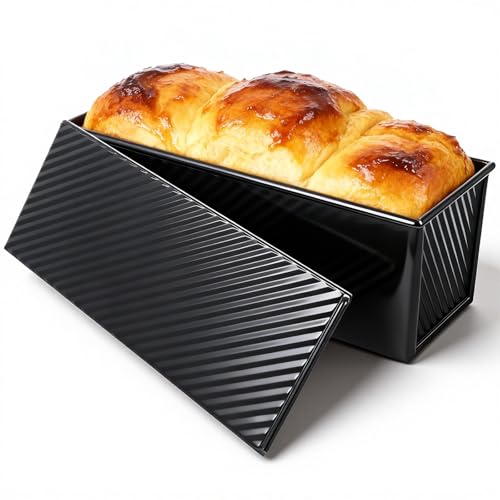
Quick take: The 13×4-inch footprint and thickened 0.5mm walls solve the two problems that ruin most sandwich loaves: insufficient length and flimsy metal.
The manufacturer describes this as commercial-grade carbon steel with corrugated reinforcement. That means the pan resists warping at high oven temperatures, something thinner pans do within a dozen bakes. The 13-inch length is the standard for a 2-pound Pullman loaf, the size serious sandwich bakers want for uniform slices that span a full slice of bread. The 4-vent steam circulation system is a genuine differentiator: bottom vents let steam escape evenly rather than pooling under the loaf, which should prevent the soft, pale bottom common to lidded pans.
The 0.5mm wall thickness isn’t the thickest, but paired with corrugated reinforcement it’s a calculated design rather than a cost cut. The listing doesn’t state a coating type, which is a small gap—PTFE versus ceramic matters for long-term release. However, the vent system and commercial construction target exactly the failure modes I see in this category: domed tops, pale bottoms, and pans that warp in week two. If you bake sandwich bread more than once a month, this is the one to get.
Pros:
- 13×4 professional footprint — fits 2-pound dough properly
- 4-vent steam system — crisp bottom, even crumb
- Reinforced carbon steel — resists warping
Cons:
- Coating type not specified — unknown long-term release
- Single pan — batch baking limited
Why it stands out:
Best overall for: serious sandwich loaf bakers. Skip if: you need a multi-pan set on a tight budget.
Gicyiit Pullman Loaf Pan with Lid (Thick-Gauge Contender)

Quick take: The 40% thicker heavy-gauge carbon steel and stated 2.2-pound dough capacity make this the most spec-transparent pan here.
The listing tells you the exact dough weight: 2.2 pounds. That kind of clarity is rare and genuinely useful—most pans hide capacity, forcing bakers to gamble. The nonstick coating is explicitly PTFE, PFOA, and BPA free, which answers the food-safety question head-on. That coating will release loaves cleanly but still should not meet metal utensils or abrasive scrubbers.
At a stated 2.2-pound capacity, this pan is slightly larger than a standard 2-pound Pullman, giving your dough more room to expand without forcing the lid up. The extra thickness also means better heat distribution, reducing hot spots that cause patchy browning. The main unknown is length; without a dimension spec, you cannot verify whether it will fit your oven rack or bread slicer. Still, on paper this is a close second to the Lyksgir.
Pros:
- Explicit 2.2-lb capacity — no guessing
- 40% thicker steel — durability
- PTFE/PFOA/BPA-free coating — clear safety profile
Cons:
- Dimensions missing — can’t confirm length
- Single pan — no batch option
Our take:
Recommended for: bakers who want a clearly specified 2.2-pound pan. Think twice if: you need a verified 13-inch length.
Articasting Cast Iron Loaf Pan with Lid (Enameled and Oven-Safe to 500°F)
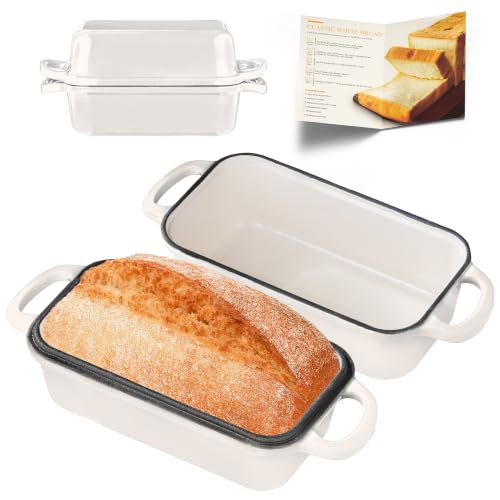
Quick take: Enameled cast iron offers cast iron’s heat with an easier cleaning surface than raw iron—assuming you don’t drop it.
The enameled finish is the standout. Unlike raw cast iron, it doesn’t need seasoning after every wash, which reduces the maintenance barrier for beginners. The pan is safe to 500°F, so it can handle high-heat artisan loaves and even double as a small Dutch oven if you partially remove the lid. The steel’s heat retention will produce a thick, crunchy crust across the entire surface.
The 2-in-1 design means you can bake two smaller loaves side by side or use the lid as a baking surface, though the listing doesn’t state whether both wells are full 9×5 size or smaller. Weight is again substantial—cast iron is never friendly to wrists or glass shelves. The enamel, while easier than raw iron, can still chip if dropped or scraped with metal tools. For someone who wants cast iron’s performance without raw-iron upkeep, this is the gentle entry point.
Pros:
- Enameled finish — no seasoning needed
- 500°F tolerance — high-heat safe
- 2-in-1 design — versatile
Cons:
- Heavy — cast iron weight
- Enamel can chip — handle carefully
The real deal:
Best for: high-heat bread bakers who want cast iron without raw-iron maintenance. Not great if: you have wrist issues or a glass-top stove.
Homemade Sandwich Bread Loaf Pan 12×4.2×4.5 Silicone (Extra-Large Mold)

Quick take: The only silicone option here, and the reinforced metal frame solves the biggest silicone weakness—you don’t need a separate baking sheet.
The 12×4.2×4.5-inch mold is extra-large, enough for a multi-slice family loaf. A reinforced metal frame supports up to 3.3 kg of water weight, meaning the full pan of wet dough won’t collapse or slosh when carried to the oven. The 99% release rate claim is bold but plausible for food-grade silicone; the material fundamentally repels baked goods better than metal coatings. That said, silicone bakes pale, especially on the sides, because it insulates rather than conducts heat.
If you’re chasing a golden, crisp sandwich crust, this is the wrong material. But if your priority is a soft, uniform interior and easy cleanup, silicone’s nonstick nature is hard to beat. The pan must still be greased lightly for best results, despite the marketing—oils help the release further. The open top means no square lid, so you’ll still get a domed top unless you trim it. For soft, moist sandwich breads like pain de mie without a hard crust, this works well.
Pros:
- Reinforced metal frame — self-supporting
- Extra-large 12-inch length — big family loaves
- 99% release claim — near stick-proof
Cons:
- Insulates heat — pale, soft crust
- No lid — dome not square
Our verdict:
Best for: gluten-free or soft sandwich loaves that don’t need browning. Skip if: you want a crackly brown exterior.
What to Look For in a Sandwich Loaf Pan
A sandwich loaf pan is not a one-size-fits-all tool. The pan you pick changes crumb, shape, and how much bread you waste trimming a domed top. Here is what actually matters.
Best bread pans for sandwich bread start with the right dimensions
Capacity labels such as 1 lb or 2 lb refer to dough weight, not pan volume. A 1-pound dough typically fits a 9×5 pan; a 2-pound dough needs a 13×4 Pullman for full square slices. If you ignore this, you’ll get an overflowing pan or a short, dense loaf. Check the pan’s length before you buy—the Lyksgir 13×4 and Gicyiit’s stated 2.2-lb capacity are the rare listings that tell you exactly what dough they hold. If a recipe doesn’t specify pan size, a moist apple bread recipe sized for a standard 9×5 pan is a good reference point.
Lid or no lid: that is the square-slice question
A Pullman pan’s lid creates square, even slices ideal for sandwiches; without it, you get a domed top that needs trimming. The lid traps steam and forces the dough to fill the rectangular space, producing a tighter crumb. If you always bake sandwich bread, choose a lidded pan—the Lollicy, Saiveina, Heysagix, Lyksgir, Gicyiit, and Articasting all include one. Silicone and basic nonstick pans like the AKOLAFE skip the lid, so square slices require a bread knife. Square slices also make the base for layered desserts like brownie cookie dough sandwich cookies.
Material controls browning and crust
Carbon steel heats fast and bakes crisp, so it is the default for golden sandwich loaves. Cast iron gives deeper browning and a thicker crust but is heavy and needs seasoning. Silicone bakes pale and must sit on a sturdy baking sheet unless it has a built-in metal frame; if yours doesn’t, use a flat, warp-resistant sheet from our baking sheet guide to keep the mold steady. No material is perfect—pick based on the crust you want, not marketing.
Nonstick safety and care
Nonstick coatings release loaves easily but release harmful fumes if heated empty above 500°F and scratch with metal utensils. Hand-washing and silicone tools are essential. Cast iron needs a thin oil layer after every wash to prevent rust; enameled cast iron skips that step but can chip. Always lightly grease even a nonstick pan—fat fills microscopic pores and helps the crust pull away cleanly. A pan that lasts decades is one you never preheat empty and never scour with steel wool.
Our Final Recommendation
For overall sandwich performance, the Lyksgir Pullman Loaf Pan with Lid 13×4 wins on footprint, reinforcement, and steam venting. Budget shoppers should grab the Lollicy 3-Pack for lidded square slices at the lowest realistic price. If premium heat retention is your priority, the Articasting enameled cast iron gives deep browning without raw-iron seasoning. Whichever you choose, match the pan’s dimensions to your dough weight first—everything else is secondary.
Frequently Asked Questions
Do I really need a lid to make square sandwich slices?
Yes. A Pullman lid traps steam and forces the dough to fill the rectangular pan, giving flat, uniform sides. Without a lid, bread rises into a dome that must be trimmed for even sandwich slices. If square slices are non-negotiable, stick with a lidded pan like the Lyksgir, Lollicy, or Gicyiit.
Which material gives the most even browning: carbon steel, cast iron, or silicone?
Carbon steel gives the most even golden browning for standard sandwich loaves because it conducts heat quickly and recovers temperature fast. Cast iron gives deeper, thicker crusts due to its heat retention but can produce dark edges if not monitored. Silicone insulates rather than conducts, so it bakes pale and unevenly on the sides—fine for soft loaves, poor for a browned crust.
How do I care for a nonstick loaf pan so it lasts?
Hand-wash only with warm soapy water and a soft sponge. Never preheat the pan empty above 500°F, which can release harmful fumes from PTFE coatings. Avoid metal utensils and abrasive scrubbers, and lightly grease the pan before each bake. Store pans with a paper towel between stacked pieces to prevent scratches.