Smooth, elastic dough without someone else’s arms doing the kneading is the whole point of this page. The best budget dough mixers manage that without a premium stand mixer’s footprint or price. Cheap machines hide their weak spots, though. Wattage, flour capacity and braced weight are what they tend to conceal.
Six budget machines are compared here, from dedicated dough makers to two tilt-head mixers that only do dough on the side.
As an Amazon Associate we earn from qualifying purchases. This does not affect the price you pay.
CERTAIN CONTENT THAT APPEARS ON THIS SITE COMES FROM AMAZON. THIS CONTENT IS PROVIDED ‘AS IS’ AND IS SUBJECT TO CHANGE OR REMOVAL AT ANY TIME.
Short answer: the AIZIYO DoughChief takes the top spot, pairing a 7.4QT 304 stainless steel bowl with the heaviest body (10.0 pounds) of the dedicated dough machines.
| Product | Best for | Capacity | Weight |
|---|---|---|---|
| AIZIYO DoughChief | Best overall | 7.4QT | 10.0 lb |
| SAMSAIMO Electric Dough Mixer | Best value | 6.5QT (300 to 1,400 g dough) | 6.48 lb |
| VEVOR 6.9 Quart Dough Maker | Largest flour claim | 7L (up to 1600 g flour) | 9.26 lb |
| EkitLife 7.4Qt Dough Maker | Big family batches | 7.4Qt (title only) | 9.04 lb |
| Kitchen in the box Stand Mixer | Light occasional dough | 3.2QT | 7.0 lb |
| Aucma Stand Mixer | All-round baking | 6.5QT | Not listed |
There’s one grouping rule before the reviews. The first four are dedicated dough machines with a fixed blade and a lidded bowl. The last two are tilt-head general-purpose mixers. They’re judged on their own terms, not ranked as like-for-like.
Home Fresh Eats is funded by affiliate commission. Our picks come from comparing published specifications and documented features against what matters in the category — no brand pays for a place on this page. If you buy through a link here we may earn a commission at no extra cost to you, and it pays for the research behind the next guide. Full disclosure.
SAMSAIMO Electric Dough Mixer with Ferment Function (6.5QT Compact Body)

AIZIYO DoughChief (7.4QT Mix-and-Ferment Dough Maker)

- BrandAIZIYO
- Model804-7L Red
- Dimensions11.42 inches x 12.2 inches x 9.6 inches
- Weight10.0 pounds
- Size / capacity7.4QT
- ColourRed
Quick take: The most complete spec sheet of the dedicated machines, aimed at bakers who want a big bowl and a proofing mode in one body.
The AIZIYO DoughChief pairs a 7.4QT 304 stainless steel bowl with an S-shaped blade and a face-up touch panel. Its body weighs 10.0 pounds and measures 11.42 x 12.2 x 9.6 inches. That’s the heaviest in this group. Weight keeps a dough machine planted when a stiff batch pushes back.
The mix function runs a mix-pause-mix program meant to imitate hand kneading, and the ferment mode holds 77 to 100°F. That’s a modest range, so it’s a convenience rather than a replacement for a proofing box. Dough still needs watching to avoid overproofing, and the wide top opening lets you add ingredients mid-run. The listing never states motor wattage or a flour-weight limit. For dense, low-hydration dough, those are exactly the numbers buyers want.
Pros:
- Heaviest body here — 10.0 pounds gives more resistance to walking than the 6.48-pound SAMSAIMO.
- 304 stainless steel bowl — a food-grade bowl that wipes clean and doesn’t coat-chip like lighter alternatives.
- Wide top opening — water or flour can be adjusted while the machine runs.
Cons:
- Wattage not listed — there’s no way to judge stiff-dough stamina from the sheet alone.
- Bowl volume, not flour weight — the 7.4QT figure says little about how much bagel dough it can really take.
Who Should Buy This
Best overall: households baking bread and pizza weekly who want kneading and proofing together. Skip if: the main job is very stiff bagel dough, where a stated wattage and flour limit would matter more.
SAMSAIMO Electric Dough Mixer with Ferment Function (6.5QT Compact Body)
- BrandSAMSAIMO
- Model6023
- Dimensions11.3 inches x 10.7 inches x 10.82 inches
- Weight6.48 pounds
- Size / capacity10.82*11.33*10.70
- ColourJet Black
The short version: A lighter, smaller dough machine that undercuts the bigger models on size and keeps the important features.
Sold as the Electric Dough Mixer with Ferment Function, this SAMSAIMO model has a 6.5QT 304 stainless steel bowl and a stainless S-shaped kneading blade. The manufacturer recommends 300 to 1,400 grams of dough per batch. That’s a rare, useful figure. It’s a dough weight, not just a bowl volume. At 11.3 x 10.7 x 10.82 inches it’s the most compact of the four dedicated machines.
The weight is the trade-off. So bracing relies on the suction-cup base and double safety buckles. Fermentation runs 77 to 95°F, a narrower band than the AIZIYO. Motor wattage isn’t listed. Heavy dough near the 1,400-gram ceiling will test the light body first.
Pros:
- Stated dough range — 300 to 1,400 grams is easier to plan around than a quart figure.
- Compact footprint — a smaller box than the 7.4QT machines on a crowded counter.
- Suction base and double buckles — extra anchoring for a light body.
Cons:
- Light at 6.48 pounds — more likely to shift with stiff dough than the heavier rivals.
- No wattage listed — stamina under load stays a guess.
Our Take
Best value: small households that want a dough-specific machine with a clear batch limit. Pass on this if: you regularly knead near the upper limit or want a bigger bowl.
VEVOR Dough Mixer 6.9 Quart (250W Motor, Ferment Mode)

- BrandVEVOR
- ModelLY-801-07A
- Dimensions11.61 inches x 11.42 inches x 13.19 inches
- Weight9.26 pounds
- Size / capacity7L
- ColourLight Blue
Why it earns a spot: The only dedicated machine here that publishes a motor rating, plus the biggest flour claim.
VEVOR lists a 250W motor at 150 RPM, a bowl it says holds up to 1600 grams of flour, and a detachable ingredient chute. Its body weighs 9.26 pounds and measures 11.61 x 11.42 x 13.19 inches. Publishing wattage counts in its favour. It allows an actual comparison with other budget machines.
The listing is inconsistent on size, though. The title says 6.9 quart, the marketing copy says a 6.5L bowl and the spec table says 7L. Three sizes for one bowl. That mismatch is worth clearing up before you order. A 1600-gram flour claim is also a manufacturer figure, so treat it as a ceiling for easy dough, not a daily load for stiff dough.
Pros:
- 250W motor listed — a number to check against the other machines.
- Detachable ingredient chute — adds water, butter or yeast without stopping the machine.
- Digital timer panel — set run times for routine batches.
Cons:
- Conflicting capacity figures — 6.9 quart, 6.5L and 7L all appear.
- Warranty not listed — support from a bigger brand still needs confirming before purchase.
Final Thoughts
Great match for: larger families who want a stated flour limit and wattage. Think twice if: you need a clean, unambiguous capacity figure.
EkitLife 7.4Qt Electric Dough Maker (Intermittent Kneading)

- BrandEkitlife
- ModelEKL-DM07
- Dimensions11.23 inches x 9.5 inches x 13.2 inches
- Weight9.04 pounds
- ColourWhite
In a nutshell: A big-bowl, suction-footed dough maker whose listing leaves out most of the numbers.
The EkitLife EKL-DM07 is a 7.4Qt machine according to its title. It’s white, weighs 9.04 pounds and measures 11.23 x 9.5 x 13.2 inches. The 304 stainless steel bowl is smooth for release, and bottom suction cups hold it in place. Kneading is intermittent. The manufacturer says it may limit heat buildup, since the dough rests between cycles.
Heat matters. Yeast fails if the temperature is badly off, and a pause pattern helps with that. The gap is data. There’s no capacity in the spec table, no wattage, no flour limit, no ferment temperature range. Compared with the VEVOR or SAMSAIMO, there is simply less to evaluate.
Pros:
- Intermittent kneading — rest periods between cycles to limit heat in the dough.
- Suction feet — grip for stiffer bread or pizza batches.
- Single steel bowl — mixing and proofing happen in one vessel, so fewer transfers.
Cons:
- Sparse specification — no wattage, flour limit or temperature range given.
- Capacity only in the title — the spec table leaves it blank.
Who Should Buy This
Big family batches: bakers wanting a 7.4Qt machine for rolls and sourdough who accept a thin spec sheet. Skip if: you want published numbers to compare before buying.
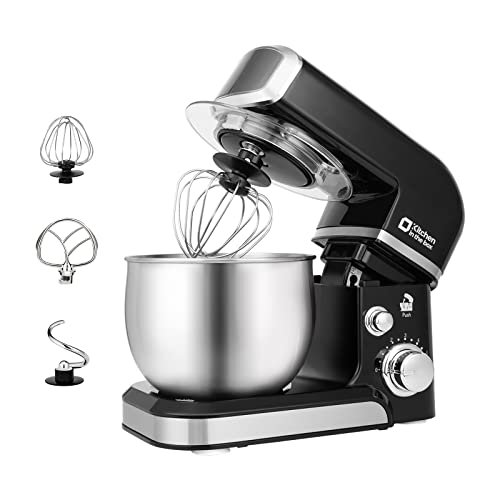
Kitchen in the box Stand Mixer (3.2Qt Tilt-Head)
- BrandKitchen in the box
- ModelSC-627
- Dimensions12.9 inches x 7.0 inches x 10.2 inches
- Weight7.0 pounds
- Size / capacity3.2QT
- ColourBlack
Here’s the deal: A small general-purpose mixer, light enough to store anywhere, and not built for serious bread.
This SC-627 is a 3.2QT tilt-head with six speeds, four anti-slip suckers and an aluminium dough hook, flat beater and stainless whisk. It weighs 7.0 pounds and measures 12.9 x 7.0 x 10.2 inches. The listing aims it at new bakers and one or two person households. New bakers, small households.
A small tilt-head with a hook is general-purpose equipment, and sustained kneading of heavy bread dough can strain it. Wattage isn’t listed. It suits a small loaf, soft rolls, batters and whipped cream far better than stiff dough. Stiff dough is a stretch. Don’t compare it directly with the four dedicated machines above; the ferment lid and fixed blade are a different design.
Pros:
- Compact and light — 7.0 pounds and a narrow 7-inch width suit apartment storage.
- Three attachments — hook, beater and whisk cover cakes and meringue as well as dough.
- Tilt head — easy access when swapping the bowl or accessories.
Cons:
- 3.2QT bowl — too small for large or dense batches.
- No wattage listed — a poor sign for anyone planning to knead regularly.
The Real Deal
Perfect for: light occasional dough and everyday mixing in a small kitchen. Not great if: bread or pizza dough is a weekly habit.
Aucma Stand Mixer (6.5QT 660W Tilt-Head)

- BrandAucma
- ModelAUCMA
- Dimensions15.2 inches x 9.4 inches x 12.4 inches
- Size / capacity6.5QT
- ColourRoyal Blue
The short version: The only mixer here with a big bowl and a stated wattage, but a tilt-head built for baking in general.
The Aucma lists a 660W copper motor, a 6.5QT stainless steel bowl with dual handles, six speeds with pulse, an ABS housing and a splash guard with access hatch. Its dough hook, whisk and beater are described as dishwasher safe. It measures 15.2 x 9.4 x 12.4 inches. Weight isn’t listed.
Wattage is the highest on any listing here, which helps stiff dough in theory. Still, a planetary tilt-head works the dough differently than a fixed-blade machine. A spiral mixer is faster and leaves less dough under-mixed at similar power, while a planetary mixer can also whip and blend. That makes this the right pick for cakes and cookies with some bread on the side. With no weight listed, braced stability remains unknown. A head that tilts can bounce under heavy loads. It takes more room than the dough makers, given its 15.2-inch depth. Depth costs counter space.
Pros:
- 660W motor — the highest stated power of the six.
- Whip and blend ability — the whisk and beater cover batters that dedicated dough makers can’t.
- Dishwasher-safe attachments — cleanup is easier than hand-scrubbing a hook.
Cons:
- Weight not listed — stability under dense dough is unknown.
- No ferment mode — proofing needs a separate bowl and a warm spot.
Who Should Buy This
Best for: all-round baking where dough is one of several jobs. Skip if: a proofing function and a fixed hook matter most.
How These Picks Were Selected
These picks come from comparing published specifications, materials, care details and documented features. None of the machines was tested hands-on. The heaviest weighting went to what decides dough performance: motor and gearing sustaining dense, lower-hydration dough at the stated bowl size. Bowl material (304 stainless steel), stability under load and hook design came next, with ferment mode, timer and cleaning as secondary conveniences. Tilt-head mixers were kept separate from dedicated dough machines. Before ordering, check the actual wattage, the flour weight limit, the warranty and the return policy for yourself.
How to Pick the Best Budget Dough Mixers
Do You Need a Dedicated Dough Mixer?
A tilt-head stand mixer handles soft, high-hydration doughs fine, but dense doughs are harder on its motor. Dense doughs strain the motor. A fixed-blade dough machine suits weekly bread and pizza. The comparison in our dough hook versus paddle for bread guide explains which attachment belongs in which job. Hand kneading, bread machines and no-knead methods are still real alternatives, and a premium mixer such as a KitchenAid Artisan or Ankarsrum remains the benchmark for heavy loads.
Bowl Volume Isn’t Flour Weight
Capacity is usually quoted in quarts, not flour weight, and dense dough tops out well below the bowl size. Check for a stated flour or dough limit, as the SAMSAIMO (300 to 1,400 grams of dough) and the VEVOR (up to 1600 grams of flour) provide. Hydration percentage matters too: stiff bagel or pasta dough asks far more of the motor than a wet pizza dough.
Kneading Mechanics and Heat
Kneading means working the dough until it’s smooth and elastic, which develops gluten. Spiral mixers create less friction than planetary ones, so dough stays cooler, proofs well, and they work the same batch faster. Less friction keeps dough cool. Yeast won’t activate if dough runs too hot or too cold. Intermittent mix-pause-mix programs, like those on the AIZIYO and SAMSAIMO, mimic hand kneading and give dough rest. A short autolyse, resting flour and water before the final mix, can also shorten kneading time.
The Best Budget Bread Mixers and Food Safety
The best budget bread mixers use a 304 stainless steel bowl for food contact, since lighter or coated bowls can chip or wear. Food-contact materials fall under FDA rules in the United States, so ask a lesser-known seller for food-contact documentation. Budget brands vary widely on warranty and parts availability. Many listings share the same generic specs. For a deeper checklist, see the dough mixer buying guide.
Our Final Recommendation
The AIZIYO DoughChief is the overall winner: the largest bowl at 7.4QT, a 304 stainless steel bowl, the heaviest body and a 77 to 100°F ferment range. The SAMSAIMO Electric Dough Mixer is the best value, with a stated 300 to 1,400-gram dough range in a compact body. For anyone who wants a published 250W rating and a 1600-gram flour claim, the VEVOR is the recommended pick. Treat the Kitchen in the box as a light-duty mixer, not a dough machine.
Frequently Asked Questions
Can a 3.2 quart mixer knead bread dough without burning out?
A small 3.2QT tilt-head like the Kitchen in the box is a general-purpose mixer, and sustained kneading of heavy bread dough can strain it. Small loaves and soft rolls are reasonable. Stiff, dense dough is not. The wattage isn’t listed, so keep batches small and rest the machine.
Does the ferment function replace a proofing box?
No. The listed ranges are modest, 77 to 100°F on the AIZIYO and 77 to 95°F on the SAMSAIMO. That’s useful for steady rising. Dough must still be watched to avoid overproofing, especially sourdough, where bulk fermentation timing matters.
Is a 304 stainless steel bowl worth having?
Yes. Four of these machines use one. It cleans easily and is food-grade. A coated or lighter bowl can wear over time. The material alone doesn’t prove the motor is strong, so check the wattage as well.
How much flour can a 6.5 or 7.4 quart dough mixer take?
Bowl volume isn’t flour weight. SAMSAIMO recommends 300 to 1,400 grams of dough, while VEVOR claims up to 1600 grams of flour. AIZIYO and EkitLife list no flour limit, so low-hydration doughs should be started with small batches.